Trenton Historic District

Why it's listed
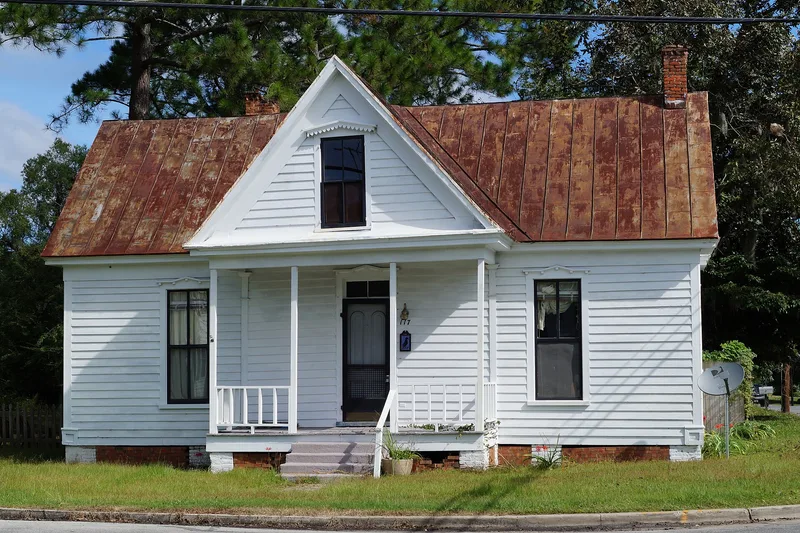
Trenton, the seat of Jones County, North Carolina, is a village of small frame buildings arranged on a grid of streets beside N.C. 58 and a large cypress mill pond. The district covers about 300 acres and includes houses, churches and a brick commercial row dating from nearly two centuries of building. Most homes are simple two-story gabled dwellings, often with a central front gable added later. Notable examples include the Federal-style Smith House, the Italianate McDaniel-Dixon House, the Carpenter Gothic Grace Episcopal Church, an early brick jail and the 1908 Bank of Jones County. Trenton was authorized as a town in 1784 on the site of the county courthouse and developed as a market town for a farming county. Its Federal-era houses reflect the influence of New Bern. The nomination values the consistent small scale, the moss-draped trees and the largely unencroached mill pond, which predates the town.
Significance in brief: The nomination argues that Trenton's consistent small scale, vernacular frame architecture, Carpenter Gothic churches, moss-draped trees and the unspoiled mill pond together give it the character of a serene country market town. Its Federal-era houses also show the architectural influence of nearby New Bern. The district also reflects the town's role as county seat and farm market town.
Machine-generated summary. This summary was generated by a language model from the official nomination document and has not been reviewed line by line by an editor. It may contain errors. Check the source document before relying on any detail. Source: nomination document (PDF) · National Archives catalog entry. NRHP reference 74001357, listed July 3, 1974. Summary generated October 2026 (model claude-sonnet-5-5, prompt v1.0-2026-10-29, confidence medium).
Key facts
| Address | Roughly bounded by Trent, Lower and Pollock Sts., and Brock Mill Pond, Trenton |
|---|---|
| County | Jones County |
| Listed | July 3, 1974 |
| Reference number | 74001357 |
| Resource type | District |
| Architectural style | Vernacular, with Georgian, Federal, Greek Revival, Italianate, Gothic Revival (Carpenter Gothic), and Queen Anne/Eastlake examples |
| Areas of significance | Commerce, Politics/Government, Architecture |
| Level of significance | Local |
| Status (as stated in the nomination) | Marked occupied and in use as government, commercial, private residence and religious property, in excellent to fair condition; the mill pond is owned by a non-profit corporation that intends to preserve it. |
| Acreage | 300 |
| Coordinates | 35.06488, -77.35816 (NPS GIS) |
What listing means for this property
This is a historic district. Buildings within its boundary are either contributing (they add to the district's significance) or non-contributing. Owners of contributing income-producing buildings can claim the 20% federal rehabilitation tax credit; homeowners should look at state credits. National Register districts impose no design review by themselves; a local historic district ordinance, if one exists, does (the difference explained).
General information, not legal or tax advice. Rules change; confirm with your State Historic Preservation Office or a qualified adviser.
Sources and further reading
- National Park Service, National Register of Historic Places database (snapshot May 2026), reference 74001357.
- Nomination form (PDF, National Archives) — catalog entry
- Wikipedia article (used for cross-checking only; text not reproduced here)
- Wikidata Q22061109
- This listing as JSON
Last updated October 2026. Found an error? See the editorial policy for how to report it.