Princeton Graded School
Princeton Graded School is a building in Princeton, Johnston County, North Carolina, listed on the National Register of Historic Places on October 4, 2005 (reference number 05001139). The National Park Service records its significance in Architecture, Education and Black at the local level.
Facts from the NPS National Register database (); nomination summary October 2026. Last updated . Sources for each fact.

Approximate location: the National Park Service places this pin arbitrarily within the property, not at a surveyed point (stated accuracy ±12 m).
Why it's listed
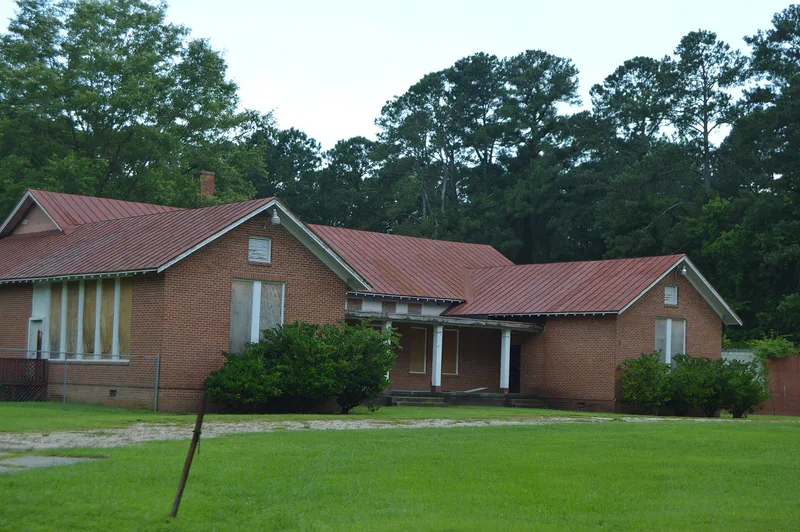
Princeton Graded School is a six-classroom brick school built in 1925-1926 on West Edwards Street in Princeton, Johnston County, North Carolina. Its H-shaped plan has an auditorium in the central section, large grouped windows for natural light, and a shed-roof porch with Doric-style posts. It follows Rosenwald Fund Plan No. 6-A, though the county chose brick veneer instead of wood. Local African American citizens petitioned for the school and were required to contribute $1,000 in cash. J.P. Rogers of Smithfield built it. It was one of ten Rosenwald-aided schools in the county and one of two that survive. A 1952 cafeteria and classroom building stands beside it, and a small cemetery on the grounds was used from 1934 to 1960-1961 for burying African Americans excluded from the town cemetery. The school served the community until the mid-1950s, closed by 1973, and now stands vacant.
Significance in brief: The nomination argues the school meets Criterion A for education and Black ethnic heritage, as one of ten Rosenwald-aided schools built in Johnston County and one of only two surviving. It served as an educational and social center for the African American community from 1925 to 1955. It also meets Criterion C as an example of Rosenwald school architecture, and the grounds include a cemetery used for Black burials.
Machine-generated summary. This summary was generated by a language model from the official nomination document and has not been reviewed line by line by an editor. It may contain errors. Check the source document before relying on any detail. Source: nomination document (PDF) · National Archives catalog entry. NRHP reference 05001139, listed October 4, 2005. Summary generated October 2026 (model claude-sonnet-5-5, prompt v1.0-2026-10-29, confidence high).
Key facts
| Official database NPS National Register database, ref. 05001139 , checked | |
|---|---|
| Address | 601-611 W. Edwards St., Princeton |
| County | Johnston County |
| Listed | October 4, 2005 |
| Reference number | 05001139 |
| Resource type | Building |
| Areas of significance | Architecture, Education, Black |
| Level of significance | Local |
| National Historic Landmark | No |
| Acreage | 3.9 |
| Official document, machine-extracted Nomination form (National Archives) , checked | |
| Period of significance | 1925/1926-1955 |
| Architect / builder | Rogers, J.P. (Smithfield, N.C.), Builder |
| Architectural style | Other: Rosenwald School |
| Criteria |
|
| Status (as stated in the nomination) | Present function is listed as vacant; the school closed by 1973. The eastern section of the 1952 building has had its roof, ceilings and windows removed in an asbestos abatement program. |
| Official dataset NPS cultural-resource GIS (NRHP locations) | |
| Coordinates | 35.46997, -78.16822 |
What listing means for this property
For a publicly owned building or structure, listing mainly matters when federal funds, permits or licences are involved: projects then go through Section 106 review so effects on the property are considered. Listing also strengthens applications for preservation grants and, for leased income-producing uses, can enable the federal rehabilitation tax credit.
Noted as vacant in the nomination. Nomination documents can be decades old; current status may differ. If you are considering buying an empty listed property, read the due-diligence checklist.
General information, not legal or tax advice. Rules change; confirm with your State Historic Preservation Office or a qualified adviser.
Questions about Princeton Graded School
When was Princeton Graded School added to the National Register of Historic Places?
Princeton Graded School was listed on October 4, 2005. Its National Register reference number is 05001139.
Is Princeton Graded School a National Historic Landmark?
No. The National Park Service database (snapshot of May 2026) lists Princeton Graded School on the National Register but does not record it as a National Historic Landmark.
Where is Princeton Graded School?
601-611 W. Edwards St., Princeton, Johnston County, North Carolina; coordinates 35.46997, -78.16822.
Why is Princeton Graded School historically significant?
According to a machine-generated summary of its nomination form: The nomination argues the school meets Criterion A for education and Black ethnic heritage, as one of ten Rosenwald-aided schools built in Johnston County and one of only two surviving. It served as an educational and social center for the African American community from 1925 to 1955. It also meets Criterion C as an example of Rosenwald school architecture, and the grounds include a cemetery used for Black burials. Check the nomination document before relying on any detail.
Who designed or built Princeton Graded School?
The nomination form names Rogers, J.P. (Smithfield, N.C.), Builder as architect or builder (extracted by machine from the nomination; check the source document).
Where can I read the original nomination for Princeton Graded School?
The nomination form is a public record held by the National Archives: nomination document (PDF).
Sources and further reading
- National Park Service, National Register of Historic Places database (snapshot May 2026), reference 05001139.
- Nomination form (PDF, National Archives) — catalog entry
- Wikipedia article (used for cross-checking only; text not reproduced here)
- Wikidata Q19987681
- This listing as JSON
Last updated November 2026. Found an error? See the editorial policy for how to report it.