High Hampton Inn Historic District
Also known as: High Hampton; High Hampton Inn and Country Club
High Hampton Inn Historic District is a historic district in Cashiers, Jackson County, North Carolina, listed on the National Register of Historic Places on September 26, 1991 (reference number 91001468). The National Park Service records its significance in Entertainment/Recreation and Architecture at the local level.
Facts from the NPS National Register database (); nomination summary October 2026. Last updated . Sources for each fact.

The pin is a point inside the NPS boundary polygon, not a surveyed location.
Why it's listed
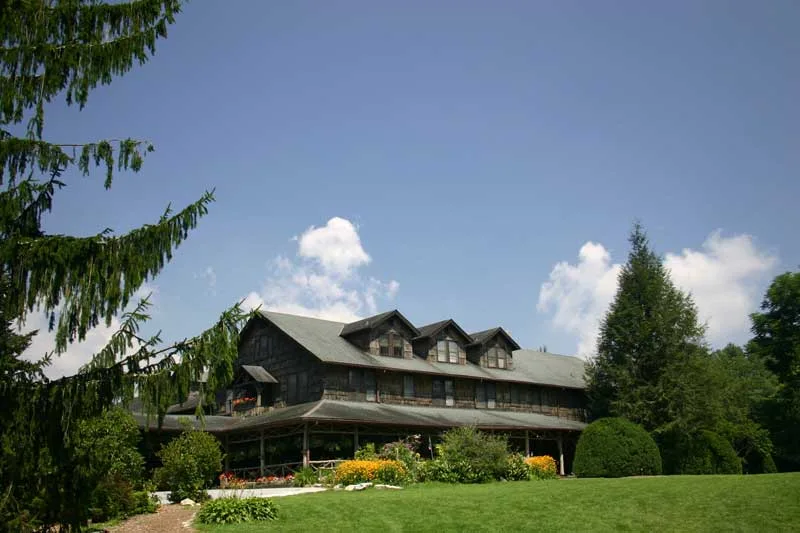
High Hampton Inn is a mountain resort on about 30 acres near Cashiers, in Jackson County, North Carolina. Its main building, a gable-roofed inn sided in chestnut bark, was completed in 1933 to designs by Erle Stillwell after a fire destroyed the earlier inn in 1932. Around it sit cottages, a smokehouse, a stable and a recreational landscape that includes two lakes, a golf course laid out in 1924, clay tennis courts and walking trails. The property's resort use began with the Hampton family and continued under the Halsteds, but the surviving buildings and grounds best reflect the years from 1922 to 1941, when lumber industrialist Ernest Lyndon McKee and his wife, Gertrude Dills McKee, developed the inn. The district was listed for its role in early twentieth-century recreation and for its rustic architecture, which features bark shingles, board-and-batten siding, twig stickwork and stone chimneys. Sixteen resources contribute to the district and four do not.
Significance in brief: The district is argued to represent the McKee era (1922-1941) of a long-running mountain resort, illustrating entertainment and recreation in western North Carolina (Criterion A). It is also significant as a fine collection of rustic resort architecture using chestnut bark shingles, board-and-batten siding, twig stickwork and stone chimneys (Criterion C).
Machine-generated summary. This summary was generated by a language model from the official nomination document and has not been reviewed line by line by an editor. It may contain errors. Check the source document before relying on any detail. Source: nomination document (PDF) · National Archives catalog entry. NRHP reference 91001468, listed September 26, 1991. Summary generated October 2026 (model claude-sonnet-5-5, prompt v1.0-2026-10-29, confidence high).
Key facts
| Official database NPS National Register database, ref. 91001468 , checked | |
|---|---|
| Address | NC 107 E side, 1.5 mi. S of US 64, Cashiers |
| County | Jackson County |
| Listed | September 26, 1991 |
| Reference number | 91001468 |
| Resource type | District |
| Areas of significance | Entertainment/Recreation, Architecture |
| Level of significance | Local |
| National Historic Landmark | No |
| Acreage | 30 |
| Official document, machine-extracted Nomination form (National Archives) , checked | |
| Period of significance | 1922-1941 |
| Architect / builder | Erle Stillwell (architect of the inn); Builders Supply and Lumber Company of Sylva (builder of the inn) |
| Architectural style | Other: rustic resort |
| Criteria |
|
| Status (as stated in the nomination) | Still operating as a hotel (inn and cottages) at the time of the nomination, with an 18-hole golf course. |
| Official dataset NPS cultural-resource GIS (NRHP locations) | |
| Coordinates | 35.09788, -83.08247 |
What listing means for this property
This is a historic district. Buildings within its boundary are either contributing (they add to the district's significance) or non-contributing. Owners of contributing income-producing buildings can claim the 20% federal rehabilitation tax credit; homeowners should look at state credits. National Register districts impose no design review by themselves; a local historic district ordinance, if one exists, does (the difference explained).
General information, not legal or tax advice. Rules change; confirm with your State Historic Preservation Office or a qualified adviser.
Questions about High Hampton Inn Historic District
When was High Hampton Inn Historic District added to the National Register of Historic Places?
High Hampton Inn Historic District was listed on September 26, 1991. Its National Register reference number is 91001468.
Is High Hampton Inn Historic District a National Historic Landmark?
No. The National Park Service database (snapshot of May 2026) lists High Hampton Inn Historic District on the National Register but does not record it as a National Historic Landmark.
Where is High Hampton Inn Historic District?
NC 107 E side, 1.5 mi. S of US 64, Cashiers, Jackson County, North Carolina; coordinates 35.09788, -83.08247.
Why is High Hampton Inn Historic District historically significant?
According to a machine-generated summary of its nomination form: The district is argued to represent the McKee era (1922-1941) of a long-running mountain resort, illustrating entertainment and recreation in western North Carolina (Criterion A). It is also significant as a fine collection of rustic resort architecture using chestnut bark shingles, board-and-batten siding, twig stickwork and stone chimneys (Criterion C). Check the nomination document before relying on any detail.
Who designed or built High Hampton Inn Historic District?
The nomination form names Erle Stillwell (architect of the inn); Builders Supply and Lumber Company of Sylva (builder of the inn) as architect or builder (extracted by machine from the nomination; check the source document).
Where can I read the original nomination for High Hampton Inn Historic District?
The nomination form is a public record held by the National Archives: nomination document (PDF).
Sources and further reading
- National Park Service, National Register of Historic Places database (snapshot May 2026), reference 91001468.
- Nomination form (PDF, National Archives) — catalog entry
- Wikipedia article (used for cross-checking only; text not reproduced here)
- Wikidata Q5755594
- This listing as JSON
Last updated November 2026. Found an error? See the editorial policy for how to report it.