Ebenezer Academy, Bethany Presbyterian Church and Cemetery
Ebenezer Academy, Bethany Presbyterian Church and Cemetery is a building in Houstonville, Iredell County, North Carolina, listed on the National Register of Historic Places on December 8, 1980 (reference number 80002857). The National Park Service records its significance in Art, Architecture and Religion at the local level.
Facts from the NPS National Register database (); nomination summary October 2026. Last updated . Sources for each fact.

Approximate location: the National Park Service places this pin arbitrarily within the property, not at a surveyed point (stated accuracy ±12 m).
Why it's listed
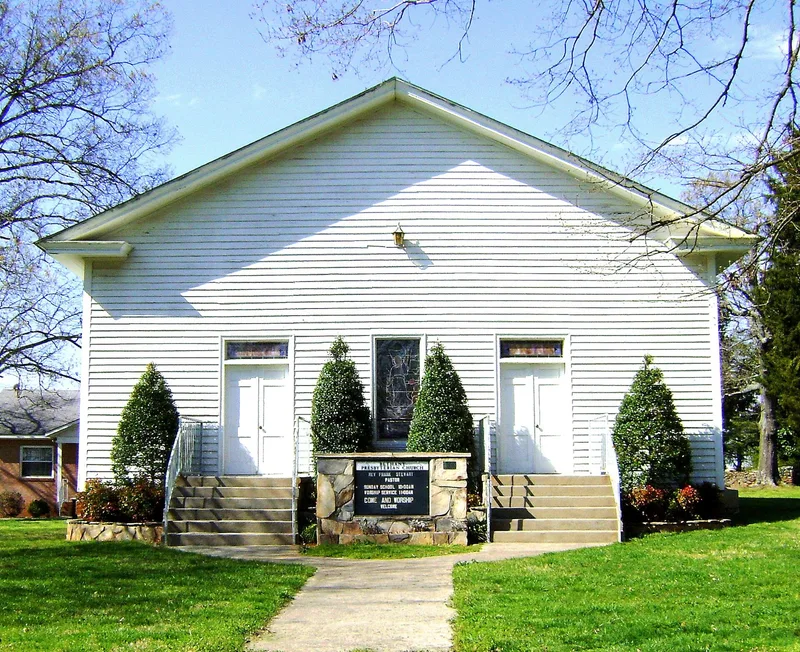
Bethany Presbyterian Church, a one-story frame building of 1855, stands in Houstonville with a fieldstone-walled cemetery on its north and east sides. Its simple Greek Revival form is typical of mid-to-late nineteenth-century Piedmont churches. Across the road stands Ebenezer Academy, a log schoolhouse built in 1823 and chartered in 1822 by trustees all tied to the church. It operated as an academy until 1856 and then as a subscription school until 1903, a longer run than any other pre-Civil War school in the county. Its founders were nephews of Rev. James Hall, the church's first pastor, who had himself founded earlier schools in Iredell. Hugh Roddy Hall taught there from 1832 to 1856, and students included future doctors, ministers, lawyers and congressmen. The cemetery holds pre-Civil War stones of church and community leaders, some dating from at least 1785. Its wrought-iron gates are noted for craftsmanship. The school was restored in 1913, 1945 and 1968.
Significance in brief: The nomination argues the academy was among the most significant pre-Civil War schools in Iredell County, operating far longer than the others. It links the church and school to the Hall family of educators, whose first pastor James Hall founded earlier schools. The cemetery's dry-laid stone wall and wrought-iron gates, and the church's connection to the early black congregation and its 1865 founding of Freedom Presbyterian Church, are also cited.
Machine-generated summary. This summary was generated by a language model from the official nomination document and has not been reviewed line by line by an editor. It may contain errors. Check the source document before relying on any detail. Source: nomination document (PDF) · National Archives catalog entry. NRHP reference 80002857, listed December 8, 1980. Summary generated October 2026 (model claude-haiku-5-5, prompt v1.1-2026-10-29, confidence medium).
Key facts
| Official database NPS National Register database, ref. 80002857 , checked | |
|---|---|
| Address | U.S. 21, Houstonville |
| County | Iredell County |
| Listed | December 8, 1980 |
| Reference number | 80002857 |
| Resource type | Building |
| Areas of significance | Art, Architecture, Religion |
| Level of significance | Local |
| National Historic Landmark | No |
| Acreage | 6.3 |
| Official document, machine-extracted Nomination form (National Archives) , checked | |
| Period of significance | 1823-1903 |
| Architectural style | Greek Revival |
| Criteria |
|
| Status (as stated in the nomination) | Ebenezer Academy is still owned by Bethany Church and used as the chapter house of the Fourth Creek Chapter, Daughters of the American Revolution. |
| Official dataset NPS cultural-resource GIS (NRHP locations) | |
| Coordinates | 35.86219, -80.84440 |
What listing means for this property
Religious properties are listed for their architectural or historical significance, not their religious use. Listing is honorary and does not restrict the congregation's use of the building. The federal rehabilitation credit is generally unavailable unless part of the building is income-producing; some state programmes and preservation grants do cover religious buildings. Federal funding or permits trigger Section 106 review.
General information, not legal or tax advice. Rules change; confirm with your State Historic Preservation Office or a qualified adviser.
Questions about Ebenezer Academy, Bethany Presbyterian Church and Cemetery
When was Ebenezer Academy, Bethany Presbyterian Church and Cemetery added to the National Register of Historic Places?
Ebenezer Academy, Bethany Presbyterian Church and Cemetery was listed on December 8, 1980. Its National Register reference number is 80002857.
Is Ebenezer Academy, Bethany Presbyterian Church and Cemetery a National Historic Landmark?
No. The National Park Service database (snapshot of May 2026) lists Ebenezer Academy, Bethany Presbyterian Church and Cemetery on the National Register but does not record it as a National Historic Landmark.
Where is Ebenezer Academy, Bethany Presbyterian Church and Cemetery?
U.S. 21, Houstonville, Iredell County, North Carolina; coordinates 35.86219, -80.84440.
Why is Ebenezer Academy, Bethany Presbyterian Church and Cemetery historically significant?
According to a machine-generated summary of its nomination form: The nomination argues the academy was among the most significant pre-Civil War schools in Iredell County, operating far longer than the others. It links the church and school to the Hall family of educators, whose first pastor James Hall founded earlier schools. The cemetery's dry-laid stone wall and wrought-iron gates, and the church's connection to the early black congregation and its 1865 founding of Freedom Presbyterian Church, are also cited. Check the nomination document before relying on any detail.
Where can I read the original nomination for Ebenezer Academy, Bethany Presbyterian Church and Cemetery?
The nomination form is a public record held by the National Archives: nomination document (PDF).
Sources and further reading
- National Park Service, National Register of Historic Places database (snapshot May 2026), reference 80002857.
- Nomination form (PDF, National Archives) — catalog entry
- Wikipedia article (used for cross-checking only; text not reproduced here)
- Wikidata Q14707914
- This listing as JSON
Last updated November 2026. Found an error? See the editorial policy for how to report it.