Raeford Historic District

Why it's listed
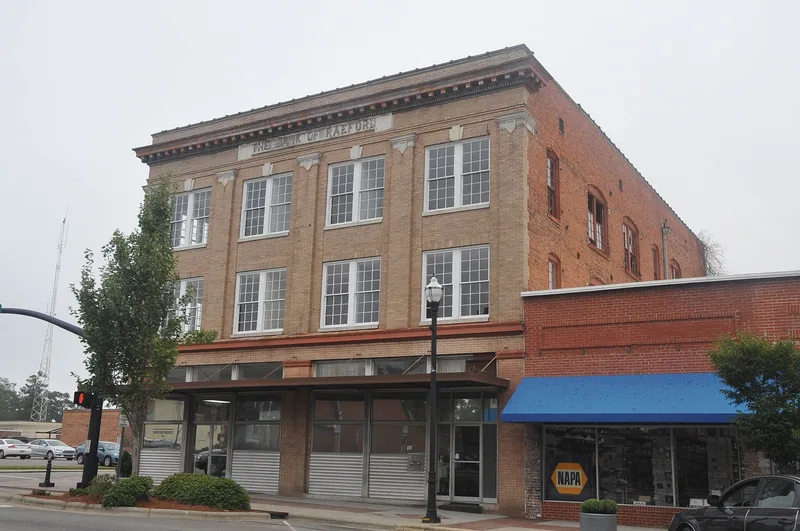
Raeford's historic district covers about twenty acres of the Hoke County town in North Carolina's Sandhills. It centers on North and South Main Street, which the Aberdeen & Rockfish Railroad divides, and includes a stretch of East Central Avenue with houses. Of 63 resources, 50 contribute to the district's character. Commercial buildings include the three-story Bank of Raeford and Page Trust Building, the brick railroad depot that replaced a wooden one around 1910, and smaller shops such as Kinlaw's Jewelry Store, built after a 1925 fire. Service stations from the 1920s to 1950s show how automobiles shaped the downtown, and the White Deer sculptures sit atop Graham's Service Station. The houses range from Queen Anne examples like the 1903 B. R. and Margaret Gatlin House to the Neoclassical McLauchlin House of 1905, now a local history museum. Together they illustrate the growth of a railroad town between 1897 and 1956.
Significance in brief: The district holds the greatest concentration of commercial and institutional buildings in Raeford that kept their integrity and date from the period of significance. Its buildings show the styles and vernacular forms of a small railroad town during its time of greatest prosperity. The railroad depot, banks, shops, service stations and houses of the families behind the commercial rise reflect the town's growth.
Machine-generated summary. This summary was generated by a language model from the official nomination document and has not been reviewed line by line by an editor. It may contain errors. Check the source document before relying on any detail. Source: nomination document (PDF) · National Archives catalog entry. NRHP reference 06000690, listed August 9, 2006. Summary generated October 2026 (model claude-sonnet-5-5, prompt v1.0-2026-10-29, confidence medium).
Key facts
| Address | Roughly bounded by Jackson St., E. Central Ave., the Aberdeen and Rockfish, and E and W Elwood Ave., Raeford |
|---|---|
| County | Hoke County |
| Listed | August 9, 2006 |
| Reference number | 06000690 |
| Resource type | District |
| Period of significance | 1897-1956 |
| Architect / builder | Marcus W. Dew (contractor, Hallie and Margaret Gatlin House); J.B. Thomas (built McDonald's Esso gas station, 1937) |
| Architectural style | Late Victorian/Queen Anne, Colonial Revival, Commercial Style, Classical Revival |
| Areas of significance | Architecture, Transportation, Community Planning and Development, Commerce |
| Level of significance | Local |
| Status (as stated in the nomination) | The J. W. and Christina McLauchlin House now serves as a local history museum and research center. Many commercial buildings are still in business use. |
| Acreage | 23 |
| Coordinates | 34.97808, -79.22239 (NPS GIS) |
What listing means for this property
This is a historic district. Buildings within its boundary are either contributing (they add to the district's significance) or non-contributing. Owners of contributing income-producing buildings can claim the 20% federal rehabilitation tax credit; homeowners should look at state credits. National Register districts impose no design review by themselves; a local historic district ordinance, if one exists, does (the difference explained).
General information, not legal or tax advice. Rules change; confirm with your State Historic Preservation Office or a qualified adviser.
Sources and further reading
- National Park Service, National Register of Historic Places database (snapshot May 2026), reference 06000690.
- Nomination form (PDF, National Archives) — catalog entry
- Wikipedia article (used for cross-checking only; text not reproduced here)
- Wikidata Q19987720
- This listing as JSON
Last updated October 2026. Found an error? See the editorial policy for how to report it.