Summerville Presbyterian Church and Cemetery

Why it's listed
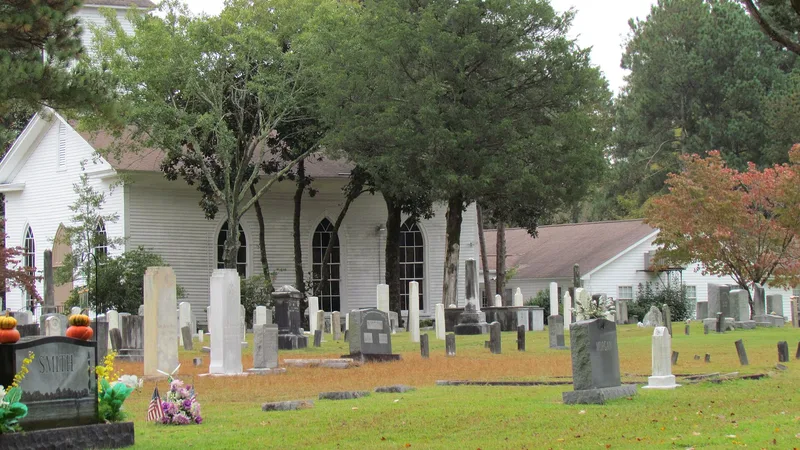
Summerville Presbyterian Church and its cemetery occupy a gently raised site in western Harnett County, North Carolina. The congregation began in 1811 as Tirzah Church, and the present rectangular frame building dates to about 1848, making it the oldest surviving church building in the county. Its original Greek Revival character was updated in the 1870s with lancet-arched windows and a square steeple with a tent roof, giving it a Gothic Revival look. Inside, the original gallery with boxed seats survives. The church is linked to Highland Scots settlers and to the Reverend Neill McKay, who served as minister for fifty years, was a church historian, and served as a University of North Carolina trustee. The cemetery holds roughly one hundred fifty plots and many nineteenth-century markers, about twenty signed by Scots stonemason George Lauder of Fayetteville. Surnames such as McKay, McLean, McLeod and McNeill reflect the community's Scottish roots.
Significance in brief: It is the oldest surviving church building in Harnett County and reflects the Highland Scots settlement of the sandhills region. It is tied to the Reverend Neill McKay, its minister for fifty years. Its Greek Revival form with later Gothic Revival touches, and a cemetery with about twenty markers signed by stonemason George Lauder, add architectural interest.
Machine-generated summary. This summary was generated by a language model from the official nomination document and has not been reviewed line by line by an editor. It may contain errors. Check the source document before relying on any detail. Source: nomination document (PDF) · National Archives catalog entry. NRHP reference 85000903, listed April 25, 1985. Summary generated October 2026 (model claude-sonnet-5-5, prompt v1.0-2026-10-29, confidence high).
Key facts
| Address | Off SR 1291, Lillington |
|---|---|
| County | Harnett County |
| Listed | April 25, 1985 |
| Reference number | 85000903 |
| Resource type | Building |
| Architect / builder | Builder/Architect unknown |
| Architectural style | Greek Revival with Gothic Revival alterations |
| Criteria |
|
| Areas of significance | Architecture |
| Level of significance | Local |
| Status (as stated in the nomination) | Condition listed as good and altered; the church was reopened in 1948 and reorganized in 1951, and the church is occupied and in use with its cemetery. |
| Acreage | 2.9 |
| Coordinates | 35.40285, -78.85508 (NPS GIS) |
What listing means for this property
Religious properties are listed for their architectural or historical significance, not their religious use. Listing is honorary and does not restrict the congregation's use of the building. The federal rehabilitation credit is generally unavailable unless part of the building is income-producing; some state programmes and preservation grants do cover religious buildings. Federal funding or permits trigger Section 106 review.
General information, not legal or tax advice. Rules change; confirm with your State Historic Preservation Office or a qualified adviser.
Sources and further reading
- National Park Service, National Register of Historic Places database (snapshot May 2026), reference 85000903.
- Nomination form (PDF, National Archives) — catalog entry
- Wikipedia article (used for cross-checking only; text not reproduced here)
- Wikidata Q7637724
- This listing as JSON
Last updated October 2026. Found an error? See the editorial policy for how to report it.