Whitaker's Chapel

Why it's listed
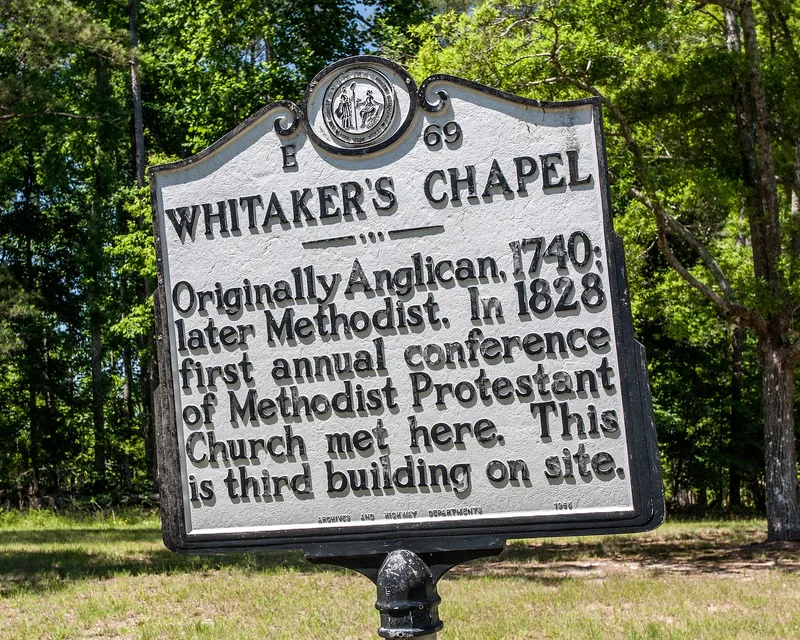
A gable-front frame church set on a four-acre tract in rural southern Halifax County, North Carolina, Whitaker's Chapel was probably built in the second quarter of the nineteenth century, with features that blend Federal and Greek Revival traits. In 1880-1881 it was moved a short distance across the road to a site in front of its cemetery and later enlarged with a front vestibule and a rear chancel extension. The interior keeps its handmade pews, a balustrade around the chancel, and walnut Eastlake-style furniture, along with brass chandeliers that carry an 1887 patent stamp. The adjacent cemetery, begun in 1856 on land deeded by Theodore Lucien Whitaker, has about 200 graves and a formal plan centered on a giant cedar. The church is important for its link to the 1828 founding of the North Carolina Annual Conference of the Methodist Protestant Church and for its illustration of rural church building traditions in the region.
Significance in brief: The nomination argues the chapel is tied to the founding of the North Carolina Annual Conference of the Methodist Protestant Church in December 1828 and to the denomination's early leadership in the state. It also presents the building as a well-preserved example of how rural frame churches were enlarged in the late nineteenth century, with the cemetery and its furnishings contributing to the site.
Machine-generated summary. This summary was generated by a language model from the official nomination document and has not been reviewed line by line by an editor. It may contain errors. Check the source document before relying on any detail. Source: nomination document (PDF) · National Archives catalog entry. NRHP reference 97001522, listed December 8, 1997. Summary generated October 2026 (model claude-haiku-5-5, prompt v1.1-2026-10-29, confidence medium).
Key facts
| Address | NC 1003;0.4 mi. E of jct. of NC 1100 and NC 1003, Enfield |
|---|---|
| County | Halifax County |
| Listed | December 8, 1997 |
| Reference number | 97001522 |
| Resource type | Building |
| Period of significance | 1828-1939 |
| Architectural style | Federal; Greek Revival; Late Gothic Revival |
| Criteria |
|
| Areas of significance | Religion, Architecture |
| Level of significance | State |
| Status (as stated in the nomination) | Restored in 1965 and back in use for services after being re-established in 1964. |
| Acreage | 4 |
| Coordinates | 36.14007, -77.59206 (NPS GIS) |
What listing means for this property
Religious properties are listed for their architectural or historical significance, not their religious use. Listing is honorary and does not restrict the congregation's use of the building. The federal rehabilitation credit is generally unavailable unless part of the building is income-producing; some state programmes and preservation grants do cover religious buildings. Federal funding or permits trigger Section 106 review.
General information, not legal or tax advice. Rules change; confirm with your State Historic Preservation Office or a qualified adviser.
Sources and further reading
- National Park Service, National Register of Historic Places database (snapshot May 2026), reference 97001522.
- Nomination form (PDF, National Archives) — catalog entry
- Wikipedia article (used for cross-checking only; text not reproduced here)
- Wikidata Q7994116
- This listing as JSON
Last updated October 2026. Found an error? See the editorial policy for how to report it.