George, Charles Noden, House

Why it's listed
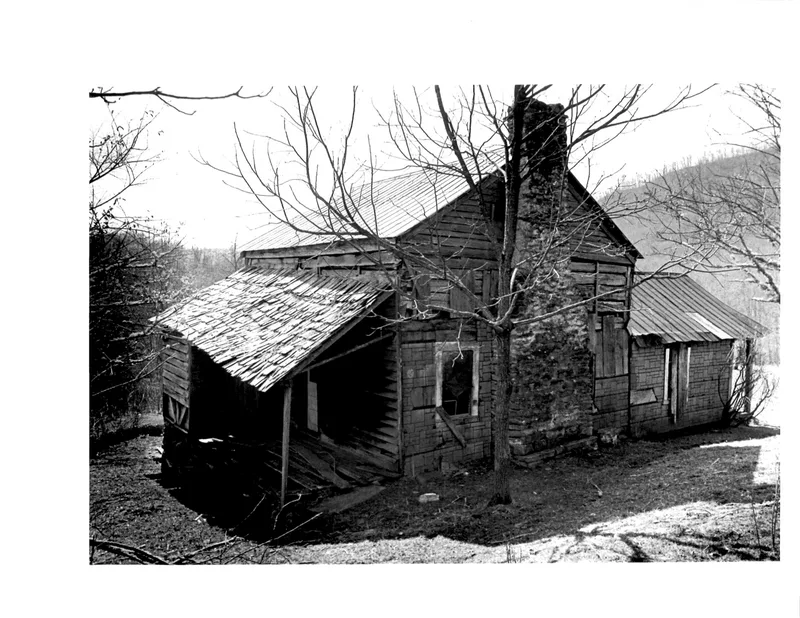
Built around 1853, this single-pen log house sits at the upper edge of a pasture beneath Nolton Ridge in mountainous Graham County. Half-dovetail notched poplar logs rise a story and a loft over a dry-laid fieldstone foundation, with a small dug-out cellar and a kitchen ell added about 1900. Inside, tongue-and-groove poplar boards cover the walls, and molded battens give the hall ceiling a paneled look. A log double corncrib and the remains of an apple orchard complete the farmstead. Charles Noden George, born in 1790, came from Tennessee after the Cherokee lands opened to settlement. He farmed on a small scale, taught school, and led a Confederate company called George's Guards. After his death in 1869 the property passed to Payton S. Colvard. The house is listed as a representative mountain farmstead of the nineteenth century and for its link to the second wave of settlement. Its exterior is deteriorating and it stands unoccupied, though its setting remains largely intact.
Significance in brief: The nomination argues the house and its well-preserved setting represent the nineteenth-century vernacular farmstead of the North Carolina mountains. It is also tied to the second wave of settlement in far western North Carolina after the Cherokee lands opened. Archaeological remains on the site may add further information.
Machine-generated summary. This summary was generated by a language model from the official nomination document and has not been reviewed line by line by an editor. It may contain errors. Check the source document before relying on any detail. Source: nomination document (PDF) · National Archives catalog entry. NRHP reference 84002314, listed April 5, 1984. Summary generated October 2026 (model claude-sonnet-5-5, prompt v1.0-2026-10-29, confidence high).
Key facts
| Address | Off US 129, Topton |
|---|---|
| County | Graham County |
| Listed | April 5, 1984 |
| Reference number | 84002314 |
| Resource type | Building |
| Period of significance | ca. 1853 |
| Architect / builder | Unknown |
| Architectural style | Vernacular log construction; story-and-loft, hall-and-parlor plan |
| Criteria |
|
| Areas of significance | Exploration/Settlement, Architecture |
| Level of significance | Local |
| Status (as stated in the nomination) | Unoccupied and beginning to deteriorate; windows and siding are partly lost and porches sag. The owner intends to stabilize or rehabilitate it. |
| Acreage | 1.6 |
| Coordinates | 35.28295, -83.70105 (NPS GIS) |
What listing means for this property
National Register listing is honorary for a privately owned home: it does not by itself restrict what an owner may do with their own money, and it does not require public access. Restrictions come from local landmark or historic-district ordinances, which are separate (how they differ).
Owner-occupied houses are not eligible for the 20% federal rehabilitation tax credit, which applies to income-producing buildings, but many states offer credits for homeowners. Listing also opens the door to preservation easements and to buying a plaque. Start with what listing means for homeowners, renovating a listed house and selling one.
Noted as vacant in the nomination. Nomination documents can be decades old; current status may differ. If you are considering buying an empty listed property, read the due-diligence checklist.
General information, not legal or tax advice. Rules change; confirm with your State Historic Preservation Office or a qualified adviser.
Sources and further reading
- National Park Service, National Register of Historic Places database (snapshot May 2026), reference 84002314.
- Nomination form (PDF, National Archives) — catalog entry
- Wikipedia article (used for cross-checking only; text not reproduced here)
- Wikidata Q18150681
- This listing as JSON
Last updated October 2026. Found an error? See the editorial policy for how to report it.