Freeman House
Also known as: The Stateline House

Why it's listed
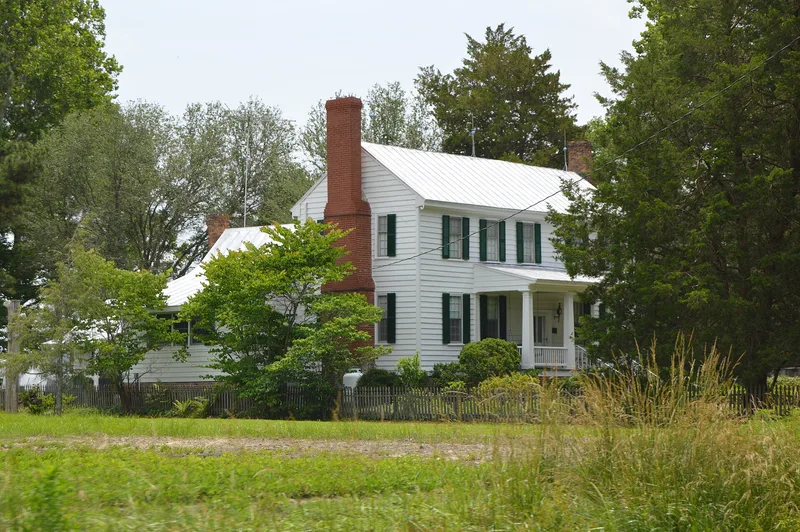
Standing directly on the line between Virginia and North Carolina, this vernacular farmhouse began as a one-room dwelling with a loft, probably in the late eighteenth century, and was later enlarged in stages into a side-hall and then a center-hall plan. Its builder is not documented. The earliest documented occupant was Samuel Cross, and the house was the centre of a farming operation of about 350 acres through the nineteenth century. Edmund J. Freeman, who bought the property in 1876, served as a justice of the peace in both states and performed many marriages for couples crossing the border to wed. The one-room section, with its tripartite mantel and enclosed corner stair, is regarded as a rare surviving example of an early regional house type. The house is also known for stories of local duels and divided loyalties among family members.
Significance in brief: The house is significant as an example of the evolution of the regional vernacular farmhouse, with its one-room original section regarded as an important survival of a type rarely found in recognizable form. Its location straddling the state line gave it a distinctive history, including its owner's dual justice-of-the-peace role and the marriages performed there. The nomination also cites its representation of Federal, late-Federal and Greek Revival building characteristics.
Machine-generated summary. This summary was generated by a language model from the official nomination document and has not been reviewed line by line by an editor. It may contain errors. Check the source document before relying on any detail. Source: nomination document (PDF) · National Archives catalog entry. NRHP reference 82003454, listed September 23, 1982. Summary generated October 2026 (model claude-haiku-5-5, prompt v1.1-2026-10-29, confidence high).
Key facts
| Address | N of Gates on US 13, Gates |
|---|---|
| County | Gates County |
| Listed | September 23, 1982 |
| Reference number | 82003454 |
| Resource type | Building |
| Period of significance | 1817-1917 |
| Architectural style | Federal, late-Federal and Greek Revival (vernacular farmhouse) |
| Criteria |
|
| Areas of significance | Architecture |
| Level of significance | Local |
| Status (as stated in the nomination) | The home is in excellent condition and is occupied by its owners. |
| Acreage | 1.3 |
| Coordinates | 36.55073, -76.75503 (NPS GIS) |
What listing means for this property
National Register listing is honorary for a privately owned home: it does not by itself restrict what an owner may do with their own money, and it does not require public access. Restrictions come from local landmark or historic-district ordinances, which are separate (how they differ).
Owner-occupied houses are not eligible for the 20% federal rehabilitation tax credit, which applies to income-producing buildings, but many states offer credits for homeowners. Listing also opens the door to preservation easements and to buying a plaque. Start with what listing means for homeowners, renovating a listed house and selling one.
General information, not legal or tax advice. Rules change; confirm with your State Historic Preservation Office or a qualified adviser.
Sources and further reading
- National Park Service, National Register of Historic Places database (snapshot May 2026), reference 82003454.
- Nomination form (PDF, National Archives) — catalog entry
- Wikipedia article (used for cross-checking only; text not reproduced here)
- Wikidata Q19461838
- This listing as JSON
Last updated October 2026. Found an error? See the editorial policy for how to report it.