Belmont Abbey Historic District

Why it's listed
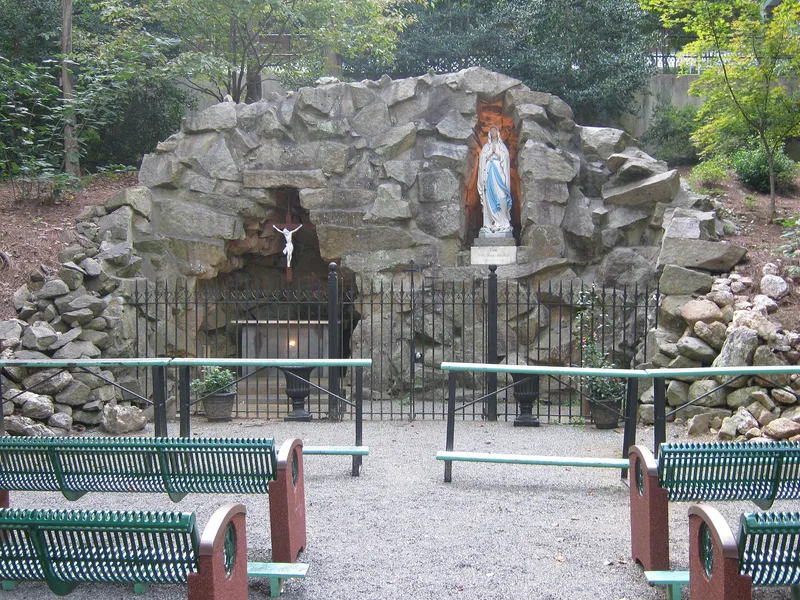
Belmont Abbey Historic District covers 37.5 acres on the western edge of a Benedictine monastery and college campus in Gaston County, North Carolina. Its buildings, sites and objects date from the 1880s onward and include the Abbey Cathedral, the Monastery, the College Building (now Stowe Hall), Saint Leo Hall, The Haid, the Grotto of Our Lady of Lourdes and the Abbey Cemetery. Most buildings use the American Benedictine style, a vernacular Gothic Revival in handmade red brick with tall arched windows and restrained ornament. Dom Michael McInerney, a monk who lived at the Abbey, designed many of them over a career of about six decades. The district is recognized for its part in spreading Catholicism across the Southeast. Abbot and Bishop Leo Haid led the Abbey from 1885 to 1924, and under him it founded other monasteries and schools in the region. The Abbey still houses monks and a college of about 1,000 students.
Significance in brief: The nomination argues national significance under three criteria. Criterion A covers the Abbey's role in the growth of Catholicism in the southeastern United States. Criterion B covers its links to Abbot-Bishop Leo Haid and the monk-architect Dom Michael McInerney. Criterion C covers the campus's American Benedictine architecture, a Gothic Revival variant, shown in McInerney's work.
Machine-generated summary. This summary was generated by a language model from the official nomination document and has not been reviewed line by line by an editor. It may contain errors. Check the source document before relying on any detail. Source: nomination document (PDF) · National Archives catalog entry. NRHP reference 93000584, listed July 14, 1993. Summary generated October 2026 (model claude-sonnet-5-5, prompt v1.0-2026-10-29, confidence medium).
Key facts
| Address | 100 Belmont--Mt. Holly Rd. (NC 2093, E side), Belmont |
|---|---|
| County | Gaston County |
| Listed | July 14, 1993 |
| Reference number | 93000584 |
| Resource type | District |
| Architect / builder | Dom Michael McInerney (architect of many buildings); Dom Placidus Pilz, O.S.B. (laid out the original monastery section) |
| Architectural style | Gothic Revival; Other: American Benedictine |
| Criteria |
|
| Areas of significance | Architecture, Religion |
| Level of significance | National |
| Status (as stated in the nomination) | Still used as a Benedictine monastery and a Catholic liberal arts college; buildings have been adapted for offices, classrooms, a student center and a bookstore. |
| Acreage | 37.5 |
| Coordinates | 35.26123, -81.04275 (NPS GIS) |
What listing means for this property
This is a historic district. Buildings within its boundary are either contributing (they add to the district's significance) or non-contributing. Owners of contributing income-producing buildings can claim the 20% federal rehabilitation tax credit; homeowners should look at state credits. National Register districts impose no design review by themselves; a local historic district ordinance, if one exists, does (the difference explained).
General information, not legal or tax advice. Rules change; confirm with your State Historic Preservation Office or a qualified adviser.
Sources and further reading
- National Park Service, National Register of Historic Places database (snapshot May 2026), reference 93000584.
- Nomination form (PDF, National Archives) — catalog entry
- Wikidata Q124172857
- This listing as JSON
Last updated October 2026. Found an error? See the editorial policy for how to report it.