Laurel Mill and Col. Jordan Jones House
Laurel Mill and Col. Jordan Jones House is a building in Gupton, Franklin County, North Carolina, listed on the National Register of Historic Places on May 30, 1975 (reference number 75001262). The National Park Service records its significance in Industry, Commerce, Architecture and Invention at the local level.
Facts from the NPS National Register database (); nomination summary October 2026. Last updated . Sources for each fact.

The pin is a point inside the NPS boundary polygon, not a surveyed location.
Why it's listed
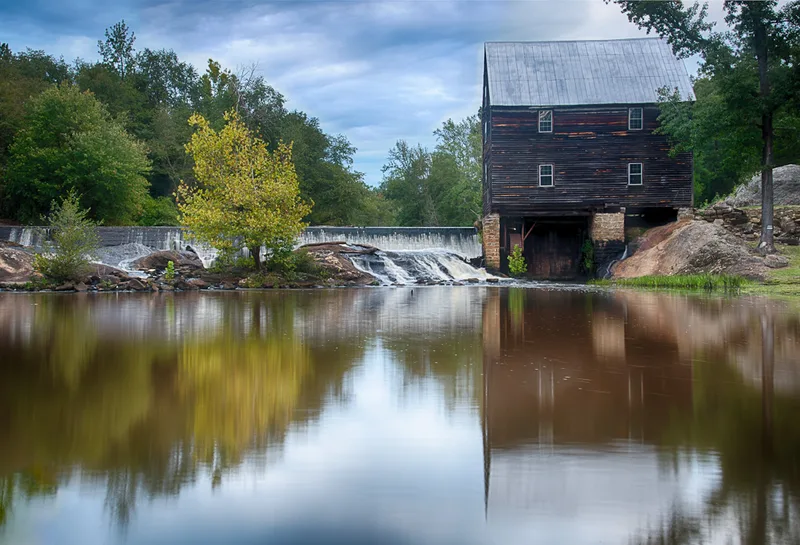
At the crossing of Sandy and Richland creeks near Gupton stand the last remains of Laurel, once a busy little town. Laurel Mill is a two-story frame grist mill set on stone piers over the water, with turbine machinery beneath and millstones inside. Across the road, on a hill above the creek, sits a one-story frame cottage on a raised brick basement, with fluted pilasters at the corners and heavy bracketed cornices in a vernacular Greek Revival-Italianate style. Both are linked to Colonel Jordan F. Jones, born in 1821, who bought the mill property in 1860 and built a complex of saw, grist and cotton mills, a store, a gin and later a creamery and wagon factory. Jones died in 1906, and the properties were sold at auction in 1909. The mill is the only operating grist mill in Franklin County, and the house is probably from the 1850s.
Significance in brief: Laurel Mill is the only operating grist mill in Franklin County and the sole surviving part of Colonel Jordan F. Jones's industrial complex, which included saw, grist and cotton mills. The nearby cottage, probably built for Jones in the 1850s, is an example of the vernacular Greek Revival-Italianate style. Together they represent nineteenth-century industry in an overwhelmingly agricultural county.
Machine-generated summary. This summary was generated by a language model from the official nomination document and has not been reviewed line by line by an editor. It may contain errors. Check the source document before relying on any detail. Source: nomination document (PDF) · National Archives catalog entry. NRHP reference 75001262, listed May 30, 1975. Summary generated October 2026 (model claude-sonnet-5-5, prompt v1.0-2026-10-29, confidence high).
Key facts
| Official database NPS National Register database, ref. 75001262 , checked | |
|---|---|
| Address | SW of Gupton at jct. of SR 1432 and 1436, Gupton |
| County | Franklin County |
| Listed | May 30, 1975 |
| Reference number | 75001262 |
| Resource type | Building |
| Areas of significance | Industry, Commerce, Architecture, Invention |
| Level of significance | Local |
| National Historic Landmark | No |
| Acreage | 40 |
| Official document, machine-extracted Nomination form (National Archives) , checked | |
| Period of significance | 1850s, 1860s (19th century) |
| Architectural style | Vernacular Greek Revival-Italianate (house); nineteenth-century grist mill |
| Status (as stated in the nomination) | Both buildings are described as in good condition and occupied; the mill is running again and grinds meal on a limited scale. |
| Official dataset NPS cultural-resource GIS (NRHP locations) | |
| Coordinates | 36.17792, -78.19139 |
What listing means for this property
National Register listing is honorary for a privately owned home: it does not by itself restrict what an owner may do with their own money, and it does not require public access. Restrictions come from local landmark or historic-district ordinances, which are separate (how they differ).
Owner-occupied houses are not eligible for the 20% federal rehabilitation tax credit, which applies to income-producing buildings, but many states offer credits for homeowners. Listing also opens the door to preservation easements and to buying a plaque. Start with what listing means for homeowners, renovating a listed house and selling one.
General information, not legal or tax advice. Rules change; confirm with your State Historic Preservation Office or a qualified adviser.
Questions about Laurel Mill and Col. Jordan Jones House
When was Laurel Mill and Col. Jordan Jones House added to the National Register of Historic Places?
Laurel Mill and Col. Jordan Jones House was listed on May 30, 1975. Its National Register reference number is 75001262.
Is Laurel Mill and Col. Jordan Jones House a National Historic Landmark?
No. The National Park Service database (snapshot of May 2026) lists Laurel Mill and Col. Jordan Jones House on the National Register but does not record it as a National Historic Landmark.
Where is Laurel Mill and Col. Jordan Jones House?
SW of Gupton at jct. of SR 1432 and 1436, Gupton, Franklin County, North Carolina; coordinates 36.17792, -78.19139.
Why is Laurel Mill and Col. Jordan Jones House historically significant?
According to a machine-generated summary of its nomination form: Laurel Mill is the only operating grist mill in Franklin County and the sole surviving part of Colonel Jordan F. Jones's industrial complex, which included saw, grist and cotton mills. The nearby cottage, probably built for Jones in the 1850s, is an example of the vernacular Greek Revival-Italianate style. Together they represent nineteenth-century industry in an overwhelmingly agricultural county. Check the nomination document before relying on any detail.
Where can I read the original nomination for Laurel Mill and Col. Jordan Jones House?
The nomination form is a public record held by the National Archives: nomination document (PDF).
Sources and further reading
- National Park Service, National Register of Historic Places database (snapshot May 2026), reference 75001262.
- Nomination form (PDF, National Archives) — catalog entry
- Wikipedia article (used for cross-checking only; text not reproduced here)
- Wikidata Q19875017
- This listing as JSON
Last updated November 2026. Found an error? See the editorial policy for how to report it.