Winston-Salem Tobacco Historic District

Why it's listed
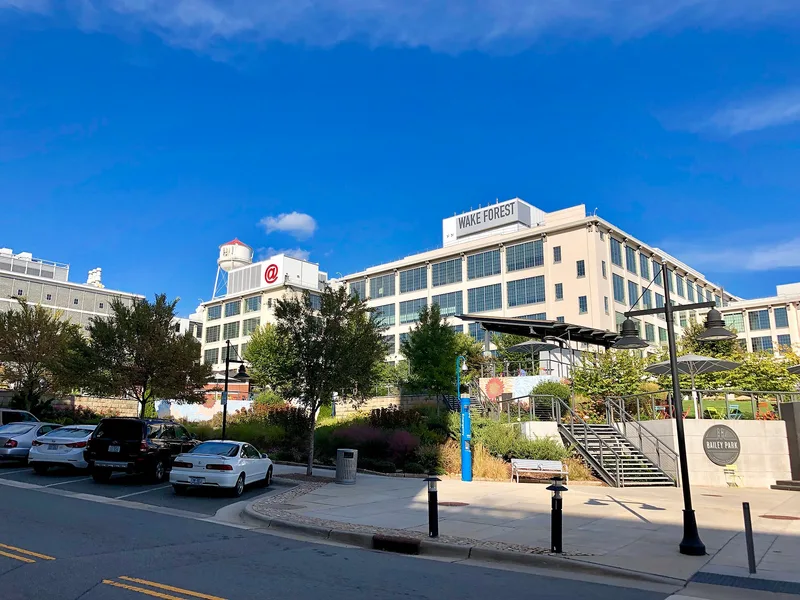
Winston-Salem's eastern downtown holds the largest surviving industrial section of a tobacco manufacturing center that once covered roughly ten square blocks. The district includes R. J. Reynolds Tobacco Company factories and warehouses built mainly in the 1910s through 1930s, such as Factory 60 from 1923 and Factory 90 from 1926, along with the S. J. Nissen Building of 1894-95 and the Piedmont Leaf Tobacco Company buildings. It is regarded as important because it preserves the physical link between the tobacco factories and the African American commercial district that developed around them, a district much of which was lost to urban renewal from the late 1950s. Elevated railroad bridges, a creek emerging from beneath Patterson Avenue, and granite Durax pavement from about 1915 also record how goods moved through the area. The district's labor significance centers on the 1940s strikes at the Reynolds plant, led by Local 22 of the CIO-affiliated Tobacco Workers Organizing Committee.
Significance in brief: The district is significant for its association with the R. J. Reynolds Tobacco Company and the early twentieth-century tobacco industry, for its link to the African American business and commercial district that grew around the factory complex, and for its connection to African American labor history, including 1940s strikes led by Local 22. The nomination also cites the transportation resources, such as railroad bridges and Durax pavement, as evidence of the district's industrial function.
Machine-generated summary. This summary was generated by a language model from the official nomination document and has not been reviewed line by line by an editor. It may contain errors. Check the source document before relying on any detail. Source: nomination document (PDF) · National Archives catalog entry. NRHP reference 09000602, listed August 5, 2009. Summary generated October 2026 (model claude-haiku-5-5, prompt v1.1-2026-10-29, confidence medium).
Key facts
| Address | Bounded by Chestnut St. on the W., 5th and 7th Sts. on the N., Linden St. on the E., and 4th and Fogle Sts. on the S., Winston-Salem |
|---|---|
| County | Forsyth County |
| Listed | August 5, 2009 |
| Reference number | 09000602 |
| Resource type | District |
| Period of significance | 1890-1959 |
| Architectural style | Commercial Style |
| Criteria |
|
| Areas of significance | Industry, Commerce, Black, Social History |
| Level of significance | Local |
| Acreage | 31 |
| Coordinates | 35.20061, -80.24885 (NPS GIS) |
What listing means for this property
This is a historic district. Buildings within its boundary are either contributing (they add to the district's significance) or non-contributing. Owners of contributing income-producing buildings can claim the 20% federal rehabilitation tax credit; homeowners should look at state credits. National Register districts impose no design review by themselves; a local historic district ordinance, if one exists, does (the difference explained).
General information, not legal or tax advice. Rules change; confirm with your State Historic Preservation Office or a qualified adviser.
Sources and further reading
- National Park Service, National Register of Historic Places database (snapshot May 2026), reference 09000602.
- Nomination form (PDF, National Archives) — catalog entry
- Wikipedia article (used for cross-checking only; text not reproduced here)
- Wikidata Q21016358
- This listing as JSON
Last updated October 2026. Found an error? See the editorial policy for how to report it.