Holly Avenue Historic District

The pin is a point inside the NPS boundary polygon, not a surveyed location.
Why it's listed
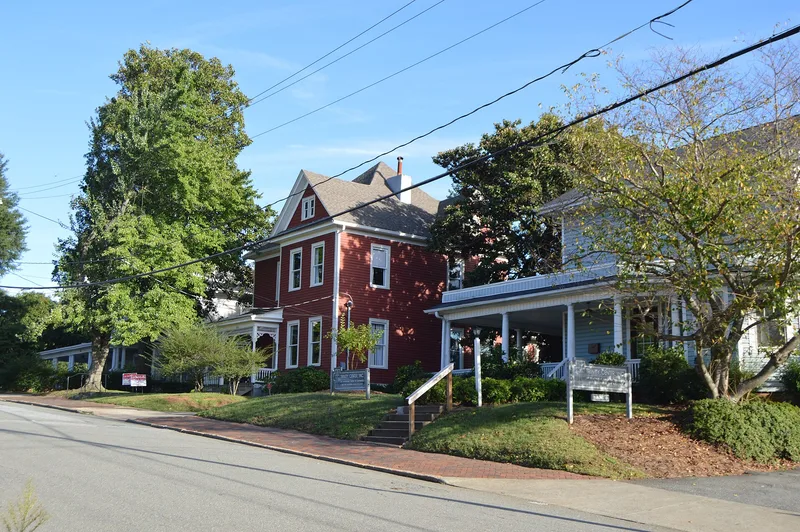
Holly Avenue Historic District covers fifty-nine acres on the west side of downtown Winston-Salem. Its houses sit on narrow lots in a bowl-shaped landscape of steep hills that descend to springs once used by eighteenth-century Moravian settlers as a water source for Salem. In 1903 the Moravian congregation subdivided the land around the springs, known as the Reservation, and laid out Shady Boulevard and extended Second Street and Holly Avenue. Most of the district's 136 resources were built between 1900 and 1930, with construction peaking from 1906 to 1910. Housing ranges from the Italianate Henry Case House of about 1885, the oldest in the district, to Queen Anne and Colonial Revival homes, bungalows and post-war Minimal Traditional apartment buildings. Calvary Moravian Church, completed in 1926 to designs by Willard Northup, is the most prominent non-residential building. Of the 136 resources, 116 contribute to the district. Losses came from commercial development, parking lots and construction of the East-West Expressway in the early 1950s.
Significance in brief: The district developed around springs once used by Moravian settlers and was subdivided in 1903 as the Moravian congregation's Reservation. It preserves a bowl-shaped landscape and a range of houses, apartment buildings and outbuildings in Queen Anne, Colonial Revival, Craftsman and Minimal Traditional styles. Seventy-nine percent of its resources were built between 1900 and 1930.
Machine-generated summary. This summary was generated by a language model from the official nomination document and has not been reviewed line by line by an editor. It may contain errors. Check the source document before relying on any detail. Source: nomination document (PDF) · National Archives catalog entry. NRHP reference 02000442, listed May 2, 2002. Summary generated October 2026 (model claude-sonnet-5-5, prompt v1.0-2026-10-29, confidence medium).
Key facts
| Address | Roughly bounded by Broad and Marshall Sts., Holly Ave. and Business I-40, Winston-Salem |
|---|---|
| County | Forsyth County |
| Listed | May 2, 2002 |
| Reference number | 02000442 |
| Resource type | District |
| Period of significance | c. 1885 to 1952 |
| Architect / builder | Willard Northup of Northup and O'Brien (Calvary Moravian Church) |
| Architectural style | Late Victorian (Queen Anne, Italianate); Late 19th and 20th Century Revivals (Colonial Revival); Bungalow/Craftsman |
| Areas of significance | Community Planning and Development, Architecture |
| Level of significance | Local |
| Status (as stated in the nomination) | Mostly residential and still in use, with some apartments, a restaurant, businesses and a church. Some historic buildings have been lost to demolition, parking lots and highway construction. |
| Acreage | 59 |
| Within district | Downtown Winston-Salem Historic District |
| Coordinates | 36.09493, -80.25266 (NPS GIS) |
What listing means for this property
This is a historic district. Buildings within its boundary are either contributing (they add to the district's significance) or non-contributing. Owners of contributing income-producing buildings can claim the 20% federal rehabilitation tax credit; homeowners should look at state credits. National Register districts impose no design review by themselves; a local historic district ordinance, if one exists, does (the difference explained).
General information, not legal or tax advice. Rules change; confirm with your State Historic Preservation Office or a qualified adviser.
Sources and further reading
- National Park Service, National Register of Historic Places database (snapshot May 2026), reference 02000442.
- Nomination form (PDF, National Archives) — catalog entry
- Wikipedia article (used for cross-checking only; text not reproduced here)
- Wikidata Q19462369
- This listing as JSON
Last updated October 2026. Found an error? See the editorial policy for how to report it.