Clayton Family Farm

Why it's listed
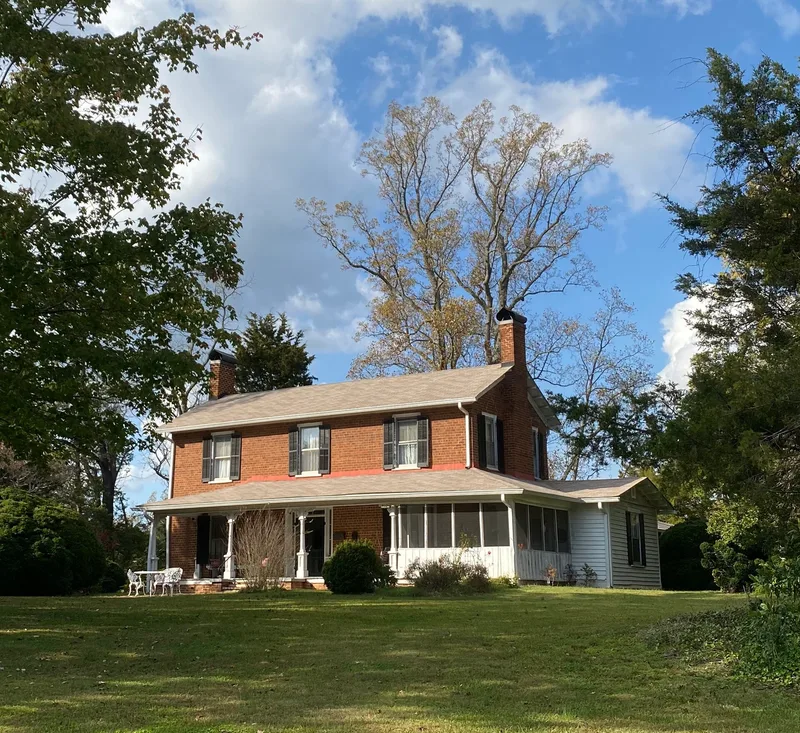
Clayton Family Farm occupies about twenty-five acres where Stanleyville Drive meets NC 66 in northern Forsyth County, now at the edge of Winston-Salem. The land has belonged to one family since the late eighteenth century. Its fifteen resources include the ca. 1800 weatherboarded log John Clayton House, the 1879 two-story brick Matthew C. Clayton House with Italianate details, a store built around 1910, log and frame outbuildings, a family cemetery, and a pond site. Twelve resources contribute to its historic character. Two old roadbeds, the Great Wagon Road and Old Hollow Road, crossed here and put the family at a busy crossroads. Travelers watered their animals at the "open pond," which appears on an eighteenth-century map of Wachovia. The farm grew corn, tobacco, wheat and potatoes, and the store served the neighborhood. The property keeps a high degree of integrity of setting and materials, though only a fraction of the original Clayton land remains.
Significance in brief: The land has stayed in one family since the late eighteenth century and keeps a ca. 1800 log house, an 1879 brick I-house, a store, log outbuildings and a family cemetery. It also includes roadbeds of the Great Wagon Road and Old Hollow Road and an "open pond" used by travelers. Together these resources show how a Piedmont farm family lived and changed over time at a strategic crossroads.
Machine-generated summary. This summary was generated by a language model from the official nomination document and has not been reviewed line by line by an editor. It may contain errors. Check the source document before relying on any detail. Source: nomination document (PDF) · National Archives catalog entry. NRHP reference 01001072, listed October 5, 2001. Summary generated October 2026 (model claude-sonnet-5-5, prompt v1.0-2026-10-29, confidence medium).
Key facts
| Address | 5809 Stanley Dr., Stanleyville |
|---|---|
| County | Forsyth County |
| Listed | October 5, 2001 |
| Reference number | 01001072 |
| Resource type | District |
| Architectural style | Greek Revival; Italianate; Other: Single-pen log; Other: I-house |
| Areas of significance | Transportation, Architecture |
| Level of significance | Local |
| Status (as stated in the nomination) | The land is no longer farmed. The Matthew C. Clayton House is occupied by family. The John Clayton House is unoccupied and has been given to Preservation North Carolina. The Clayton Store is used for storage. Resources range from fair to excellent condition. |
| Acreage | 25 |
| Coordinates | 36.20085, -80.27157 (NPS GIS) |
What listing means for this property
This is a historic district. Buildings within its boundary are either contributing (they add to the district's significance) or non-contributing. Owners of contributing income-producing buildings can claim the 20% federal rehabilitation tax credit; homeowners should look at state credits. National Register districts impose no design review by themselves; a local historic district ordinance, if one exists, does (the difference explained).
General information, not legal or tax advice. Rules change; confirm with your State Historic Preservation Office or a qualified adviser.
Sources and further reading
- National Park Service, National Register of Historic Places database (snapshot May 2026), reference 01001072.
- Nomination form (PDF, National Archives) — catalog entry
- Wikipedia article (used for cross-checking only; text not reproduced here)
- Wikidata Q19461029
- This listing as JSON
Last updated October 2026. Found an error? See the editorial policy for how to report it.