Win-Mock Farm Dairy
Win-Mock Farm Dairy is a building in Davie, Davie County, North Carolina, listed on the National Register of Historic Places on December 27, 2010 (reference number 10001057). The National Park Service records its significance in Architecture at the local level.
Facts from the NPS National Register database (); nomination summary October 2026. Last updated . Sources for each fact.

Approximate location: the National Park Service places this pin arbitrarily within the property, not at a surveyed point (stated accuracy ±12 m).
Why it's listed
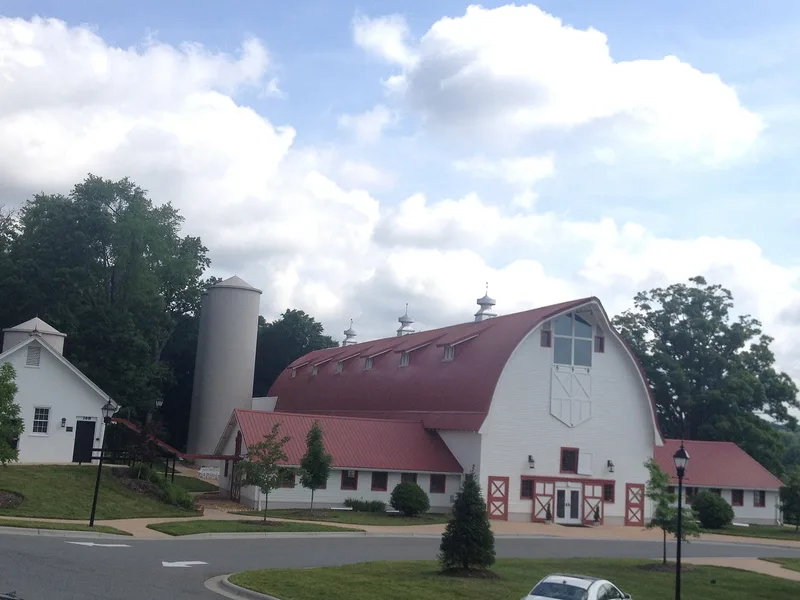
Built about 1930 on the eastern edge of Davie County, North Carolina, the Win-Mock Farm Dairy is a group of three main buildings and two structures that together formed a complete commercial dairy. The dairy barn is a two-story frame building 38 feet wide and 180 feet long, with a Gothic-arch roof, nine-light slanting windows along both sides, and two concrete silos at its north end. A concrete-block bottling plant is joined to the barn by a covered walkway, and a frame granary with its own Gothic-arch roof stands nearby. The complex was developed for R. J. Reynolds Tobacco Company executive S. Clay Williams, whose herd of 484 cows in 1945 was nearly four times the size of the next largest in the area. Its barn and layout are presented as reflecting the sanitation, ventilation and labor-saving practices of the period, and as exceptional for their size in the county.
Significance in brief: The nomination argues that the buildings embody the distinctive characteristics of American dairy farm buildings of about 1920 to 1950, and that the barn's exceptional length and Gothic-arch roof set it apart from comparable barns in Davie and Forsyth counties. The complex was developed by R. J. Reynolds executive S. Clay Williams, whose herd of 484 cows in 1945 was far larger than any other in the county. The buildings are presented as showing period advances in sanitation, mechanization and efficient dairy layout.
Machine-generated summary. This summary was generated by a language model from the official nomination document and has not been reviewed line by line by an editor. It may contain errors. Check the source document before relying on any detail. Source: nomination document (PDF) · National Archives catalog entry. NRHP reference 10001057, listed December 27, 2010. Summary generated October 2026 (model claude-haiku-5-5, prompt v1.1-2026-10-29, confidence high).
Key facts
| Official database NPS National Register database, ref. 10001057 , checked | |
|---|---|
| Address | 168 E Kinderton Way, Davie |
| County | Davie County |
| Listed | December 27, 2010 |
| Reference number | 10001057 |
| Resource type | Building |
| Areas of significance | Architecture |
| Level of significance | Local |
| National Historic Landmark | No |
| Acreage | 4.6 |
| Official document, machine-extracted Nomination form (National Archives) , checked | |
| Period of significance | ca. 1930 |
| Architectural style | No Style |
| Criteria |
|
| Status (as stated in the nomination) | The now-unoccupied barns stand on a tract of 18.39 acres owned by the Hillsdale Group, LLC, with part of the western portion developed as a mixed-use development. |
| Official dataset NPS cultural-resource GIS (NRHP locations) | |
| Coordinates | 36.01292, -80.42252 |
What listing means for this property
National Register listing is honorary for a privately owned home: it does not by itself restrict what an owner may do with their own money, and it does not require public access. Restrictions come from local landmark or historic-district ordinances, which are separate (how they differ).
Owner-occupied houses are not eligible for the 20% federal rehabilitation tax credit, which applies to income-producing buildings, but many states offer credits for homeowners. Listing also opens the door to preservation easements and to buying a plaque. Start with what listing means for homeowners, renovating a listed house and selling one.
Noted as vacant in the nomination. Nomination documents can be decades old; current status may differ. If you are considering buying an empty listed property, read the due-diligence checklist.
General information, not legal or tax advice. Rules change; confirm with your State Historic Preservation Office or a qualified adviser.
Questions about Win-Mock Farm Dairy
When was Win-Mock Farm Dairy added to the National Register of Historic Places?
Win-Mock Farm Dairy was listed on December 27, 2010. Its National Register reference number is 10001057.
Is Win-Mock Farm Dairy a National Historic Landmark?
No. The National Park Service database (snapshot of May 2026) lists Win-Mock Farm Dairy on the National Register but does not record it as a National Historic Landmark.
Where is Win-Mock Farm Dairy?
168 E Kinderton Way, Davie, Davie County, North Carolina; coordinates 36.01292, -80.42252.
Why is Win-Mock Farm Dairy historically significant?
According to a machine-generated summary of its nomination form: The nomination argues that the buildings embody the distinctive characteristics of American dairy farm buildings of about 1920 to 1950, and that the barn's exceptional length and Gothic-arch roof set it apart from comparable barns in Davie and Forsyth counties. The complex was developed by R. J. Reynolds executive S. Clay Williams, whose herd of 484 cows in 1945 was far larger than any other in the county. The buildings are presented as showing period advances in sanitation, mechanization and efficient dairy layout. Check the nomination document before relying on any detail.
Where can I read the original nomination for Win-Mock Farm Dairy?
The nomination form is a public record held by the National Archives: nomination document (PDF).
Sources and further reading
- National Park Service, National Register of Historic Places database (snapshot May 2026), reference 10001057.
- Nomination form (PDF, National Archives) — catalog entry
- Wikipedia article (used for cross-checking only; text not reproduced here)
- Wikidata Q18395085
- This listing as JSON
Last updated November 2026. Found an error? See the editorial policy for how to report it.