Mount Ebal Methodist Protestant Church
Also known as: Dv-441
Mount Ebal Methodist Protestant Church is a building in Denton, Davidson County, North Carolina, listed on the National Register of Historic Places on July 10, 1984 (reference number 84002143). The National Park Service records its significance in Architecture and Religion at the local level.
Facts from the NPS National Register database (); nomination summary October 2026. Last updated . Sources for each fact.

Approximate location: the National Park Service places this pin arbitrarily within the property, not at a surveyed point (stated accuracy ±12 m).
Why it's listed
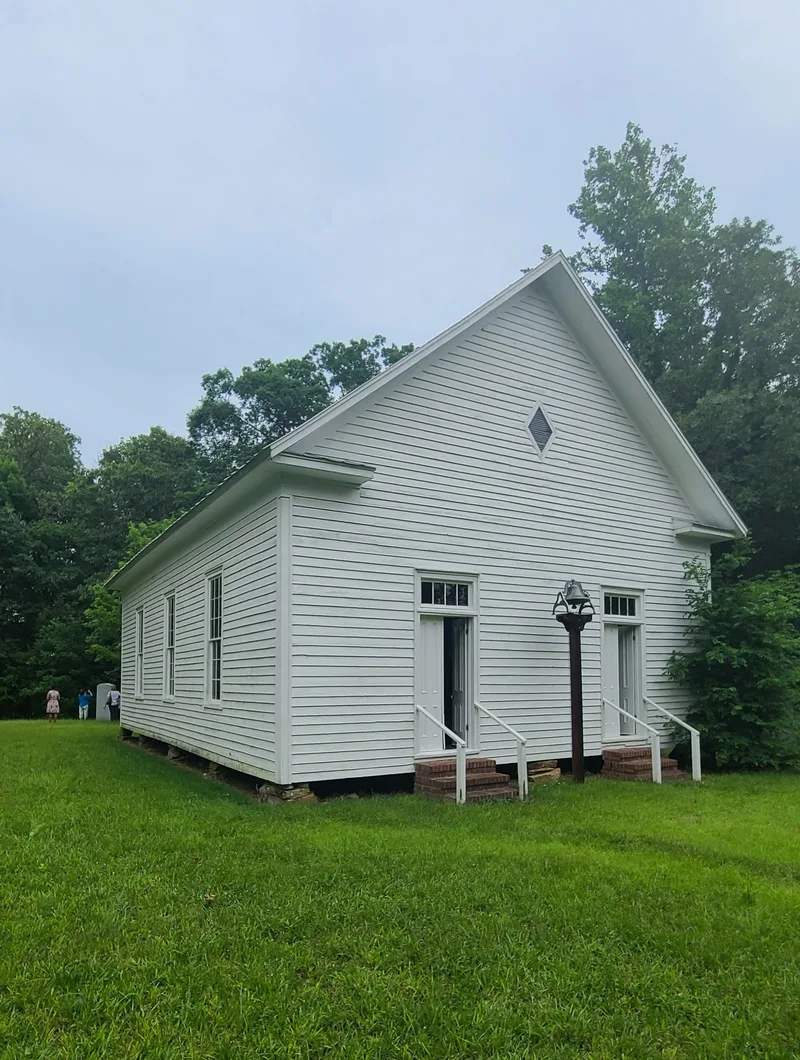
Mt. Ebal Methodist Protestant Church is a plain gabled frame building near Denton in southeast Davidson County, measuring 36 by 48 feet and resting on fieldstone piers. Two local farmers and congregation members, John T. Sexton and Alfred Thompson, reportedly built it in 1883 for $60. Inside, the walls, ceiling, pews and pulpit are hand-planed pine left unpainted. The congregation traces its origins to about 1861, and the grounds once held a camp meeting arbor lit at night by torches on stone platforms; two reconstructed cairns mark the spot. Camp meetings drew large crowds between 1870 and 1900. Regular services probably ended soon after 1919, when most members had moved to Denton and roads had been rerouted, leaving the church at the end of a dirt lane. Because use stopped around 1940, the building is almost unchanged. It was listed for its typical rural architecture and its link to the denomination's late nineteenth-century peak. A cemetery lies to the northeast, and an annual homecoming is still held.
Significance in brief: The church is significant for its representative architecture, typical of small, unpretentious frame meeting houses built across the county in the late nineteenth and early twentieth centuries. It is virtually unaltered because use stopped around 1940. It also reflects the denomination's late nineteenth-century peak and its role as a focus of annual camp meetings for rural farmers.
Machine-generated summary. This summary was generated by a language model from the official nomination document and has not been reviewed line by line by an editor. It may contain errors. Check the source document before relying on any detail. Source: nomination document (PDF) · National Archives catalog entry. NRHP reference 84002143, listed July 10, 1984. Summary generated October 2026 (model claude-sonnet-5-5, prompt v1.0-2026-10-29, confidence high).
Key facts
| Official database NPS National Register database, ref. 84002143 , checked | |
|---|---|
| Address | End of SR 2518, Denton |
| County | Davidson County |
| Listed | July 10, 1984 |
| Reference number | 84002143 |
| Resource type | Building |
| Areas of significance | Architecture, Religion |
| Level of significance | Local |
| National Historic Landmark | No |
| Acreage | 1.9 |
| Official document, machine-extracted Nomination form (National Archives) , checked | |
| Period of significance | 1883 |
| Architect / builder | John T. Sexton & Alfred Thompson |
| Criteria |
|
| Status (as stated in the nomination) | Maintained in good repair by the Mt. Ebal Memorial Association and used once a year for a homecoming service; regular services ended soon after 1919 and use ceased by about 1940. |
| Official dataset NPS cultural-resource GIS (NRHP locations) | |
| Coordinates | 35.62624, -80.06773 |
What listing means for this property
Religious properties are listed for their architectural or historical significance, not their religious use. Listing is honorary and does not restrict the congregation's use of the building. The federal rehabilitation credit is generally unavailable unless part of the building is income-producing; some state programmes and preservation grants do cover religious buildings. Federal funding or permits trigger Section 106 review.
General information, not legal or tax advice. Rules change; confirm with your State Historic Preservation Office or a qualified adviser.
Questions about Mount Ebal Methodist Protestant Church
When was Mount Ebal Methodist Protestant Church added to the National Register of Historic Places?
Mount Ebal Methodist Protestant Church was listed on July 10, 1984. Its National Register reference number is 84002143.
Is Mount Ebal Methodist Protestant Church a National Historic Landmark?
No. The National Park Service database (snapshot of May 2026) lists Mount Ebal Methodist Protestant Church on the National Register but does not record it as a National Historic Landmark.
Where is Mount Ebal Methodist Protestant Church?
End of SR 2518, Denton, Davidson County, North Carolina; coordinates 35.62624, -80.06773.
Why is Mount Ebal Methodist Protestant Church historically significant?
According to a machine-generated summary of its nomination form: The church is significant for its representative architecture, typical of small, unpretentious frame meeting houses built across the county in the late nineteenth and early twentieth centuries. It is virtually unaltered because use stopped around 1940. It also reflects the denomination's late nineteenth-century peak and its role as a focus of annual camp meetings for rural farmers. Check the nomination document before relying on any detail.
Who designed or built Mount Ebal Methodist Protestant Church?
The nomination form names John T. Sexton & Alfred Thompson as architect or builder (extracted by machine from the nomination; check the source document).
Where can I read the original nomination for Mount Ebal Methodist Protestant Church?
The nomination form is a public record held by the National Archives: nomination document (PDF).
Sources and further reading
- National Park Service, National Register of Historic Places database (snapshot May 2026), reference 84002143.
- Nomination form (PDF, National Archives) — catalog entry
- Wikipedia article (used for cross-checking only; text not reproduced here)
- Wikidata Q6920533
- This listing as JSON
Last updated November 2026. Found an error? See the editorial policy for how to report it.