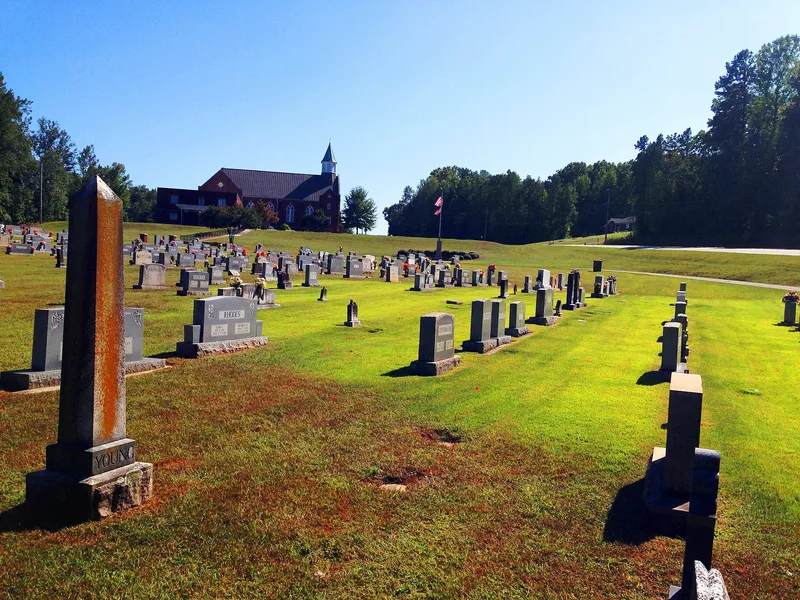
Beck's Reformed Church Cemetery

Why it's listed
Beck's Reformed Church Cemetery is a large burial ground of about 500 gravestones southeast of Lexington, in Davidson County, North Carolina. It belongs to a congregation founded in 1787 as a union Lutheran and Reformed church on land given by Dr. John Billings, L. Smith and others. The Reformed congregation built a frame church north of the cemetery in 1878, and the present brick church was dedicated in 1951. About 75 of the stones are of local manufacture, the earliest dated 1771. The cemetery holds more Early Phase gravestones than any other in the county, many with splayed sides and monogrammed or dated semicircular tops in the German tradition. Most are small, simple markers probably carved by family members. Others are decorative soapstone stones with folk symbols of resurrection and eternity, and a few are attributed to known stonecutters. Together they show the range of local German gravestone design and the folk art of the area's Anglo-German farming community.
Significance in brief: The cemetery has the largest number of early, traditional German gravestones of any cemetery in Davidson County. Its decorative soapstone markers with folk symbols of resurrection and eternity are described as the height of folk art among the area's Anglo-German farmers. The collection shows the range of the local German design idiom.
Machine-generated summary. This summary was generated by a language model from the official nomination document and has not been reviewed line by line by an editor. It may contain errors. Check the source document before relying on any detail. Source: nomination document (PDF) · National Archives catalog entry. NRHP reference 84001992, listed July 10, 1984. Summary generated October 2026 (model claude-sonnet-5-5, prompt v1.0-2026-10-29, confidence medium).
Key facts
| Address | SR 2250, Silver Hill |
|---|---|
| County | Davidson County |
| Listed | July 10, 1984 |
| Reference number | 84001992 |
| Resource type | Site |
| Period of significance | 1800-1899 and 1900- boxes checked, with 1700-1799 art also marked; specific dates given as "various" |
| Architect / builder | Stonecutters unknown; a few stones are attributed to James Cavany of York Co., S.C., John Rickard, and the Master of the Upper and Lower Case |
| Architectural style | Folk gravestone art in the traditional German design idiom (Early Phase, Pierced Tradition, Swisegood School) |
| Criteria |
|
| Areas of significance | Art, Architecture |
| Level of significance | National |
| Status (as stated in the nomination) | Marked occupied and in deteriorated condition on the form; still an active church cemetery, with the present brick Reformed church dedicated in 1951. |
| Acreage | 2.5 |
| Coordinates | 35.75819, -80.22548 (NPS GIS) |
What listing means for this property
Sites (archaeological sites, battlefields, landscapes) are often listed with a restricted address to protect them from looting or disturbance. Listing is honorary for private owners; federal undertakings on or near the site go through Section 106 review, and state laws may protect burials and artefacts regardless of listing.
General information, not legal or tax advice. Rules change; confirm with your State Historic Preservation Office or a qualified adviser.
Sources and further reading
- National Park Service, National Register of Historic Places database (snapshot May 2026), reference 84001992.
- Nomination form (PDF, National Archives) — catalog entry
- Wikipedia article (used for cross-checking only; text not reproduced here)
- Wikidata Q4878583
- This listing as JSON
Last updated October 2026. Found an error? See the editorial policy for how to report it.