Chicamacomico Life Saving Station

The pin is a point inside the NPS boundary polygon, not a surveyed location.
Why it's listed
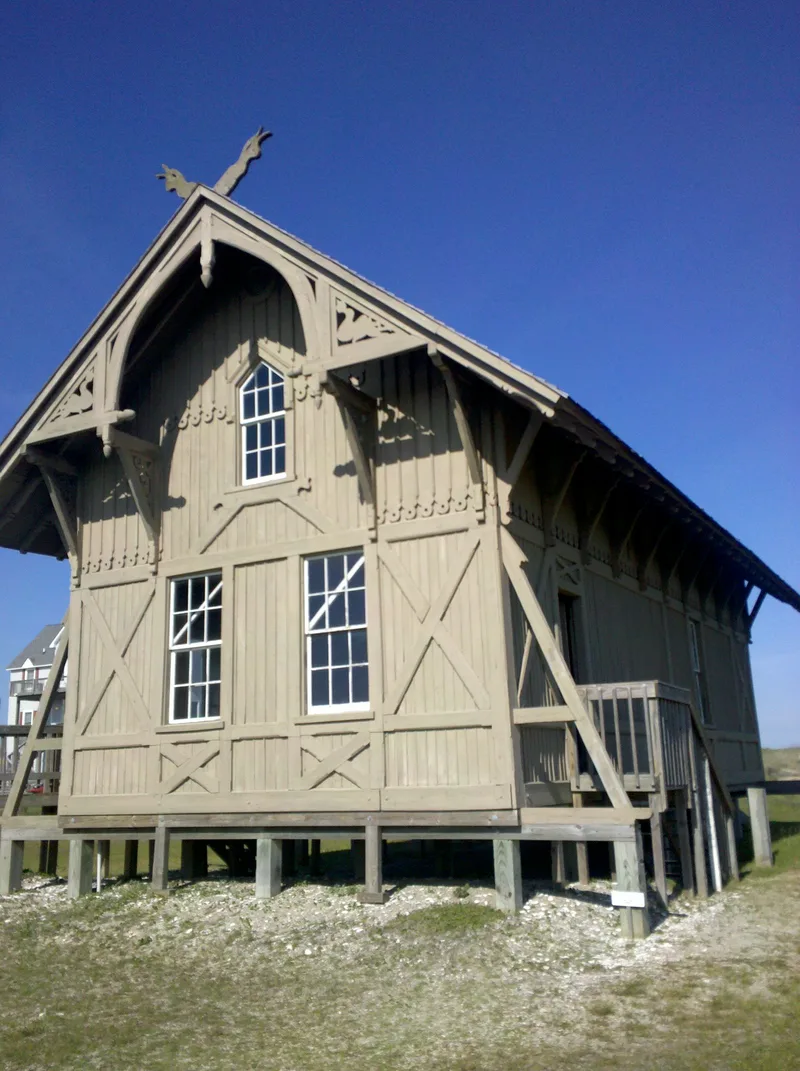
Chicamacomico Life Saving Station at Rodanthe, on North Carolina's Outer Banks, is a group of buildings that served the U.S. Lifesaving Service and later the Coast Guard. The original board-and-batten station was built in 1874, one of seven established in the state that year. In 1911 contractor Theodore S. Meekins completed a one-and-one-half story Shingle-style station with an observation tower, and the older building was later moved beside it and used as a boathouse. Kitchen, storage buildings, water tanks, a cistern and a flag tower survive, making this the most complete station complex in the state. The crew's best-known act came on August 16, 1918, when Captain John Allen Midgett and the men of surfboat 1046 pulled survivors from the sea around the torpedoed British tanker Mirlo, saving forty-two lives. Britain and the United States honored them with medals. The Coast Guard abandoned the station in 1954, and local preservation plans followed.
Significance in brief: The station was one of the first seven established in North Carolina by the U.S. Lifesaving Service and has the most complete collection of buildings of any surviving station in the state. Its crew, led by Captain John Allen Midgett, rescued 42 men from the burning British tanker Mirlo in August 1918, earning British and American medals.
Machine-generated summary. This summary was generated by a language model from the official nomination document and has not been reviewed line by line by an editor. It may contain errors. Check the source document before relying on any detail. Source: nomination document (PDF) · National Archives catalog entry. NRHP reference 76000164, listed December 12, 1976. Summary generated October 2026 (model claude-sonnet-5-5, prompt v1.0-2026-10-29, confidence medium).
Key facts
| Address | NC 12 and SR 1247, Rodanthe |
|---|---|
| County | Dare County |
| Listed | December 12, 1976 |
| Reference number | 76000164 |
| Resource type | Building |
| Period of significance | 1800-1899 |
| Architect / builder | Theodore S. Meekins, contractor-1911 |
| Architectural style | Shingle style (1911 main station); board and batten (1874 station) |
| Areas of significance | Military, Transportation, Architecture |
| Level of significance | National |
| Status (as stated in the nomination) | Abandoned by the Coast Guard in 1954 and described as falling into disrepair; the form lists it as unoccupied and in good condition, with plans to stabilize and preserve the buildings. |
| Acreage | 10 |
| Coordinates | 35.59518, -75.46447 (NPS GIS) |
What listing means for this property
For an income-producing building, listing (individually or as a contributing building in a district) is the gateway to the 20% federal rehabilitation tax credit on qualified rehabilitation costs, often stackable with state credits. Work claiming the credit must follow the Secretary of the Interior's Standards and be approved in advance.
Listing does not restrict a private owner acting without federal money or permits; where federal funding or licensing is involved, Section 106 review applies.
Noted as vacant in the nomination. Nomination documents can be decades old; current status may differ. If you are considering buying an empty listed property, read the due-diligence checklist.
General information, not legal or tax advice. Rules change; confirm with your State Historic Preservation Office or a qualified adviser.
Sources and further reading
- National Park Service, National Register of Historic Places database (snapshot May 2026), reference 76000164.
- Nomination form (PDF, National Archives) — catalog entry
- Wikipedia article (used for cross-checking only; text not reproduced here)
- Wikidata Q5095920
- This listing as JSON
Last updated October 2026. Found an error? See the editorial policy for how to report it.