Cape Hatteras Light Station
Also known as: Museum of the Sea; Cape Hatteras Lighthouse

Why it's listed
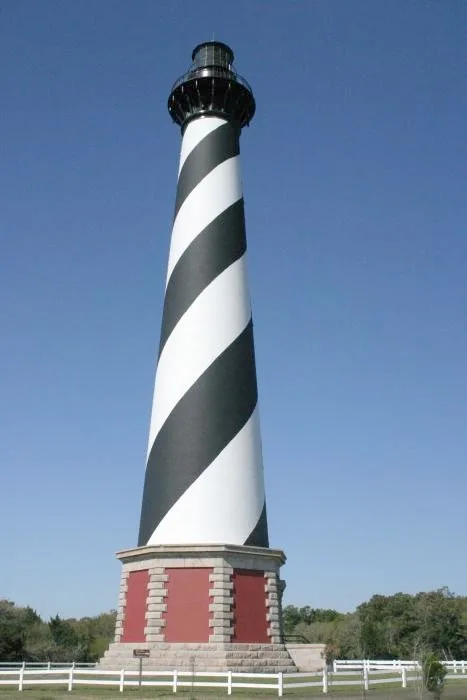
Cape Hatteras Light Station is a historic lighthouse complex on the Outer Banks at Buxton, North Carolina, now part of Cape Hatteras National Seashore. It consists of the lighthouse, a brick oil house, a double keepers' quarters used as a museum, and a principal keepers' quarters planned as a historic house museum. It was listed in 1978 under criteria A and C. The surviving papers focus on a threat from shoreline erosion, which had already destroyed the remains of the earlier 1803 lighthouse. The National Park Service proposed moving all four structures inland to keep the group intact, and approval was given in 1990. In 1998 the plan was reaffirmed with a move of 2,900 feet instead of 2,500, because the shoreline had kept retreating. The buildings were to keep their relative arrangement and a setting about 1,600 feet from the shore. Archeological testing along the route and at the new site found no cultural remains, and survey drawings and photographs were recorded beforehand.
Significance in brief: The complex was listed under criteria A and C. The surviving text is mostly about relocating the station away from beach erosion, and it does not include the original significance statement. The documents describe the move as the way to preserve the lighthouse and its related buildings.
Machine-generated summary. This summary was generated by a language model from the official nomination document and has not been reviewed line by line by an editor. It may contain errors. Check the source document before relying on any detail. Source: nomination document (PDF) · National Archives catalog entry. NRHP reference 78000266, listed March 29, 1978. Summary generated October 2026 (model claude-sonnet-5-5, prompt v1.0-2026-10-29, confidence low).
Key facts
| Address | SE of Buxton off NC 12 in Cape Hatteras National Seashore, Buxton |
|---|---|
| County | Dare County |
| Listed | March 29, 1978 |
| Reference number | 78000266 |
| Resource type | District |
| Criteria |
|
| Areas of significance | Engineering, Commerce, Social History, Transportation |
| Level of significance | National, State |
| National Historic Landmark | Yes, designated August 5, 1998 |
| Status (as stated in the nomination) | Listed in 1978. The Park Service approved a relocation plan in 1990 and reaffirmed it in 1998 with a longer move because erosion continued. The move was planned for spring 1999, subject to funding. The double keepers' quarters serves as a museum, and the principal keepers' quarters is planned as a historic house museum. |
| Acreage | 10 |
| Coordinates | 35.25406, -75.52089 (NPS GIS) |
What listing means for this property
This is a historic district. Buildings within its boundary are either contributing (they add to the district's significance) or non-contributing. Owners of contributing income-producing buildings can claim the 20% federal rehabilitation tax credit; homeowners should look at state credits. National Register districts impose no design review by themselves; a local historic district ordinance, if one exists, does (the difference explained).
General information, not legal or tax advice. Rules change; confirm with your State Historic Preservation Office or a qualified adviser.
Sources and further reading
- National Park Service, National Register of Historic Places database (snapshot May 2026), reference 78000266.
- Nomination form (PDF, National Archives) — catalog entry
- Wikipedia article (used for cross-checking only; text not reproduced here)
- Wikidata Q2508238
- This listing as JSON
Last updated October 2026. Found an error? See the editorial policy for how to report it.