Big Rockfish Presbyterian Church
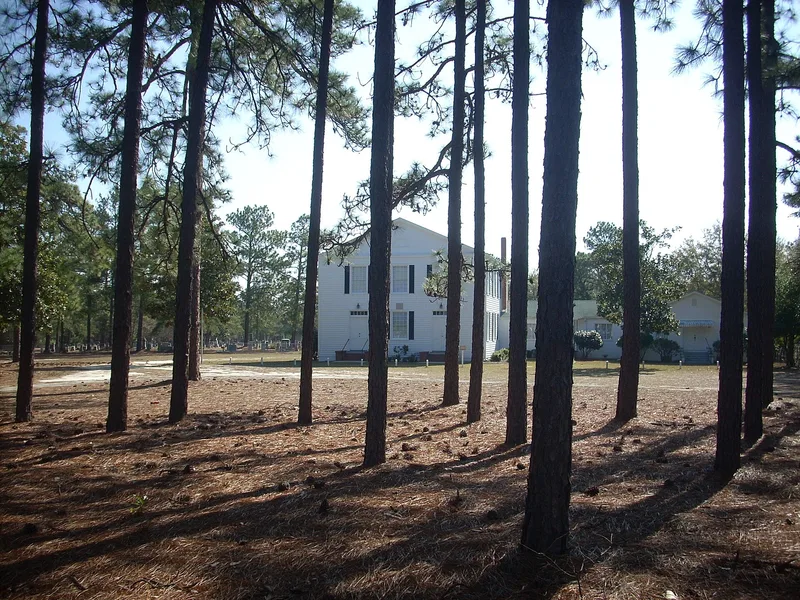

Why it's listed
Big Rockfish Presbyterian Church is a two-story frame building with a gable roof, a pedimented front and double front entrances, completed in 1855 near Hope Mills in Cumberland County. Carpenter John McDonald, an elder who had earlier led Sunday School meetings in the area, supervised its construction on a five-acre tract. The church grew from a congregation organized in December 1844 by the Fayetteville Presbytery, which drew members from the Rockfish mill community, an important antebellum textile concern. Its interior follows the traditional rural church plan, with a narthex, sanctuary and gallery supported by seven octagonal columns, and original double-curved pews still in place. The fanlight in the pediment is an earlier Federal feature, suggesting a stylistic holdover. The church is regarded as a representative example of rural church building in mid-century Cumberland County, and it also contains a nearby cemetery with graves of early members and later community residents.
Significance in brief: The nomination argues the church embodies the typical plan and construction of mid-nineteenth-century rural North Carolina churches and is one of five Cumberland County churches following these vernacular traditions. Its congregation grew out of antebellum Sunday Schools and revivals tied to the nearby Rockfish mill community, linking it to the area's early textile economy and Presbyterian life.
Machine-generated summary. This summary was generated by a language model from the official nomination document and has not been reviewed line by line by an editor. It may contain errors. Check the source document before relying on any detail. Source: nomination document (PDF) · National Archives catalog entry. NRHP reference 83001844, listed July 21, 1983. Summary generated October 2026 (model claude-haiku-5-5, prompt v1.1-2026-10-29, confidence high).
Key facts
| Address | SR 2268, Hope Mills |
|---|---|
| County | Cumberland County |
| Listed | July 21, 1983 |
| Reference number | 83001844 |
| Resource type | Building |
| Period of significance | 1855 |
| Architect / builder | John McDonald |
| Architectural style | Vernacular Greek Revival |
| Criteria |
|
| Areas of significance | Architecture |
| Level of significance | Local |
| Status (as stated in the nomination) | The church still houses a small but active congregation; a cinder block education wing was added in the early 1950s. |
| Acreage | 13.1 |
| Coordinates | 34.95185, -78.92386 (NPS GIS) |
What listing means for this property
Religious properties are listed for their architectural or historical significance, not their religious use. Listing is honorary and does not restrict the congregation's use of the building. The federal rehabilitation credit is generally unavailable unless part of the building is income-producing; some state programmes and preservation grants do cover religious buildings. Federal funding or permits trigger Section 106 review.
General information, not legal or tax advice. Rules change; confirm with your State Historic Preservation Office or a qualified adviser.
Sources and further reading
- National Park Service, National Register of Historic Places database (snapshot May 2026), reference 83001844.
- Nomination form (PDF, National Archives) — catalog entry
- Wikipedia article (used for cross-checking only; text not reproduced here)
- Wikidata Q4906233
- This listing as JSON
Last updated October 2026. Found an error? See the editorial policy for how to report it.