Cobb, John Franklin, House
Also known as: Cobb Plantation

Why it's listed
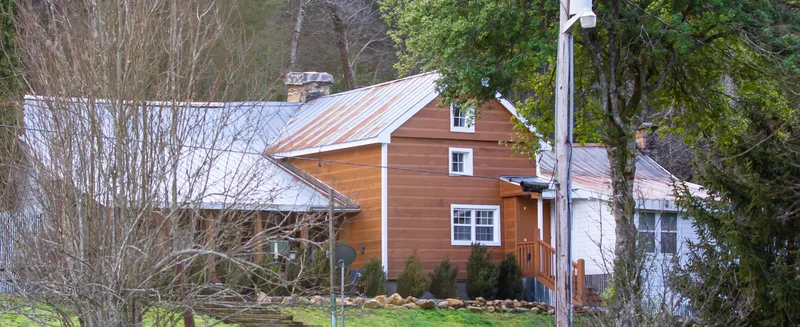
Near the Georgia line in southern Cherokee County, this farmhouse began as a one-room log cabin built by John Franklin Cobb in 1863. Cobb was a farmer and local magistrate. Over the next eight decades his family added a kitchen ell, extra bedrooms, a music room, a shed kitchen and a screened porch, all in frame and covered with weatherboard. The result is an informal, additive folk building. The nomination notes that it is one of only five or so surviving pre-1865 structures in the county. The house is also tied to baseball player Ty Cobb, John Cobb's grandson. As a teenager he spent summers here, where his grandparents encouraged his playing, and his aunt drove him by buggy to games in Murphy and Andrews. A stone-lined spring on the property holds a plaque placed in 1941 honoring him. The house stayed in the Cobb family until 1977.
Significance in brief: The nomination cites the house as the occasional childhood summer home of baseball great Ty Cobb, who gained his earliest baseball experience in nearby Murphy and Andrews. It also argues that the 1863 log cabin is typical of traditional southern Appalachian log dwellings and remains basically intact despite many additions. The house is one of only five or so surviving pre-1865 structures in the county.
Machine-generated summary. This summary was generated by a language model from the official nomination document and has not been reviewed line by line by an editor. It may contain errors. Check the source document before relying on any detail. Source: nomination document (PDF) · National Archives catalog entry. NRHP reference 84000074, listed October 11, 1984. Summary generated October 2026 (model claude-sonnet-5-5, prompt v1.0-2026-10-29, confidence high).
Key facts
| Address | U.S. 19-129, Bell View |
|---|---|
| County | Cherokee County |
| Listed | October 11, 1984 |
| Reference number | 84000074 |
| Resource type | Building |
| Period of significance | 1863 and later (specific dates given; 1800-1899 and 1900- checked) |
| Architect / builder | Unknown (built by John Franklin Cobb, per the description) |
| Architectural style | Folk building; log cabin core with additive frame construction |
| Criteria |
|
| Areas of significance | Entertainment/Recreation, Architecture |
| Level of significance | Local |
| Status (as stated in the nomination) | Occupied as a private residence, in good and basically sound condition, and carefully maintained by its owners. It was usually vacant for a period after 1959 before being sold in 1977. |
| Acreage | 5.9 |
| Coordinates | 35.00203, -84.08425 (NPS GIS) |
What listing means for this property
National Register listing is honorary for a privately owned home: it does not by itself restrict what an owner may do with their own money, and it does not require public access. Restrictions come from local landmark or historic-district ordinances, which are separate (how they differ).
Owner-occupied houses are not eligible for the 20% federal rehabilitation tax credit, which applies to income-producing buildings, but many states offer credits for homeowners. Listing also opens the door to preservation easements and to buying a plaque. Start with what listing means for homeowners, renovating a listed house and selling one.
General information, not legal or tax advice. Rules change; confirm with your State Historic Preservation Office or a qualified adviser.
Sources and further reading
- National Park Service, National Register of Historic Places database (snapshot May 2026), reference 84000074.
- Nomination form (PDF, National Archives) — catalog entry
- Wikipedia article (used for cross-checking only; text not reproduced here)
- Wikidata Q16988425
- This listing as JSON
Last updated October 2026. Found an error? See the editorial policy for how to report it.