Campbell, John C., Folk School Historic District

Why it's listed
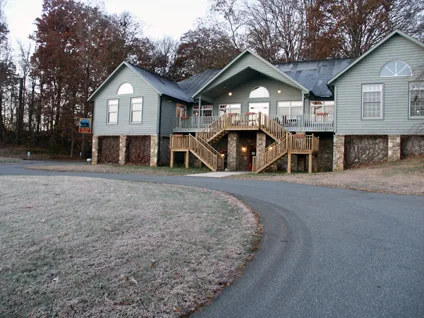
Set in the valley of Brasstown Creek along the Cherokee-Clay County line, this 366-acre campus is the home of the John C. Campbell Folk School, a working farm and school founded in 1925. Olive Dame Campbell and Marguerite Butler established it on the model of Scandinavian folk high schools, aiming to keep a contented farming population on the land and to build improvement on local folk culture. Local farmers donated land, cash, materials and labor. The oldest building is a turn-of-the-century farmhouse that served as the first classroom. Keith House, begun in 1926, became the main administrative and dormitory building. A Danish farm manager, Georg Bidstrup, and a Belgian engineer, Leon Deschamps, oversaw construction of half-timbered and stone barns, shops and houses with a distinct European character. Two nineteenth-century cabins were rebuilt in 1926 as a log house museum, possibly the first community effort in North Carolina to preserve rural vernacular architecture. The school still teaches folk arts today.
Significance in brief: The school, founded in 1925 by Olive Dame Campbell and Marguerite Butler, was a unique experiment in bringing the Scandinavian folk school model to Southern Appalachian rural life. Its farm, credit and craft cooperatives influenced the region. Its buildings combine European and American vernacular forms, shaped by Danish and Belgian staff Georg Bidstrup and Leon Deschamps.
Machine-generated summary. This summary was generated by a language model from the official nomination document and has not been reviewed line by line by an editor. It may contain errors. Check the source document before relying on any detail. Source: nomination document (PDF) · National Archives catalog entry. NRHP reference 83001839, listed August 22, 1983. Summary generated October 2026 (model claude-sonnet-5-5, prompt v1.0-2026-10-29, confidence high).
Key facts
| Address | Off US 64, Brasstown |
|---|---|
| County | Cherokee County |
| Listed | August 22, 1983 |
| Reference number | 83001839 |
| Resource type | District |
| Period of significance | 1925 to present |
| Architect / builder | Various; Georg Bidstrup and Leon Deschamps designed or supervised many buildings; Keith House design by Dorothy Bacon |
| Architectural style | Mix of European-influenced and American vernacular; Craftsman and Bungalow elements (Keith House) |
| Criteria |
|
| Areas of significance | Art, Economics, Conservation, Education, Architecture, Social History, Agriculture |
| Level of significance | National |
| Status (as stated in the nomination) | School remains in operation as a working farm and folk arts school; Log House Museum recently restored. |
| Acreage | 366 |
| Coordinates | 35.03623, -83.96511 (NPS GIS) |
What listing means for this property
This is a historic district. Buildings within its boundary are either contributing (they add to the district's significance) or non-contributing. Owners of contributing income-producing buildings can claim the 20% federal rehabilitation tax credit; homeowners should look at state credits. National Register districts impose no design review by themselves; a local historic district ordinance, if one exists, does (the difference explained).
General information, not legal or tax advice. Rules change; confirm with your State Historic Preservation Office or a qualified adviser.
Sources and further reading
- National Park Service, National Register of Historic Places database (snapshot May 2026), reference 83001839.
- Nomination form (PDF, National Archives) — catalog entry
- Wikipedia article (used for cross-checking only; text not reproduced here)
- Wikidata Q6224322
- This listing as JSON
Last updated October 2026. Found an error? See the editorial policy for how to report it.