Portsmouth Village
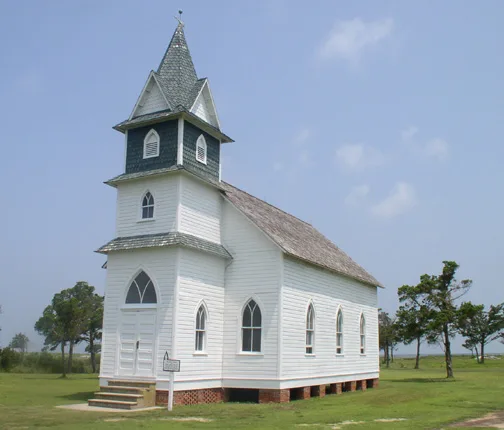

Why it's listed
Portsmouth Village occupies the northern end of Portsmouth Island on the Outer Banks of North Carolina, south of Ocracoke Inlet. The village was authorized by the colonial legislature in 1753, and by 1860 it had 109 dwellings and was a shipping point where vessels waited to cross the shallow bar of Ocracoke Inlet, with cargo carried across by lighters. Its population peaked around 1860, then declined sharply after Hatteras Inlet opened in 1846 and grew, drawing shipping away. Confederate troops were stationed there in 1861 before Federal forces found it nearly deserted. The district is significant as the only surviving village on the Core Banks. About 25 complexes of mostly late nineteenth and early twentieth century buildings remain, set among dunes and vegetation on narrow grassy lanes. The Methodist Church, rebuilt in 1901, is among the surviving structures.
Significance in brief: The nomination argues that Portsmouth is the only surviving village on the Core Banks and the remnant of a pre-Civil War port that reached its peak around 1860 as a trans-shipment point for cargo. Its informal layout of complexes on high ground connected by grassy lanes is described as characteristic of early coastal villages, and the district is said to retain a strong sense of place from about 1930.
Machine-generated summary. This summary was generated by a language model from the official nomination document and has not been reviewed line by line by an editor. It may contain errors. Check the source document before relying on any detail. Source: nomination document (PDF) · National Archives catalog entry. NRHP reference 78000267, listed November 29, 1978. Summary generated October 2026 (model claude-haiku-5-5, prompt v1.1-2026-10-29, confidence medium).
Key facts
| Address | N end of Portsmouth Island, Portsmouth |
|---|---|
| County | Carteret County |
| Listed | November 29, 1978 |
| Reference number | 78000267 |
| Resource type | District |
| Architectural style | Vernacular; bungaloid with additions; Coast Guard Building with elements of Stick style |
| Areas of significance | Commerce, Social History |
| Level of significance | State |
| Status (as stated in the nomination) | Most houses are used as vacation or weekend retreats under renewable 1-year special use permits; four complexes are life estates or long-term leases; several buildings have collapsed or are in ruins. |
| Acreage | 250 |
| Coordinates | 35.06405, -76.06330 (NPS GIS) |
What listing means for this property
This is a historic district. Buildings within its boundary are either contributing (they add to the district's significance) or non-contributing. Owners of contributing income-producing buildings can claim the 20% federal rehabilitation tax credit; homeowners should look at state credits. National Register districts impose no design review by themselves; a local historic district ordinance, if one exists, does (the difference explained).
General information, not legal or tax advice. Rules change; confirm with your State Historic Preservation Office or a qualified adviser.
Sources and further reading
- National Park Service, National Register of Historic Places database (snapshot May 2026), reference 78000267.
- Nomination form (PDF, National Archives) — catalog entry
- Wikipedia article (used for cross-checking only; text not reproduced here)
- Wikidata Q7232418
- This listing as JSON
Last updated October 2026. Found an error? See the editorial policy for how to report it.