Rocky River Presbyterian Church

Why it's listed
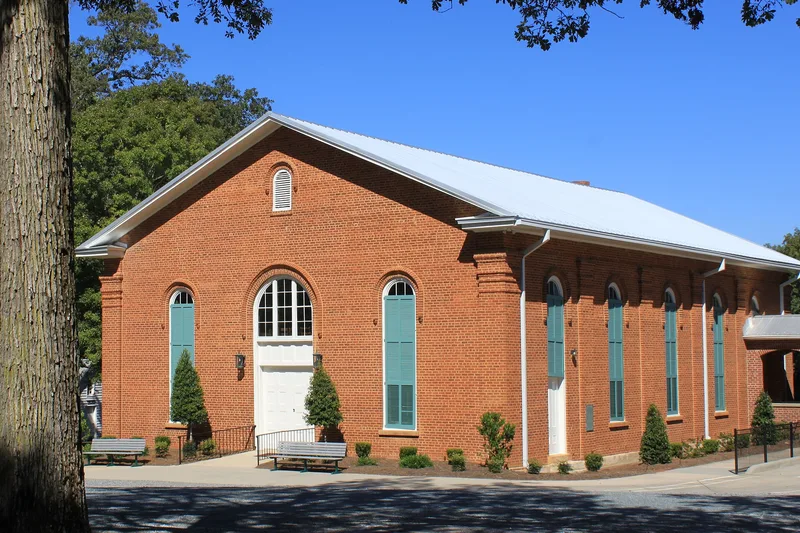
Set on a wooded hillside near Harrisburg in southwestern Cabarrus County, the brick Rocky River Presbyterian Church was completed in 1861 in a blend of Greek Revival and Italianate styles. Its brickwork is laid in a one-to-four common bond, and its horseshoe-arched windows and interior balcony survive largely intact. The congregation, organized by Scotch-Irish settlers by 1754, had a slave gallery in the original building. The district also includes an 1839 Session House, a cemetery dating to about 1814 holding the graves of early ministers and the Regulator-era figure William White, and a manse finished in 1873. The Kirkpatrick House, a two-storey farmhouse of Federal and Greek Revival character, was donated to the church and is linked to an early North Carolina use of X-ray diagnosis in the 1890s. Its importance lies in its architecture, its early religious history and its association with the Scotch-Irish settlement of the area.
Significance in brief: The nomination argues the district is significant as the surviving antebellum church of a Scotch-Irish Presbyterian congregation organized in the mid-eighteenth century, as the best preserved of many piedmont Presbyterian churches of the period, and for its Greco-Italianate architecture. It also cites the church's leading ministers, the cemetery's notable burials, and the Kirkpatrick House's association with an early medical X-ray use in North Carolina.
Machine-generated summary. This summary was generated by a language model from the official nomination document and has not been reviewed line by line by an editor. It may contain errors. Check the source document before relying on any detail. Source: nomination document (PDF) · National Archives catalog entry. NRHP reference 86000419, listed March 6, 1986. Summary generated October 2026 (model claude-haiku-5-5, prompt v1.1-2026-10-29, confidence medium).
Key facts
| Address | Jct. of NC 1139 and NC 1158, Rocky River |
|---|---|
| County | Cabarrus County |
| Listed | March 6, 1986 |
| Reference number | 86000419 |
| Resource type | Building |
| Period of significance | 1800-1899 |
| Architect / builder | J. Norman Pease (architect of the 1949 education building) |
| Architectural style | Greco-Italianate |
| Criteria |
|
| Areas of significance | Architecture, Religion |
| Level of significance | Local |
| Status (as stated in the nomination) | The Kirkpatrick House is described as empty and in desperate need of repairs. |
| Acreage | 43 |
| Coordinates | 35.29723, -80.59804 (NPS GIS) |
What listing means for this property
Religious properties are listed for their architectural or historical significance, not their religious use. Listing is honorary and does not restrict the congregation's use of the building. The federal rehabilitation credit is generally unavailable unless part of the building is income-producing; some state programmes and preservation grants do cover religious buildings. Federal funding or permits trigger Section 106 review.
Noted as vacant in the nomination. Nomination documents can be decades old; current status may differ. If you are considering buying an empty listed property, read the due-diligence checklist.
General information, not legal or tax advice. Rules change; confirm with your State Historic Preservation Office or a qualified adviser.
Sources and further reading
- National Park Service, National Register of Historic Places database (snapshot May 2026), reference 86000419.
- Nomination form (PDF, National Archives) — catalog entry
- Wikipedia article (used for cross-checking only; text not reproduced here)
- Wikidata Q7355995
- This listing as JSON
Last updated October 2026. Found an error? See the editorial policy for how to report it.