Mt. Horeb Presbyterian Church and Cemetery

Why it's listed
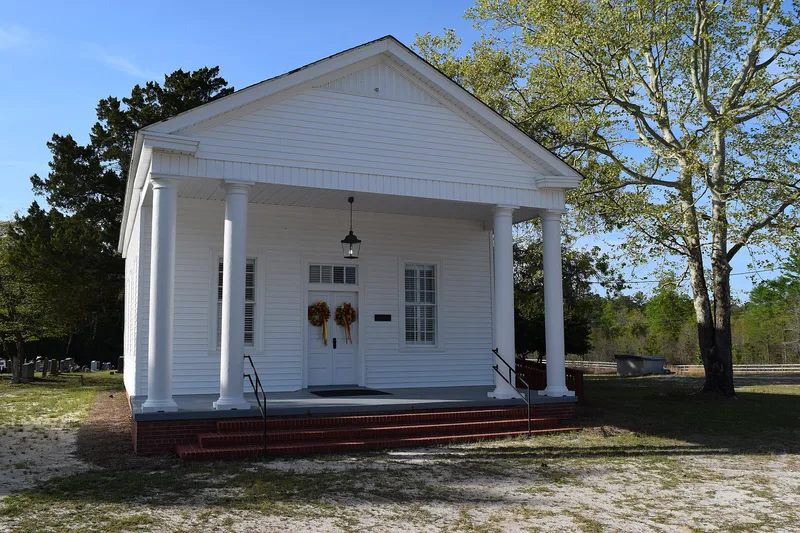
Mt. Horeb Presbyterian Church is a simple white frame sanctuary with a neighboring cemetery, set on a gentle rise beside NC 87 in rural Bladen County. Builder George Cromartie was hired in the summer of 1845 to erect it for a congregation organized through the missionary work of the Rev. H. A. Munroe, and the first service was held on December 6, 1845. The cost was only $400. Its modest Greek Revival finish remained unaltered until 1932, when a porch was added; a Sunday School wing and columns followed in the early 1950s. It is the second oldest surviving Presbyterian church in the county and one of a group of frame Greek Revival churches built by Highland Scot descendants in the upper Cape Fear Valley. The cemetery holds about 425 stones, including that of John Henry Wehmann, a German who died in 1849 and was the first person buried there. It also served as a community burying ground.
Significance in brief: It is the second oldest surviving Presbyterian church in Bladen County, after Brown Marsh Church, and the only building ever erected by its congregation. It is a modest Greek Revival frame church, one of a group built by Highland Scot descendants in the upper Cape Fear Valley in the mid-1800s. It is also tied to the spread of Presbyterianism in the region, and its cemetery served as a community burying ground.
Machine-generated summary. This summary was generated by a language model from the official nomination document and has not been reviewed line by line by an editor. It may contain errors. Check the source document before relying on any detail. Source: nomination document (PDF) · National Archives catalog entry. NRHP reference 87000695, listed May 13, 1987. Summary generated October 2026 (model claude-sonnet-5-5, prompt v1.0-2026-10-29, confidence high).
Key facts
| Address | SW corner of NC 87 and SR 1712 Jct., Elizabethtown |
|---|---|
| County | Bladen County |
| Listed | May 13, 1987 |
| Reference number | 87000695 |
| Resource type | Building |
| Period of significance | 1800-1899, 1900- (specific date 1845) |
| Architect / builder | George Cromartie (builder); Leslie Boney of Wilmington designed the 1952 Sunday School addition, built by Howard Johnson, Glenn Parker, and Kadell Peterson |
| Architectural style | Greek Revival |
| Criteria |
|
| Areas of significance | Architecture, Religion |
| Level of significance | Local |
| Status (as stated in the nomination) | Occupied and in use as a church; the congregation had 37 members in 1984, and the building's condition is listed as good and altered. |
| Acreage | 6 |
| Coordinates | 34.51638, -78.45034 (NPS GIS) |
What listing means for this property
Religious properties are listed for their architectural or historical significance, not their religious use. Listing is honorary and does not restrict the congregation's use of the building. The federal rehabilitation credit is generally unavailable unless part of the building is income-producing; some state programmes and preservation grants do cover religious buildings. Federal funding or permits trigger Section 106 review.
General information, not legal or tax advice. Rules change; confirm with your State Historic Preservation Office or a qualified adviser.
Sources and further reading
- National Park Service, National Register of Historic Places database (snapshot May 2026), reference 87000695.
- Nomination form (PDF, National Archives) — catalog entry
- Wikipedia article (used for cross-checking only; text not reproduced here)
- Wikidata Q14708065
- This listing as JSON
Last updated October 2026. Found an error? See the editorial policy for how to report it.