Brown Marsh Presbyterian Church

Why it's listed
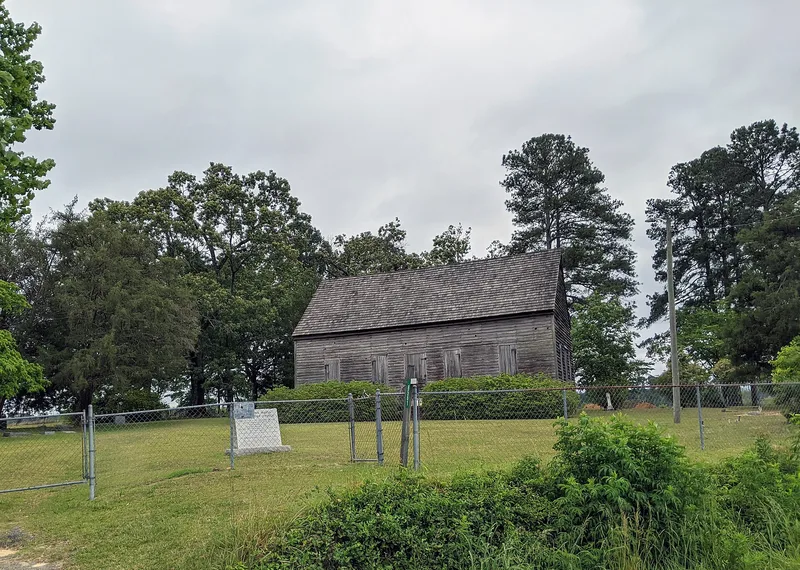
Brown Marsh Presbyterian Church is a small, weathered frame meeting house on a knoll above Brown Marsh Creek near Clarkton, in a grove of oak and cedar. Five bays wide and three deep, it has a gable roof of wooden shingles, unpainted siding, nine-over-nine windows with batten shutters, and a single large interior room with a high three-sided pulpit and a later gallery. A chalk inscription on the ceiling reads "Thos. Sheridan 1828" (or 1818), and the church was dedicated in December 1828. Scots immigrants who settled the Upper Cape Fear valley founded the congregation, which was active by 1795. Regular worship ended in 1871 when a new church was built nearer Clarkton, though some members stayed until 1873, and a newly formed congregation used the building from 1911 to 1949. It is the oldest church building in Bladen County, and about 200 gravestones surround it, the oldest dated 1786.
Significance in brief: It is the oldest church building in Bladen County and is thought to be the only surviving example of the simple, pre-Greek Revival churches built by the Scots Presbyterians who dominated the Upper Cape Fear region. Its cemetery holds many early grave markers, including a stone dated 1786. It is considered perhaps the chief early landmark of the area's Scots Presbyterian community.
Machine-generated summary. This summary was generated by a language model from the official nomination document and has not been reviewed line by line by an editor. It may contain errors. Check the source document before relying on any detail. Source: nomination document (PDF) · National Archives catalog entry. NRHP reference 75001239, listed September 2, 1975. Summary generated October 2026 (model claude-sonnet-5-5, prompt v1.0-2026-10-29, confidence high).
Key facts
| Address | N of Clarkton on SR 1700 off SR 1762, Clarkton |
|---|---|
| County | Bladen County |
| Listed | September 2, 1975 |
| Reference number | 75001239 |
| Resource type | Building |
| Period of significance | 1800-1899 |
| Architect / builder | Thomas Sheridan |
| Areas of significance | Religion |
| Level of significance | Local |
| Status (as stated in the nomination) | Building has remained vacant since 1949 but is preserved by the region's Presbyterians; condition listed as fair. |
| Acreage | 9 |
| Coordinates | 34.52602, -78.63827 (NPS GIS) |
What listing means for this property
Religious properties are listed for their architectural or historical significance, not their religious use. Listing is honorary and does not restrict the congregation's use of the building. The federal rehabilitation credit is generally unavailable unless part of the building is income-producing; some state programmes and preservation grants do cover religious buildings. Federal funding or permits trigger Section 106 review.
Noted as vacant in the nomination. Nomination documents can be decades old; current status may differ. If you are considering buying an empty listed property, read the due-diligence checklist.
General information, not legal or tax advice. Rules change; confirm with your State Historic Preservation Office or a qualified adviser.
Sources and further reading
- National Park Service, National Register of Historic Places database (snapshot May 2026), reference 75001239.
- Nomination form (PDF, National Archives) — catalog entry
- Wikipedia article (used for cross-checking only; text not reproduced here)
- Wikidata Q4976205
- This listing as JSON
Last updated October 2026. Found an error? See the editorial policy for how to report it.