Barrett-Faulkner House

Why it's listed
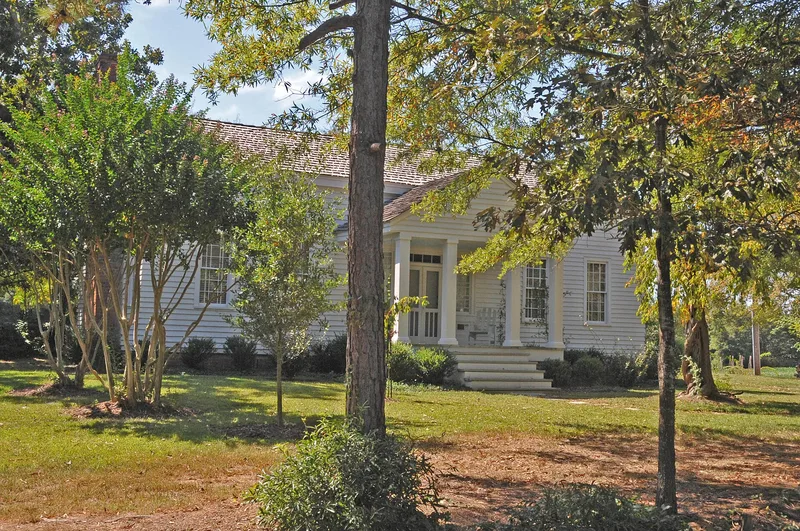
Set among farmland in southwestern Anson County, this one-and-one-half-story frame house combines a traditional dogtrot plan with Greek Revival styling. Family tradition holds that it was built in the early nineteenth century on land assembled by Dominic Barrett, then moved about 1,200 feet in 1847 by Armstrong and Margaret Barrett to face the Charlotte-Cheraw stage road, where they ran a small stagecoach stop. At that time it was remodeled with a gable-front porch with paneled piers, an entrance with sidelights and transom, and post-and-lintel mantels. The wide center hall sheathed in weatherboard points to its origin as a dogtrot house, the only one identified in the county. Later the Faulkner family farmed the land for generations, adding a west wing and outbuildings in the twentieth century. A restoration in 2010-2011 returned the porch to its 1847 design. The house is recognized for its architecture and for its relocation and remodeling.
Significance in brief: The house is a well-preserved local example of the Greek Revival style, one of a small group of surviving mid-nineteenth-century Greek Revival houses in Anson County. It is also the only dogtrot house identified in the county. It meets the criteria for moved properties because it has architectural significance both before and after its 1847 relocation.
Machine-generated summary. This summary was generated by a language model from the official nomination document and has not been reviewed line by line by an editor. It may contain errors. Check the source document before relying on any detail. Source: nomination document (PDF) · National Archives catalog entry. NRHP reference 12000601, listed September 4, 2012. Summary generated October 2026 (model claude-sonnet-5-5, prompt v1.0-2026-10-29, confidence high).
Key facts
| Address | 2063 Monroe-White Store Rd., Peachland |
|---|---|
| County | Anson County |
| Listed | September 4, 2012 |
| Reference number | 12000601 |
| Resource type | Building |
| Period of significance | Second quarter of the 19th century |
| Architectural style | Other: Dogtrot House; Mid-19th Century: Greek Revival |
| Criteria |
|
| Areas of significance | Architecture |
| Level of significance | Local |
| Status (as stated in the nomination) | Described as vacant in recent decades but remaining in the Faulkner family; restored 2010-2011 and currently used as a single dwelling. |
| Acreage | 5.3 |
| Coordinates | 34.90507, -80.30692 (NPS GIS) |
What listing means for this property
National Register listing is honorary for a privately owned home: it does not by itself restrict what an owner may do with their own money, and it does not require public access. Restrictions come from local landmark or historic-district ordinances, which are separate (how they differ).
Owner-occupied houses are not eligible for the 20% federal rehabilitation tax credit, which applies to income-producing buildings, but many states offer credits for homeowners. Listing also opens the door to preservation easements and to buying a plaque. Start with what listing means for homeowners, renovating a listed house and selling one.
General information, not legal or tax advice. Rules change; confirm with your State Historic Preservation Office or a qualified adviser.
Sources and further reading
- National Park Service, National Register of Historic Places database (snapshot May 2026), reference 12000601.
- Nomination form (PDF, National Archives) — catalog entry
- Wikipedia article (used for cross-checking only; text not reproduced here)
- Wikidata Q17515091
- This listing as JSON
Last updated October 2026. Found an error? See the editorial policy for how to report it.