Johnston Hall

Why it's listed
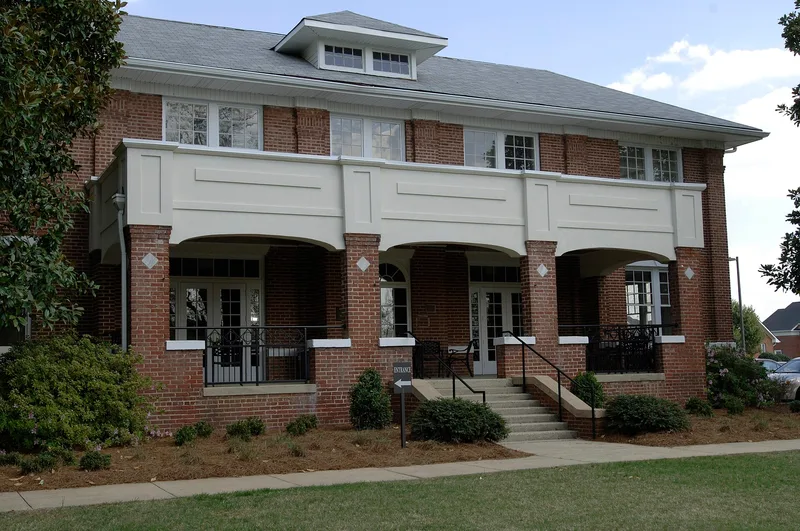
Built in 1925 in red brick on the campus of the Christian Orphanage at Elon College, Johnston Hall was constructed by John H. Wood of Burlington, the low bidder, at a cost of about $30,000, with indoor plumbing. It was named for Charles D. Johnston, the orphanage superintendent from 1916 to 1949, and dedicated in 1928. Originally its first floor held administrative offices, a library, and kitchen and dining rooms, while children slept on the second floor. Its H-shaped plan includes a hip-roofed main block and a sleeping porch used as a summer dormitory. The building is regarded as the sole survivor of the orphanage's second building campaign of the 1920s, when the original 1906 main building was supplemented. It is significant for its association with the institution's care of children orphaned in the decades after the Civil War. The building remains the anchor of the campus, which continues residential child care today.
Significance in brief: The nomination argues the building is locally significant as a reflection of church-based concern for orphaned children in North Carolina in the late nineteenth and early twentieth centuries. It is the sole surviving structure from the orphanage's second building campaign of the 1920s, and it was the center of a complex surrounded by a working farm until World War II.
Machine-generated summary. This summary was generated by a language model from the official nomination document and has not been reviewed line by line by an editor. It may contain errors. Check the source document before relying on any detail. Source: nomination document (PDF) · National Archives catalog entry. NRHP reference 94000130, listed March 7, 1994. Summary generated October 2026 (model claude-haiku-5-5, prompt v1.1-2026-10-29, confidence medium).
Key facts
| Address | 103 Antioch St., Elon College |
|---|---|
| County | Alamance County |
| Listed | March 7, 1994 |
| Reference number | 94000130 |
| Resource type | Building |
| Period of significance | 1925 |
| Architect / builder | John H. Wood, contractor |
| Architectural style | Classical Revival |
| Criteria |
|
| Areas of significance | Social History |
| Level of significance | Local |
| Status (as stated in the nomination) | Used today for administrative offices, a reception center and staff training classes; partially restored. |
| Acreage | 1 |
| Coordinates | 36.10031, -79.50006 (NPS GIS) |
What listing means for this property
National Register listing is honorary for a privately owned home: it does not by itself restrict what an owner may do with their own money, and it does not require public access. Restrictions come from local landmark or historic-district ordinances, which are separate (how they differ).
Owner-occupied houses are not eligible for the 20% federal rehabilitation tax credit, which applies to income-producing buildings, but many states offer credits for homeowners. Listing also opens the door to preservation easements and to buying a plaque. Start with what listing means for homeowners, renovating a listed house and selling one.
General information, not legal or tax advice. Rules change; confirm with your State Historic Preservation Office or a qualified adviser.
Sources and further reading
- National Park Service, National Register of Historic Places database (snapshot May 2026), reference 94000130.
- Nomination form (PDF, National Archives) — catalog entry
- Wikipedia article (used for cross-checking only; text not reproduced here)
- Wikidata Q14708000
- This listing as JSON
Last updated October 2026. Found an error? See the editorial policy for how to report it.