Jay, John, Homestead
Also known as: Bedford House

The pin is a point inside the NPS boundary polygon, not a surveyed location.
Why it's listed
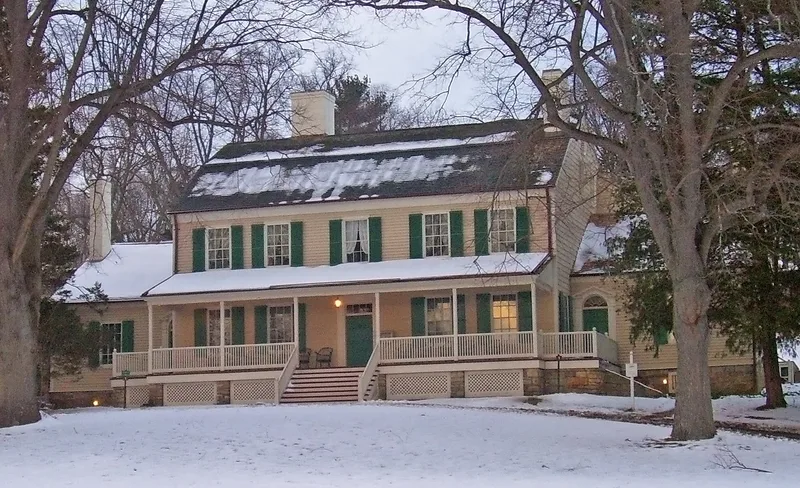
Set near one of the highest points in Westchester County, this farmhouse and its surrounding farm buildings in Katonah were developed by John Jay, the first Chief Justice of the United States. Jay inherited an estate of about 1000 acres and authorized a small farmhouse in 1787. After retiring as New York's governor in 1801, he oversaw its expansion into a larger home, with further additions in 1818. The five-bay, two-story wood-frame central block has recessed one-story wings, and its design was kept deliberately simple to suit the American countryside. Jay's descendants occupied the house until 1959, so later additions and furnishings were kept alongside areas restored to his period. Original doors, some mantels, and some of Jay's furniture and paintings survive. Outbuildings include an overseer's brick cottage from 1799, a laundry, carriage barn, and sheep barn. The State of New York now owns the property and operates it as a museum.
Significance in brief: The nomination presents the homestead as a landmark of the ideals and contributions of John Jay, first Chief Justice of the United States. It is also valued because Jay's descendants lived there continuously until 1959, so the house reflects the changing tastes of a prominent American family.
Machine-generated summary. This summary was generated by a language model from the official nomination document and has not been reviewed line by line by an editor. It may contain errors. Check the source document before relying on any detail. Source: nomination document (PDF) · National Archives catalog entry. NRHP reference 72000918, listed July 24, 1972. Summary generated October 2026 (model claude-sonnet-5-5, prompt v1.0-2026-10-29, confidence high).
Key facts
| Address | Jay St., Katonah |
|---|---|
| County | Westchester County |
| Listed | July 24, 1972 |
| Reference number | 72000918 |
| Resource type | Building |
| Period of significance | 18th Century (specific dates 1787, 1800-02, 1818, 1904, 1923-24) |
| Architect / builder | John Jay (designed the house) |
| Architectural style | Federal period, combining New England and Hudson Valley elements |
| Areas of significance | Politics/Government |
| Level of significance | National |
| National Historic Landmark | Yes, designated May 29, 1981 |
| Status (as stated in the nomination) | Owned by the State of New York and open to the public as a museum; portions restored to the period of John Jay's residence. |
| Acreage | 58.9 |
| Coordinates | 41.25042, -73.65892 (NPS GIS) |
What listing means for this property
National Register listing is honorary for a privately owned home: it does not by itself restrict what an owner may do with their own money, and it does not require public access. Restrictions come from local landmark or historic-district ordinances, which are separate (how they differ).
Owner-occupied houses are not eligible for the 20% federal rehabilitation tax credit, which applies to income-producing buildings, but many states offer credits for homeowners. Listing also opens the door to preservation easements and to buying a plaque. Start with what listing means for homeowners, renovating a listed house and selling one.
General information, not legal or tax advice. Rules change; confirm with your State Historic Preservation Office or a qualified adviser.
Sources and further reading
- National Park Service, National Register of Historic Places database (snapshot May 2026), reference 72000918.
- Nomination form (PDF, National Archives) — catalog entry
- Wikipedia article (used for cross-checking only; text not reproduced here)
- Wikidata Q6241707
- This listing as JSON
Last updated October 2026. Found an error? See the editorial policy for how to report it.