Bedford Village Historic District

Why it's listed
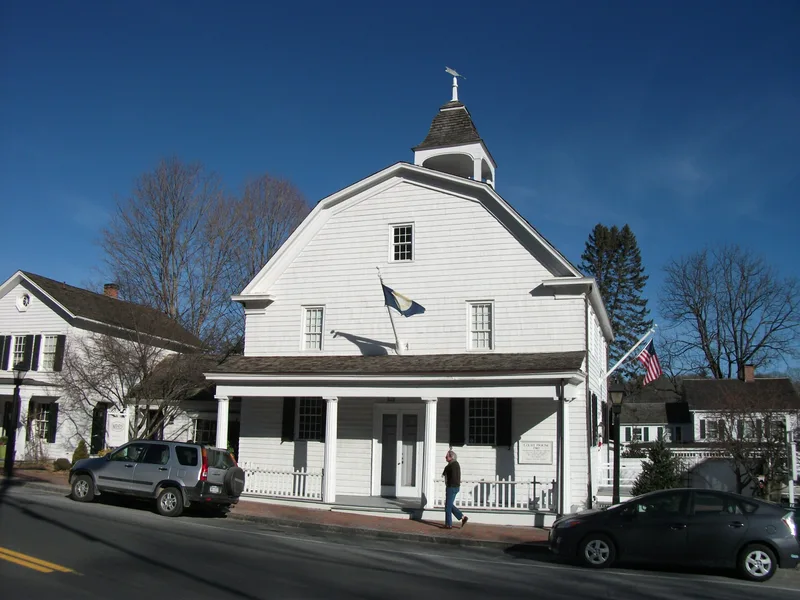
Bedford Village Historic District is an 89-acre area in Westchester County, New York, near the Connecticut border. It preserves the core of a hamlet founded in 1680 by settlers from Connecticut and laid out in the New England village green pattern, with a town common, a village street and house plots for twenty-two proprietors. The green, the Old Burying Ground and the meadow near the school still survive from that plan. Around them stand mostly wood frame buildings from the late 1700s to the 1870s, including the 1787 Court House, Historical Hall (1806), the Library (1807), the stone School House (1829), the Post Office (c. 1838) and the Gothic Revival Presbyterian Church (1872). Bedford served as a county seat until 1870 and was burned by the British in 1779. The railroad was built to the west in the 1840s, and county government left in 1870, so new construction slowed and the village's character endured.
Significance in brief: The district kept its original village green and the vernacular architecture around it, even as much of Westchester County was modernized. It shows Bedford's growth from the late 18th to the third quarter of the 19th century, when the village was a political hub and the economic center of a farming region. It was a county seat until 1870, and the railroad was built to the west, which diverted later development away from the village center.
Machine-generated summary. This summary was generated by a language model from the official nomination document and has not been reviewed line by line by an editor. It may contain errors. Check the source document before relying on any detail. Source: nomination document (PDF) · National Archives catalog entry. NRHP reference 73001285, listed October 2, 1973. Summary generated October 2026 (model claude-sonnet-5-5, prompt v1.0-2026-10-29, confidence high).
Key facts
| Address | Roughly bounded by Court, Seminary, Poundridge and Greenwich Rds., Bedford |
|---|---|
| County | Westchester County |
| Listed | October 2, 1973 |
| Reference number | 73001285 |
| Resource type | District |
| Period of significance | 18th and 19th centuries (late 18th through third quarter of the 19th century) |
| Architectural style | Vernacular architecture, with Greek Revival and Gothic Revival examples; mostly wood frame |
| Areas of significance | Architecture |
| Level of significance | Local |
| Status (as stated in the nomination) | Condition is marked excellent and good, with preservation work in progress. Uses include museum, commercial, educational, religious, park, private residence and graveyard. The Court House was restored in 1965-1970 and is a museum. |
| Acreage | 89 |
| Coordinates | 41.20617, -73.63948 (NPS GIS) |
What listing means for this property
This is a historic district. Buildings within its boundary are either contributing (they add to the district's significance) or non-contributing. Owners of contributing income-producing buildings can claim the 20% federal rehabilitation tax credit; homeowners should look at state credits. National Register districts impose no design review by themselves; a local historic district ordinance, if one exists, does (the difference explained).
General information, not legal or tax advice. Rules change; confirm with your State Historic Preservation Office or a qualified adviser.
Sources and further reading
- National Park Service, National Register of Historic Places database (snapshot May 2026), reference 73001285.
- Nomination form (PDF, National Archives) — catalog entry
- Wikipedia article (used for cross-checking only; text not reproduced here)
- Wikidata Q4879212
- This listing as JSON
Last updated October 2026. Found an error? See the editorial policy for how to report it.