Gates Hall and Pultneyville Public Square

Why it's listed
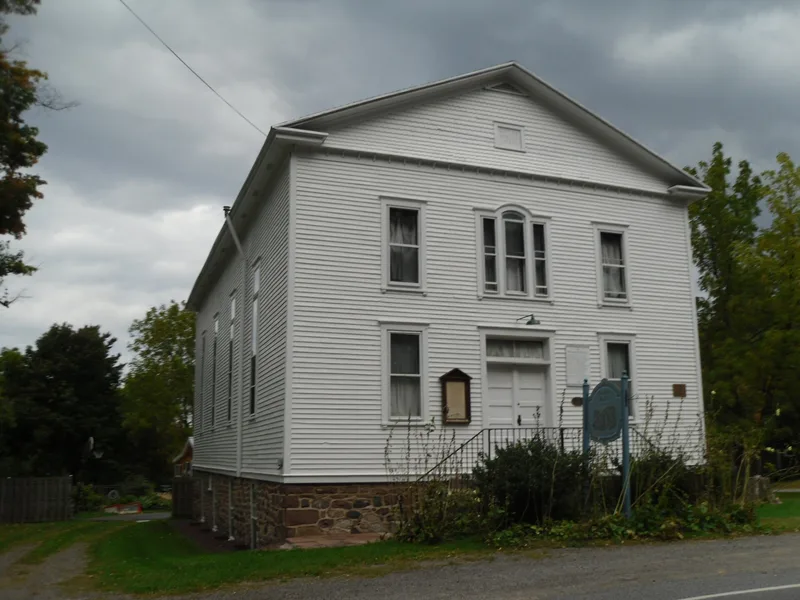
Gates Hall is a two-story, gable-roofed timber-frame building on Lake Road in Pultneyville, a lakeside hamlet in Wayne County, New York. It began in 1826 as Union Church, an ecumenical meeting house shared by Methodist, Presbyterian and Episcopal congregations. As the congregations drifted away, the building became a community hall, and from 1867 it hosted local theatrical troupes. In 1894 it was raised onto a full basement, extended north to hold a fully equipped stage, and given Queen Anne shingle work, a bracketed cornice and a tripartite window. Mary Gates paid more than half of the cost, and the hall took her name. The auditorium's wainscoting, chair rails and plaster walls survive from that period. The building has changed little since 1921 and is still used for performances. Also included is the Pultneyville Public Square, an open grassy lot of about one acre long owned by the hall's stewards and used for passive recreation.
Significance in brief: The nomination argues that Gates Hall is a remarkably intact civic building that served as the social, political and cultural center of Pultneyville, and has hosted local theatrical productions since 1867. It is also presented as an outstanding example of vernacular Queen Anne public architecture in Wayne County. The Public Square is significant as green space held in trust for the community.
Machine-generated summary. This summary was generated by a language model from the official nomination document and has not been reviewed line by line by an editor. It may contain errors. Check the source document before relying on any detail. Source: nomination document (PDF) · National Archives catalog entry. NRHP reference 00000177, listed March 3, 2000. Summary generated October 2026 (model claude-sonnet-5-5, prompt v1.0-2026-10-29, confidence high).
Key facts
| Address | Lake Rd., Pultneyville |
|---|---|
| County | Wayne County |
| Listed | March 3, 2000 |
| Reference number | 00000177 |
| Resource type | Building |
| Period of significance | 1826-1921 |
| Architect / builder | Andrew and Ansel Cornwall |
| Architectural style | Mid-19th Century: Greek Revival; Late 19th Century: Queen Anne |
| Criteria |
|
| Areas of significance | Performing Arts, Social History, Architecture |
| Level of significance | Local |
| Status (as stated in the nomination) | Still in use as a theater and community venue; the building remains essentially as it was in 1921, apart from routine maintenance. |
| Acreage | 2 |
| Coordinates | 43.27999, -77.18664 (NPS GIS) |
What listing means for this property
National Register listing is honorary for a privately owned home: it does not by itself restrict what an owner may do with their own money, and it does not require public access. Restrictions come from local landmark or historic-district ordinances, which are separate (how they differ).
Owner-occupied houses are not eligible for the 20% federal rehabilitation tax credit, which applies to income-producing buildings, but many states offer credits for homeowners. Listing also opens the door to preservation easements and to buying a plaque. Start with what listing means for homeowners, renovating a listed house and selling one.
General information, not legal or tax advice. Rules change; confirm with your State Historic Preservation Office or a qualified adviser.
Sources and further reading
- National Park Service, National Register of Historic Places database (snapshot May 2026), reference 00000177.
- Nomination form (PDF, National Archives) — catalog entry
- Wikipedia article (used for cross-checking only; text not reproduced here)
- Wikidata Q5527106
- This listing as JSON
Last updated October 2026. Found an error? See the editorial policy for how to report it.