Easton Friends North Meetinghouse

Why it's listed
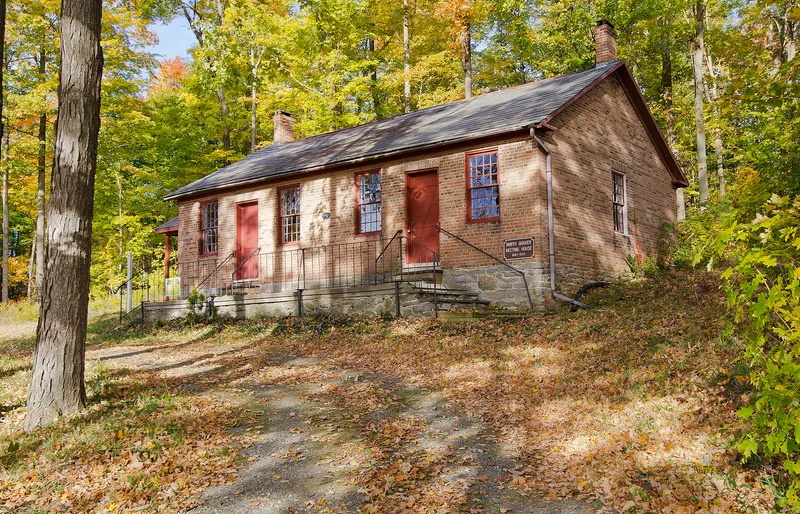
Set on a wooded hillside on the east side of Route 40 in the Town of Easton, this brick meetinghouse was built in 1838 for Quakers in the northern part of town who found the trip to the South Meetinghouse too far. Its walls are red brick laid on a limestone foundation, with twin entrance doors on the west front and twelve-over-twelve windows. Inside, two square rooms divided by a plank partition allowed men and women to sit separately, and woodstoves and movable benches remain. The plain, symmetrical design reflects Quaker ideals of simplicity. Tradition holds that the brick was made on a nearby farm. The building also matters for its role in the antebellum anti-slavery movement. Local Friends held Anti-Slavery Society meetings here until 1863, and speakers included Susan B. Anthony, Lucretia Mott and Sojourner Truth. Its rural setting, with long views toward the Catskills, remains largely intact.
Significance in brief: The nomination argues that the building is a largely intact example of vernacular Quaker meetinghouse design, marked by simplicity and symmetry. It also highlights the role of Washington County Quakers in the Abolitionist movement, since anti-slavery meetings were held here, including one in 1857 led by Susan B. Anthony. Lucretia Mott and Sojourner Truth are also said to have spoken here.
Machine-generated summary. This summary was generated by a language model from the official nomination document and has not been reviewed line by line by an editor. It may contain errors. Check the source document before relying on any detail. Source: nomination document (PDF) · National Archives catalog entry. NRHP reference 05001132, listed October 5, 2005. Summary generated October 2026 (model claude-sonnet-5-5, prompt v1.0-2026-10-29, confidence high).
Key facts
| Address | NY 40, Schaghticoke-Middle Falls Rd., Middle Falls |
|---|---|
| County | Washington County |
| Listed | October 5, 2005 |
| Reference number | 05001132 |
| Resource type | Building |
| Period of significance | 1838-1863 |
| Architect / builder | Local builders (names not given) |
| Architectural style | Vernacular |
| Criteria |
|
| Areas of significance | Architecture, Social History |
| Level of significance | State |
| Status (as stated in the nomination) | Still used as a religious facility; the form describes it as substantially intact, with a roof shoring alteration after slate replaced the original wood shake roof. |
| Acreage | 0.9 |
| Coordinates | 43.05697, -73.53410 (NPS GIS) |
What listing means for this property
Religious properties are listed for their architectural or historical significance, not their religious use. Listing is honorary and does not restrict the congregation's use of the building. The federal rehabilitation credit is generally unavailable unless part of the building is income-producing; some state programmes and preservation grants do cover religious buildings. Federal funding or permits trigger Section 106 review.
General information, not legal or tax advice. Rules change; confirm with your State Historic Preservation Office or a qualified adviser.
Sources and further reading
- National Park Service, National Register of Historic Places database (snapshot May 2026), reference 05001132.
- Nomination form (PDF, National Archives) — catalog entry
- Wikipedia article (used for cross-checking only; text not reproduced here)
- Wikidata Q5330845
- This listing as JSON
Last updated October 2026. Found an error? See the editorial policy for how to report it.