Terwilliger-Smith Farm

Why it's listed
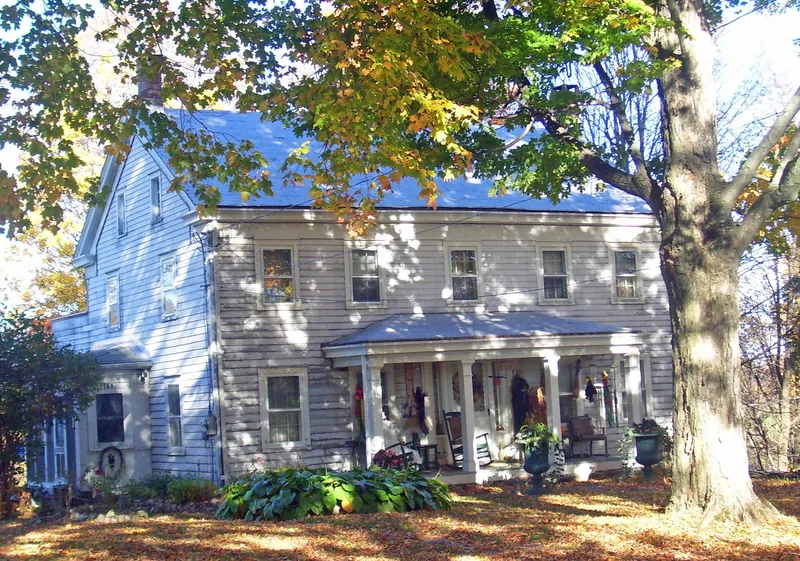
Set on a hill above the Mombaccus Creek valley, this 27-acre farm on Cherrytown Road in Rochester, Ulster County, preserves a nearly complete working farmstead. Thirteen contributing buildings are grouped around a horseshoe driveway: a two-story, five-bay Greek Revival timber-frame house and a range of specialized outbuildings. Nine buildings date from the mid-19th century, including the smokehouse, privy, slaughterhouse, swine house, hoop shop, granary, chicken house and tool shed. Four date from the early 20th century: a gambrel-roofed barn built in 1933 after a fire, plus an ice house, milk house and garage. James Terwilliger bought the farm in 1850, and Friend Smith acquired it in 1919 and modernized it for dairying. The property was listed because it shows the shift from subsistence farming to specialized dairy production. Its slaughterhouse is described as especially rare locally, and its hoop shop recalls the barrel and hoop trade that supplied Hudson Valley industries.
Significance in brief: The nomination argues the farm is a rare surviving complete farmstead in Ulster County. It shows two phases of agriculture: 19th-century subsistence farming and early 20th-century specialized dairying. It also retains uncommon outbuildings such as a slaughterhouse, hoop shop and smokehouse, and the house keeps a high degree of integrity.
Machine-generated summary. This summary was generated by a language model from the official nomination document and has not been reviewed line by line by an editor. It may contain errors. Check the source document before relying on any detail. Source: nomination document (PDF) · National Archives catalog entry. NRHP reference 02001658, listed December 31, 2002. Summary generated October 2026 (model claude-sonnet-5-5, prompt v1.0-2026-10-29, confidence high).
Key facts
| Address | 160 Cherrytown Rd., Rochester |
|---|---|
| County | Ulster County |
| Listed | December 31, 2002 |
| Reference number | 02001658 |
| Resource type | Building |
| Period of significance | ca.1830-ca.1933 |
| Architectural style | Mid-19th Century / Greek Revival |
| Criteria |
|
| Areas of significance | Architecture, Agriculture |
| Level of significance | Local |
| Status (as stated in the nomination) | Historic and current uses are both given as single-family dwelling and agricultural, including processing, storage, fields, animal facilities and outbuildings. |
| Acreage | 28 |
| Coordinates | 41.79621, -74.31745 (NPS GIS) |
What listing means for this property
National Register listing is honorary for a privately owned home: it does not by itself restrict what an owner may do with their own money, and it does not require public access. Restrictions come from local landmark or historic-district ordinances, which are separate (how they differ).
Owner-occupied houses are not eligible for the 20% federal rehabilitation tax credit, which applies to income-producing buildings, but many states offer credits for homeowners. Listing also opens the door to preservation easements and to buying a plaque. Start with what listing means for homeowners, renovating a listed house and selling one.
General information, not legal or tax advice. Rules change; confirm with your State Historic Preservation Office or a qualified adviser.
Sources and further reading
- National Park Service, National Register of Historic Places database (snapshot May 2026), reference 02001658.
- Nomination form (PDF, National Archives) — catalog entry
- Wikipedia article (used for cross-checking only; text not reproduced here)
- Wikidata Q7705373
- This listing as JSON
Last updated October 2026. Found an error? See the editorial policy for how to report it.