National Youth Administration Woodstock Resident Work Center

Why it's listed
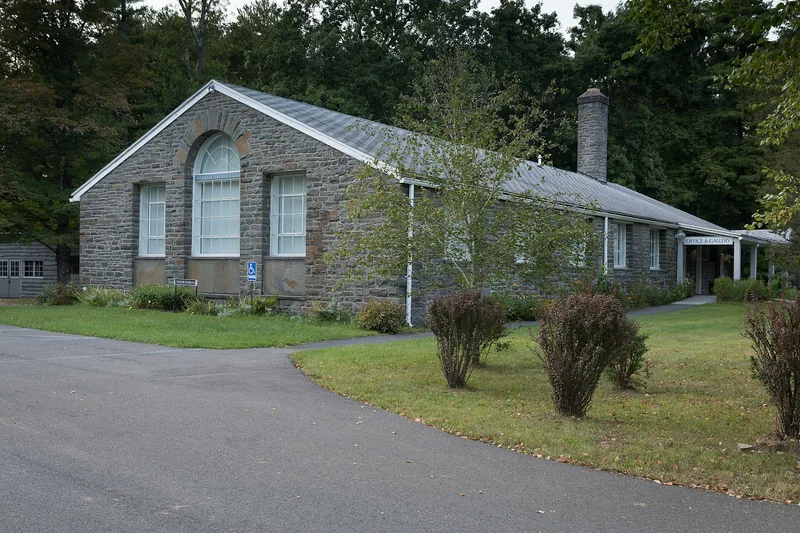
Set in a forest clearing along Route 212 east of Woodstock village, this small campus was built around 1939 as a National Youth Administration resident work center. Young people trained in metalwork, woodworking, stone carving, pottery, wool processing and weaving until the center closed about 1942, when the United States entered World War II. Students helped construct the long, low buildings of local bluestone, wood and brick, using rustic clapboard with irregular wavy edges that echoed the Woodstock art colony's studio style. A carved octagonal stone flagpole base, attributed to the influence of sculptor Thomas Penning, shows the camp's crafts, farming and sports in relief. Eleanor Roosevelt followed the center closely and attended the cornerstone setting in 1939. An earlier barn and a gazebo are also part of the group. The Woodstock School of Art still uses the buildings as studios, so they remain close to their original appearance and function.
Significance in brief: The camp is significant for its link to New Deal work-relief and education programs and to the Woodstock art colony. It is also significant for its surviving buildings, constructed and decorated by the students in the local rustic arts-and-crafts manner. Eleanor Roosevelt took a personal interest in the center, and a record of correspondence survives.
Machine-generated summary. This summary was generated by a language model from the official nomination document and has not been reviewed line by line by an editor. It may contain errors. Check the source document before relying on any detail. Source: nomination document (PDF) · National Archives catalog entry. NRHP reference 92000455, listed April 30, 1992. Summary generated October 2026 (model claude-sonnet-5-5, prompt v1.0-2026-10-29, confidence high).
Key facts
| Address | NY 212 N side, E of Woodstock, Woodstock |
|---|---|
| County | Ulster County |
| Listed | April 30, 1992 |
| Reference number | 92000455 |
| Resource type | District |
| Period of significance | 1939-c1942 |
| Architectural style | No style (local rustic vernacular) |
| Criteria |
|
| Areas of significance | Art, Education, Architecture, Social History |
| Level of significance | Local |
| Status (as stated in the nomination) | The buildings are still used as studios by the Woodstock School of Art and retain outstanding integrity. |
| Acreage | 5 |
| Coordinates | 42.04044, -74.09368 (NPS GIS) |
What listing means for this property
This is a historic district. Buildings within its boundary are either contributing (they add to the district's significance) or non-contributing. Owners of contributing income-producing buildings can claim the 20% federal rehabilitation tax credit; homeowners should look at state credits. National Register districts impose no design review by themselves; a local historic district ordinance, if one exists, does (the difference explained).
General information, not legal or tax advice. Rules change; confirm with your State Historic Preservation Office or a qualified adviser.
Sources and further reading
- National Park Service, National Register of Historic Places database (snapshot May 2026), reference 92000455.
- Nomination form (PDF, National Archives) — catalog entry
- Wikipedia article (used for cross-checking only; text not reproduced here)
- Wikidata Q6979475
- This listing as JSON
Last updated October 2026. Found an error? See the editorial policy for how to report it.