United Workers Cooperatives
Also known as: Allerton Coops; Coops

Why it's listed
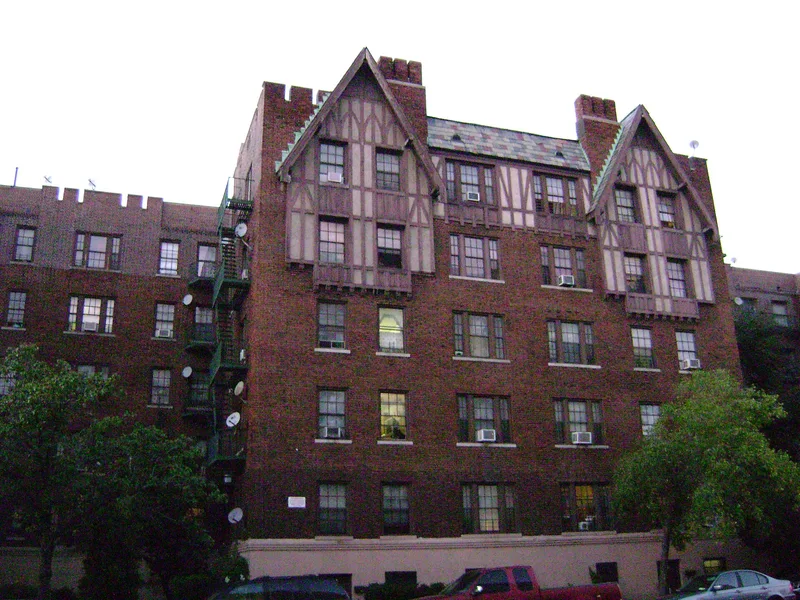
Two linked apartment complexes on Bronx Park East, facing the edge of Bronx Park, were built from 1926 to 1929 by the United Workers Cooperative Association to house roughly seven hundred working families. Members, mostly Yiddish-speaking Jewish immigrants in the needle trades, wanted to build, own and manage their own homes without philanthropy or speculators. The first complex, in a Neo-Tudor style with half-timbered gables, wraps around a landscaped court and carries entrance ornament such as a hammer and sickle and smoking factories. The second, designed by Herman Jessor, uses expressive geometric brickwork showing Dutch Expressionist influence. Apartments were arranged for light, air and privacy, with many separate stair entrances. Raised basements held a nursery, kindergarten, Yiddish schools, libraries, a gym and meeting rooms. At completion this was the largest cooperative housing complex in America and the first in the Bronx, and its success encouraged further cooperative projects in the borough.
Significance in brief: The complexes are significant in architectural and social history as an early large-scale, non-profit cooperative housing venture for working people. When completed, they were the largest cooperative housing complex in America and the first cooperative housing in the Bronx. They were built and run by Communist-inclined, mostly Yiddish-speaking Jewish needle trades workers and influenced later cooperatives in the Bronx.
Machine-generated summary. This summary was generated by a language model from the official nomination document and has not been reviewed line by line by an editor. It may contain errors. Check the source document before relying on any detail. Source: nomination document (PDF) · National Archives catalog entry. NRHP reference 86002518, listed September 11, 1986. Summary generated October 2026 (model claude-sonnet-5-5, prompt v1.0-2026-10-29, confidence high).
Key facts
| Address | 2700--2870 Bronx Park E, New York |
|---|---|
| County | The Bronx |
| Listed | September 11, 1986 |
| Reference number | 86002518 |
| Resource type | Building |
| Period of significance | 1926-29 |
| Architect / builder | Springsteen & Goldhammer and Herman Jessor |
| Architectural style | Neo-Tudor (first complex); Dutch Expressionistic influence (second complex) |
| Areas of significance | Architecture, Social History |
| Level of significance | Local |
| Status (as stated in the nomination) | Occupied private residences; the buildings retain a high degree of integrity on exterior and interior, though some original doors in the second group are deteriorated or damaged. |
| Acreage | 5.4 |
| Coordinates | 40.86659, -73.86922 (NPS GIS) |
What listing means for this property
National Register listing is honorary: it recognises significance and does not restrict what a private owner may do without federal money or permits. It unlocks the 20% federal rehabilitation tax credit for income-producing buildings, state credits in many states, and Section 106 review when federal agencies are involved. See what listing means in practice.
General information, not legal or tax advice. Rules change; confirm with your State Historic Preservation Office or a qualified adviser.
Sources and further reading
- National Park Service, National Register of Historic Places database (snapshot May 2026), reference 86002518.
- Nomination form (PDF, National Archives) — catalog entry
- Wikipedia article (used for cross-checking only; text not reproduced here)
- Wikidata Q7893657
- This listing as JSON
Last updated October 2026. Found an error? See the editorial policy for how to report it.