Pollock, Jackson, House and Studio
Also known as: Krasner-Pollock House and Study Center

Why it's listed
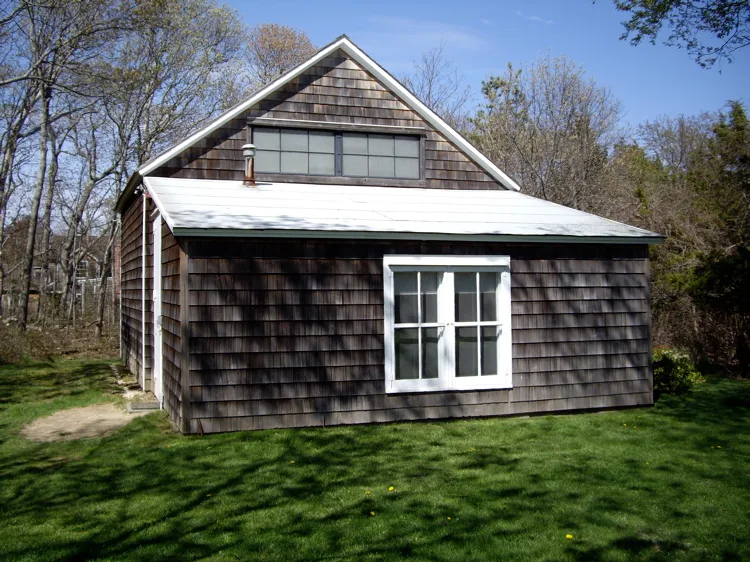
This 1.5-acre property on Fireplace Road in the Springs, East Hampton, centers on an 1879 shingled farmhouse and a wooden barn. The house is L-shaped with a few restrained Queen Anne touches, including a full-width front porch, a bay window and roof finials. The barn was once used to store fishing gear. In 1945 the artists Jackson Pollock and Lee Krasner bought the unimproved property. Pollock first painted in an upstairs bedroom, where he made his first canvas on the floor, and moved his studio to the barn in 1946. Krasner worked upstairs until 1957 and then took over the barn. The couple added heat and plumbing in 1949 and opened up the downstairs rooms, but otherwise kept the house modest. The property is valued as the place where Pollock developed his pouring technique and where Krasner became a significant artist. Because it passed intact from Krasner's estate, its furnishings and library remain in place, and it now serves as a museum and research center.
Significance in brief: The house and barn were the home and workplace of artists Jackson Pollock and Lee Krasner from 1945 to 1984. The form calls it the greatest single site associated with the birth of Abstract Expressionism, because Pollock developed his pouring technique and mature works there. Krasner also emerged as a major artist there, and the intact property now serves scholars of the New York School.
Machine-generated summary. This summary was generated by a language model from the official nomination document and has not been reviewed line by line by an editor. It may contain errors. Check the source document before relying on any detail. Source: nomination document (PDF) · National Archives catalog entry. NRHP reference 94001193, listed April 19, 1994. Summary generated October 2026 (model claude-sonnet-5-5, prompt v1.0-2026-10-29, confidence medium).
Key facts
| Address | 830 Fireplace Rd., East Hampton |
|---|---|
| County | Suffolk County |
| Listed | April 19, 1994 |
| Reference number | 94001193 |
| Resource type | Building |
| Architectural style | Late Victorian; L-shaped farmhouse with Queen Anne elements |
| Areas of significance | Art |
| Level of significance | National |
| National Historic Landmark | Yes, designated April 19, 1994 |
| Status (as stated in the nomination) | Operated as a museum and research center, with the house and barn preserved much as Krasner left them and only security and structural repairs made. |
| Acreage | 1.6 |
| Coordinates | 41.02388, -72.15469 (NPS GIS) |
What listing means for this property
National Register listing is honorary for a privately owned home: it does not by itself restrict what an owner may do with their own money, and it does not require public access. Restrictions come from local landmark or historic-district ordinances, which are separate (how they differ).
Owner-occupied houses are not eligible for the 20% federal rehabilitation tax credit, which applies to income-producing buildings, but many states offer credits for homeowners. Listing also opens the door to preservation easements and to buying a plaque. Start with what listing means for homeowners, renovating a listed house and selling one.
General information, not legal or tax advice. Rules change; confirm with your State Historic Preservation Office or a qualified adviser.
Sources and further reading
- National Park Service, National Register of Historic Places database (snapshot May 2026), reference 94001193.
- Nomination form (PDF, National Archives) — catalog entry
- Wikipedia article (used for cross-checking only; text not reproduced here)
- Wikidata Q3907611
- This listing as JSON
Last updated October 2026. Found an error? See the editorial policy for how to report it.