Bute-Warner-Truax Farm

Why it's listed
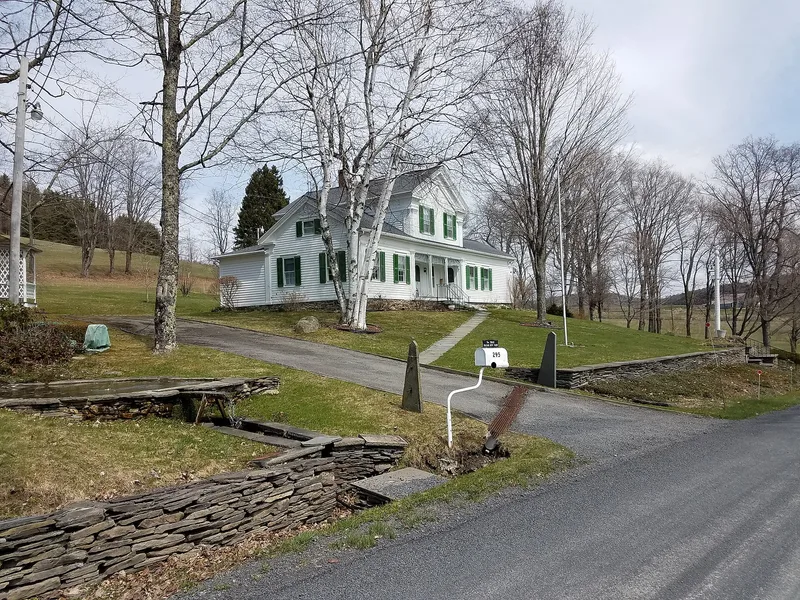
Two miles north of Charlotteville, in the western foothills of the Catskills, a 103-acre farm has kept its original boundaries since Jedediah Bute bought the land in 1853. The centerpiece is a frame Greek Revival farmhouse of about 1853-1855, with a pedimented two-story center block, flanking single-story wings, a recessed porch and a continuous entablature. Other contributing features include a nineteenth-century family burial plot, a fieldstone retaining wall, and an early twentieth-century milk house, garage and fire pond. Later owners included the Warner family, among them Civil War veteran and author George H. Warner, and then the Truax family, who ran the farm as a dairy through 1966. A mid-nineteenth-century barn moved here in 1982 replaced one lost to fire and is counted as non-contributing. Open pastures, hayfields and an apple orchard still survive. The farm is valued as an unusually intact small farmstead of the region, with continuous use since 1853.
Significance in brief: The farm is presented as a rare, intact example of the small diversified farmsteads once typical of southwestern Schoharie County. It keeps its original 103 acres and many buildings and landscape features, and it has been farmed continuously since 1853. Its vernacular Greek Revival farmhouse is described as an unusual regional variation.
Machine-generated summary. This summary was generated by a language model from the official nomination document and has not been reviewed line by line by an editor. It may contain errors. Check the source document before relying on any detail. Source: nomination document (PDF) · National Archives catalog entry. NRHP reference 85001611, listed July 25, 1985. Summary generated October 2026 (model claude-sonnet-5-5, prompt v1.0-2026-10-29, confidence high).
Key facts
| Address | Truax Rd., Charlotteville |
|---|---|
| County | Schoharie County |
| Listed | July 25, 1985 |
| Reference number | 85001611 |
| Resource type | District |
| Period of significance | 1853-1932 |
| Architectural style | Greek Revival (vernacular) |
| Areas of significance | Exploration/Settlement, Architecture |
| Level of significance | Local |
| Status (as stated in the nomination) | Still a working farm; the form reports hay, corn and pasture in production and describes the integrity as excellent. The original barn burned in 1981 and was replaced in 1982 by a moved mid-nineteenth-century barn, counted as non-contributing. |
| Acreage | 103 |
| Coordinates | 42.57211, -74.65657 (NPS GIS) |
What listing means for this property
This is a historic district. Buildings within its boundary are either contributing (they add to the district's significance) or non-contributing. Owners of contributing income-producing buildings can claim the 20% federal rehabilitation tax credit; homeowners should look at state credits. National Register districts impose no design review by themselves; a local historic district ordinance, if one exists, does (the difference explained).
General information, not legal or tax advice. Rules change; confirm with your State Historic Preservation Office or a qualified adviser.
Sources and further reading
- National Park Service, National Register of Historic Places database (snapshot May 2026), reference 85001611.
- Nomination form (PDF, National Archives) — catalog entry
- Wikipedia article (used for cross-checking only; text not reproduced here)
- Wikidata Q5002474
- This listing as JSON
Last updated October 2026. Found an error? See the editorial policy for how to report it.