Stockade Historic District
Also known as: See Also:Stockade Historic District (Boundary Increase)

Why it's listed
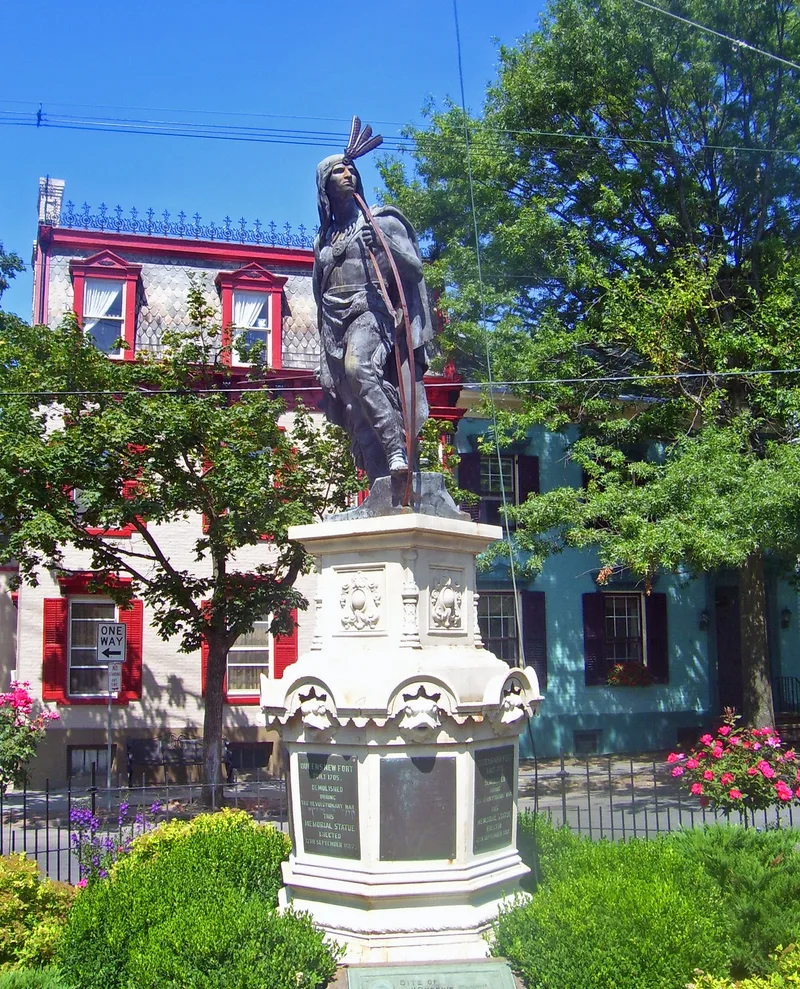
Schenectady's Stockade district is a village within a city: a wedge of downtown land between the Mohawk River, the Binne Kill and the railroad tracks. Settled by the Dutch in 1664 and burned by the French in 1690, it later served as the port where goods and travellers from Albany shifted to boats heading up the Mohawk. A fire in 1819 and the opening of the Erie Canal moved merchants to State Street, which helped save the older buildings. Today the district holds Dutch colonial houses, Federal and Greek Revival brick dwellings, Victorian-era alterations, 1890s railroad flats, churches, an old court house and 1920s Colonial Revival buildings, along with the stone abutment of Theodore Burr's bridge. Union College began here in 1795. In the 1950s residents began renovating decayed properties, and in 1962 the city adopted the first historic district zoning law in New York State.
Significance in brief: The district has been continuously inhabited for over three hundred years and shows every phase of that history in its street patterns, dense building stock and range of architectural styles. It was the early Dutch village and a transshipment point on the westward route to the Mohawk. In 1962 it became the subject of the first historic district zoning ordinance in New York State, and private renovation kept it from decay and demolition.
Machine-generated summary. This summary was generated by a language model from the official nomination document and has not been reviewed line by line by an editor. It may contain errors. Check the source document before relying on any detail. Source: nomination document (PDF) · National Archives catalog entry. NRHP reference 73001267, listed April 3, 1973. Summary generated October 2026 (model claude-sonnet-5-5, prompt v1.0-2026-10-29, confidence medium).
Key facts
| Address | Roughly bounded by Mohawk River, RR tracks, and Union St., Schenectady |
|---|---|
| County | Schenectady County |
| Listed | April 3, 1973 |
| Reference number | 73001267 |
| Resource type | District |
| Architect / builder | Samuel Fuller, "master builder of the Mohawk" (built several pre-1800 buildings); Theodore Burr (designer of the wooden suspension bridge); Phillip Hooker (Union College architect) |
| Architectural style | Wide mix: Dutch colonial, Georgian-influenced British style, Federal, Greek Revival, Italianate, Romanesque, Gothic Revival and Colonial Revival |
| Areas of significance | Commerce, Historic - Non-Aboriginal, Education, Architecture |
| Level of significance | State |
| Status (as stated in the nomination) | Condition marked excellent and good; partly altered, partly unaltered. Occupied, with mixed residential, commercial, religious, educational and government uses. Protected by a 1962 historic zoning ordinance. |
| Acreage | 82 |
| Coordinates | 42.81873, -73.94609 (NPS GIS) |
What listing means for this property
This is a historic district. Buildings within its boundary are either contributing (they add to the district's significance) or non-contributing. Owners of contributing income-producing buildings can claim the 20% federal rehabilitation tax credit; homeowners should look at state credits. National Register districts impose no design review by themselves; a local historic district ordinance, if one exists, does (the difference explained).
General information, not legal or tax advice. Rules change; confirm with your State Historic Preservation Office or a qualified adviser.
Sources and further reading
- National Park Service, National Register of Historic Places database (snapshot May 2026), reference 73001267.
- Nomination form (PDF, National Archives) — catalog entry
- Wikipedia article (used for cross-checking only; text not reproduced here)
- Wikidata Q7617933
- This listing as JSON
Last updated October 2026. Found an error? See the editorial policy for how to report it.