Saratoga Gas, Electric Light and Power Company Complex

Why it's listed
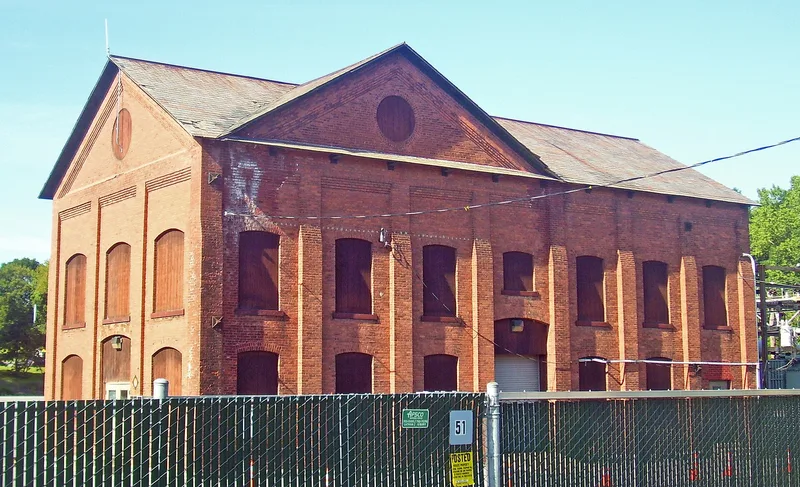
Two brick buildings and buried industrial remains survive from a utility complex on Excelsior Avenue at the northern edge of Saratoga Springs. The Saratoga Gas Light Company bought the low-lying site beside Village Brook in 1873 and began making gas from coal in 1874. The surviving gasholder house is a round brick building 70 feet across, with 18-inch walls, six buttresses and a slate conical roof. It sank into a deep layer of clay that sealed the water pit for the gas cylinder. Only 13 such buildings are known to remain in the northeast. A two-story brick substation, built in 1903, recalls the plant's later role in generating and distributing electricity. Archeological studies carried out from 1990 revealed foundations of other gas holders and showed that the site was chosen for its clay, water and rail access. The property is recognized for industry, architecture and archeology between 1873 and 1928.
Significance in brief: It is argued to be significant under Criteria A, C and D as the surviving remains of Saratoga's main utility power production and distribution facility from 1874 to 1928. The gasholder house is one of only 13 extant gasholder buildings in the northeast. The substation is the last building from the site's electric power use. Subsurface remains have yielded and may yield information on coal gasification and the engineering of gasholder siting.
Machine-generated summary. This summary was generated by a language model from the official nomination document and has not been reviewed line by line by an editor. It may contain errors. Check the source document before relying on any detail. Source: nomination document (PDF) · National Archives catalog entry. NRHP reference 00000579, listed May 1, 2001. Summary generated October 2026 (model claude-sonnet-5-5, prompt v1.0-2026-10-29, confidence medium).
Key facts
| Address | Excelsior Ave., Saratoga Springs |
|---|---|
| County | Saratoga County |
| Listed | May 1, 2001 |
| Reference number | 00000579 |
| Resource type | Building |
| Period of significance | 1873-1928 |
| Architectural style | No style |
| Criteria |
|
| Areas of significance | Industry, Architecture, Historic - Non-Aboriginal |
| Level of significance | Local |
| Status (as stated in the nomination) | Current function is listed as vacant/not in use. The gasholder house was later converted to storage and garage use, and its gasometer was removed. Modern electrical transformers and switching equipment stand nearby. |
| Acreage | 7 |
| Coordinates | 43.09061, -73.77479 (NPS GIS) |
What listing means for this property
For an income-producing building, listing (individually or as a contributing building in a district) is the gateway to the 20% federal rehabilitation tax credit on qualified rehabilitation costs, often stackable with state credits. Work claiming the credit must follow the Secretary of the Interior's Standards and be approved in advance.
Listing does not restrict a private owner acting without federal money or permits; where federal funding or licensing is involved, Section 106 review applies.
Noted as vacant in the nomination. Nomination documents can be decades old; current status may differ. If you are considering buying an empty listed property, read the due-diligence checklist.
General information, not legal or tax advice. Rules change; confirm with your State Historic Preservation Office or a qualified adviser.
Sources and further reading
- National Park Service, National Register of Historic Places database (snapshot May 2026), reference 00000579.
- Nomination form (PDF, National Archives) — catalog entry
- Wikipedia article (used for cross-checking only; text not reproduced here)
- Wikidata Q7423361
- This listing as JSON
Last updated October 2026. Found an error? See the editorial policy for how to report it.