Round Lake Historic District

Why it's listed
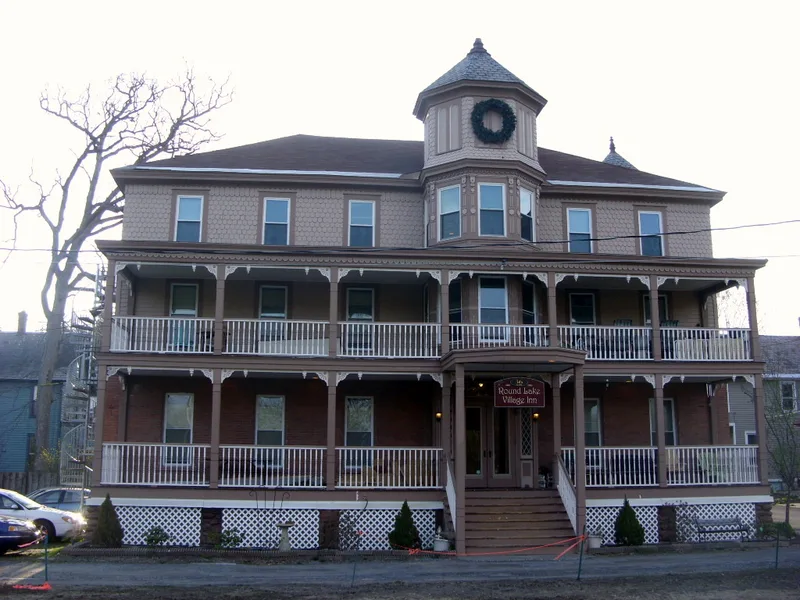
Round Lake is a village of closely spaced wooden cottages on a knoll beside Round Lake in Malta, Saratoga County. It began as a Methodist camp meeting ground, laid out on a wheel plan by Troy civil engineer H. Drube, with streets radiating from a central hub. At that hub stands a 2,000-seat auditorium built in 1884 on the site of the tabernacle tent, with a Stick Style bell tower. Its annex holds a Ferris organ, built about 1847-48 and moved from a New York City church in 1888. Most houses are modest cottages with gingerbread trim, ornate porches and bargeboards. Sixteen camp meetings took place between 1869 and 1877, including a national meeting that drew nearly 20,000 people, and President Grant visited in 1874. Temperance gatherings followed in 1878 and 1880. Later the camp became a summer cultural center, then a year-round community, incorporated as a village in 1968. Tall trees and open parks remain.
Significance in brief: The village is a remarkably homogeneous collection of late 19th century wooden cottages with Gothic-inspired "gingerbread" trim, built within a short span around a central auditorium. It also has historical importance as a major Methodist camp meeting site that hosted large gatherings, a visit by President Grant in 1874, and temperance meetings. Its auditorium houses a historic Ferris organ.
Machine-generated summary. This summary was generated by a language model from the official nomination document and has not been reviewed line by line by an editor. It may contain errors. Check the source document before relying on any detail. Source: nomination document (PDF) · National Archives catalog entry. NRHP reference 75001225, listed April 24, 1975. Summary generated October 2026 (model claude-sonnet-5-5, prompt v1.0-2026-10-29, confidence medium).
Key facts
| Address | U.S. 9, Round Lake and |
|---|---|
| County | Saratoga County |
| Listed | April 24, 1975 |
| Reference number | 75001225 |
| Resource type | District |
| Period of significance | 1800-1899 |
| Architectural style | Late 19th century picturesque Gothic cottages with "gingerbread" trim; Stick Style bell tower on the auditorium |
| Areas of significance | Community Planning and Development, Historic - Non-Aboriginal, Architecture, Religion, Philosophy |
| Level of significance | National |
| Status (as stated in the nomination) | Condition is marked excellent, good, fair and deteriorated, and the district is occupied. Most cottages were converted to year-round use. Some unsympathetic alterations are noted, and the future of the large auditorium is a concern. |
| Acreage | 200 |
| Coordinates | 42.93677, -73.79385 (NPS GIS) |
What listing means for this property
This is a historic district. Buildings within its boundary are either contributing (they add to the district's significance) or non-contributing. Owners of contributing income-producing buildings can claim the 20% federal rehabilitation tax credit; homeowners should look at state credits. National Register districts impose no design review by themselves; a local historic district ordinance, if one exists, does (the difference explained).
General information, not legal or tax advice. Rules change; confirm with your State Historic Preservation Office or a qualified adviser.
Sources and further reading
- National Park Service, National Register of Historic Places database (snapshot May 2026), reference 75001225.
- Nomination form (PDF, National Archives) — catalog entry
- Wikidata Q115951180
- This listing as JSON
Last updated October 2026. Found an error? See the editorial policy for how to report it.