Broadway Historic District
Also known as: See Also:Broadway Historic District (Boundary Increase); Broa

Why it's listed
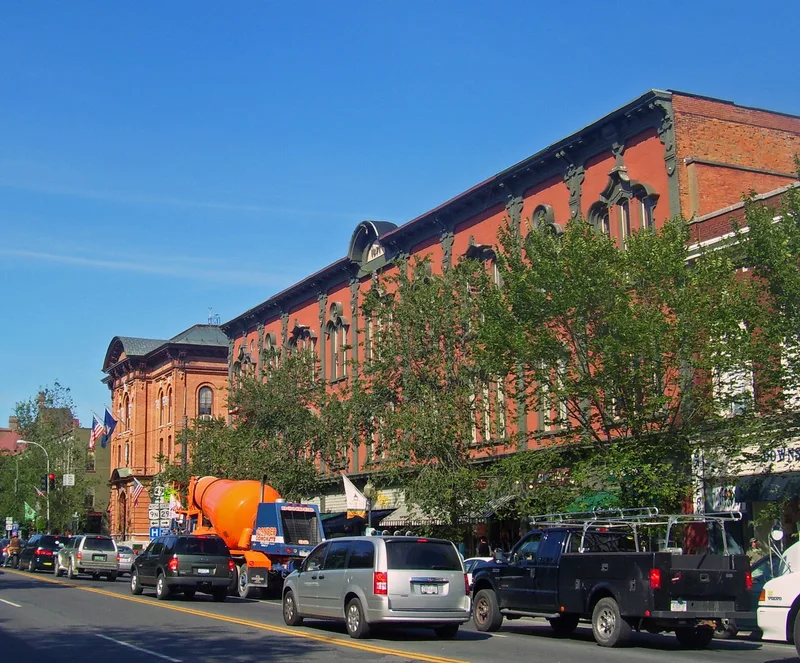
Broadway Historic District follows the main street of Saratoga Springs for about a mile, from the old business district north into the Town of Greenfield. Roughly 116 buildings are included along Broadway, Washington Street and Rock Street. The first four blocks hold two- and three-story brick commercial blocks, public buildings, hotels, apartment buildings and boarding houses, mostly from the late nineteenth-century heyday of the resort. Near the center, the street becomes a residential boulevard of large Italianate, Queen Anne and Colonial Revival houses on landscaped grounds, with carriage houses on side avenues. Notable buildings include the Adelphi Hotel, the Algonquin apartment building, City Hall of 1871, the 1910 Post Office and the Beaux Arts Adirondack Trust bank. A block of Washington Street adds three churches, and High Rock Spring and the Bryan House mark the earliest chapter of the town's history as a mineral-spring health spa. Modern buildings built after 1950s and 1960s fires intrude in places.
Significance in brief: The district preserves the late nineteenth-century commercial core and the grand residential North Broadway of Saratoga's heyday as a resort. It also includes High Rock Spring and the Bryan House, important sites in the early history of Saratoga Springs, and three churches visually tied to lower Broadway.
Machine-generated summary. This summary was generated by a language model from the official nomination document and has not been reviewed line by line by an editor. It may contain errors. Check the source document before relying on any detail. Source: nomination document (PDF) · National Archives catalog entry. NRHP reference 79001627, listed September 12, 1979. Summary generated October 2026 (model claude-sonnet-5-5, prompt v1.0-2026-10-29, confidence medium).
Key facts
| Address | Broadway, Washington and Rock Sts., Saratoga Springs |
|---|---|
| County | Saratoga County |
| Listed | September 12, 1979 |
| Reference number | 79001627 |
| Resource type | District |
| Architect / builder | Richard Upjohn (Bethesda Episcopal Church); James Knox Taylor (Post Office); Cummings and Burt of Troy (City Hall); Alfred Hopkins (Adirondack Trust Co., Reverey Gardens) |
| Architectural style | Mixed Victorian and revival styles including Italianate, Queen Anne, Romanesque, Colonial Revival, Greek Revival, Gothic Revival and Beaux Arts |
| Areas of significance | Architecture |
| Level of significance | State |
| Status (as stated in the nomination) | Mostly occupied; the form notes 13 modern intrusions in the business area and five on North Broadway, and a 1933 gas station at 522 Broadway is expected to be moved. |
| Acreage | 73 |
| Coordinates | 43.08048, -73.78749 (NPS GIS) |
What listing means for this property
This is a historic district. Buildings within its boundary are either contributing (they add to the district's significance) or non-contributing. Owners of contributing income-producing buildings can claim the 20% federal rehabilitation tax credit; homeowners should look at state credits. National Register districts impose no design review by themselves; a local historic district ordinance, if one exists, does (the difference explained).
General information, not legal or tax advice. Rules change; confirm with your State Historic Preservation Office or a qualified adviser.
Sources and further reading
- National Park Service, National Register of Historic Places database (snapshot May 2026), reference 79001627.
- Nomination form (PDF, National Archives) — catalog entry
- Wikipedia article (used for cross-checking only; text not reproduced here)
- Wikidata Q4972456
- This listing as JSON
Last updated October 2026. Found an error? See the editorial policy for how to report it.