River Street Historic District

Why it's listed
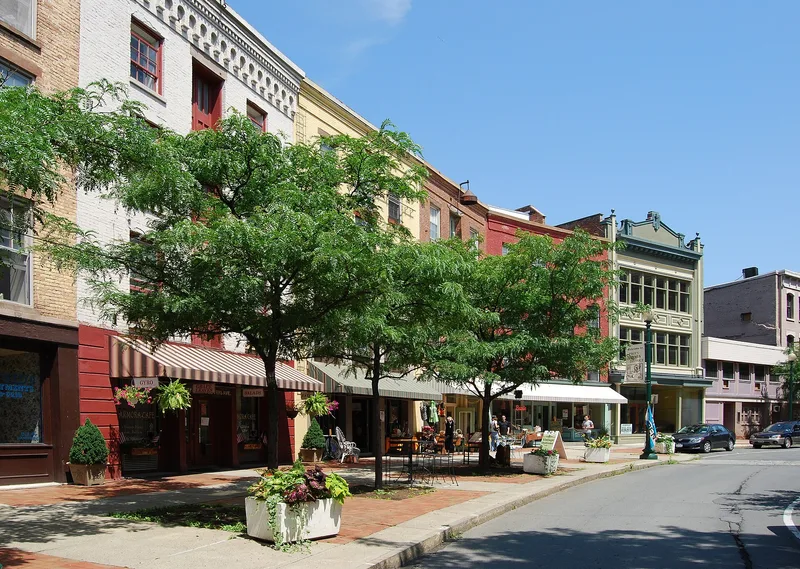
River Street in Troy, New York, runs along the east bank of the Hudson River, and its blocks between Congress and First Streets hold a collection of 19th-century warehouses and stores. Every standing building dates from after a fire in June 1820 swept through the city's core. Many have four-story street fronts and six-story river elevations, because builders used the bluff to add floors below street level. Surviving details include Flemish bond brick walls, cast iron storefronts, deep brick cornices, and a Richardson-influenced brick building of 1888 at the corner of Congress Street. The street was Troy's main commercial artery, where merchants handled grain, flour, lumber and leather goods bound downriver, and later sold stoves and other local manufactures. Steamboat offices, newspapers and a hotel also operated here. The district is recognized for its architecture and for its link to the city's commercial growth.
Significance in brief: The buildings reflect Troy's rise as a Hudson River trading center and later as an industrial city whose products were widely known. The district also shows a distinctive building method in which warehouses cut into the river bluff stand four stories on the street side and six on the river side. It contains notable examples of early 19th-century and late 19th-century commercial architecture.
Machine-generated summary. This summary was generated by a language model from the official nomination document and has not been reviewed line by line by an editor. It may contain errors. Check the source document before relying on any detail. Source: nomination document (PDF) · National Archives catalog entry. NRHP reference 76001268, listed June 3, 1976. Summary generated October 2026 (model claude-sonnet-5-5, prompt v1.0-2026-10-29, confidence medium).
Key facts
| Address | Both sides of River St. from Congress St. to jct. with 1st St., Troy |
|---|---|
| County | Rensselaer County |
| Listed | June 3, 1976 |
| Reference number | 76001268 |
| Resource type | District |
| Areas of significance | Industry, Commerce, Architecture |
| Level of significance | Local |
| Status (as stated in the nomination) | Form lists the district as both occupied and unoccupied, in excellent to deteriorated condition; a number of buildings have suffered fire damage and neglect. |
| Acreage | 7 |
| Within district | Central Troy Historic District (Boundary Increase) |
| Coordinates | 42.73045, -73.69445 (NPS GIS) |
What listing means for this property
This is a historic district. Buildings within its boundary are either contributing (they add to the district's significance) or non-contributing. Owners of contributing income-producing buildings can claim the 20% federal rehabilitation tax credit; homeowners should look at state credits. National Register districts impose no design review by themselves; a local historic district ordinance, if one exists, does (the difference explained).
General information, not legal or tax advice. Rules change; confirm with your State Historic Preservation Office or a qualified adviser.
Sources and further reading
- National Park Service, National Register of Historic Places database (snapshot May 2026), reference 76001268.
- Nomination form (PDF, National Archives) — catalog entry
- Wikidata Q130236645
- This listing as JSON
Last updated October 2026. Found an error? See the editorial policy for how to report it.