Bunche, Ralph, House

Why it's listed
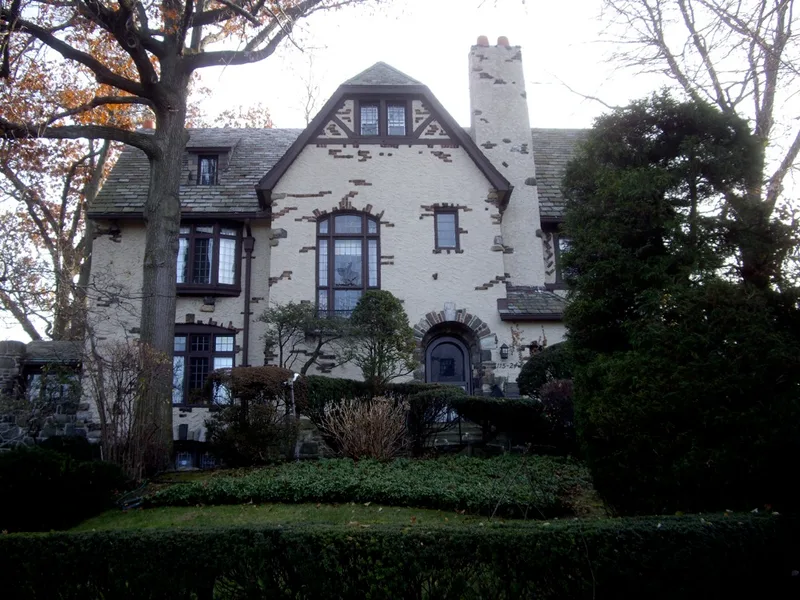
This two-and-a-half story house with an attached two-car garage sits on a roughly half-acre lot at 115-25 Grosvenor Road in Kew Gardens, Queens. Its design reflects an English Tudor Renaissance country house, with a steep slate gable roof, textured stucco over brick and stone, leaded steel casement windows, and a two-story stained glass window lighting the main staircase. It was the home of Ralph Bunche, who owned and occupied it during his years at the United Nations. Born in Detroit in 1904, Bunche earned a Harvard doctorate in political science, became the first black man to hold a desk in the State Department, and rose to Undersecretary General of the United Nations. He negotiated the 1949 Arab-Israeli armistice, helped settle the 1956 Suez Canal Crisis, and became the first black recipient of the Nobel Peace Prize. The house remains in excellent condition, and several rooms retain furnishings from his time there.
Significance in brief: The nomination argues the house is important for its association with Ralph Bunche, the highest ranking black in the United Nations Secretariat. He negotiated the 1949 Arab-Israeli truce, helped settle the 1956 Suez Canal Crisis, and was the first black recipient of the Nobel Peace Prize. He was also the first black man to hold a desk in the State Department.
Machine-generated summary. This summary was generated by a language model from the official nomination document and has not been reviewed line by line by an editor. It may contain errors. Check the source document before relying on any detail. Source: nomination document (PDF) · National Archives catalog entry. NRHP reference 76001266, listed May 11, 1976. Summary generated October 2026 (model claude-sonnet-5-5, prompt v1.0-2026-10-29, confidence high).
Key facts
| Address | 115--125 Grosvenor Rd., New York |
|---|---|
| County | Queens |
| Listed | May 11, 1976 |
| Reference number | 76001266 |
| Resource type | Building |
| Period of significance | 1952-1971 |
| Architectural style | English Tudor Renaissance style country house influence |
| Areas of significance | Black, Politics/Government, Social History |
| Level of significance | National |
| National Historic Landmark | Yes, designated May 11, 1976 |
| Status (as stated in the nomination) | Described as in excellent repair, with an interior that appears as built and several rooms still furnished as Dr. Bunche used them; listed as occupied private residence. |
| Acreage | 0.5 |
| Coordinates | 40.70648, -73.83699 (NPS GIS) |
What listing means for this property
National Register listing is honorary for a privately owned home: it does not by itself restrict what an owner may do with their own money, and it does not require public access. Restrictions come from local landmark or historic-district ordinances, which are separate (how they differ).
Owner-occupied houses are not eligible for the 20% federal rehabilitation tax credit, which applies to income-producing buildings, but many states offer credits for homeowners. Listing also opens the door to preservation easements and to buying a plaque. Start with what listing means for homeowners, renovating a listed house and selling one.
General information, not legal or tax advice. Rules change; confirm with your State Historic Preservation Office or a qualified adviser.
Sources and further reading
- National Park Service, National Register of Historic Places database (snapshot May 2026), reference 76001266.
- Nomination form (PDF, National Archives) — catalog entry
- Wikipedia article (used for cross-checking only; text not reproduced here)
- Wikidata Q7287722
- This listing as JSON
Last updated October 2026. Found an error? See the editorial policy for how to report it.