Phelps Town Hall

Why it's listed
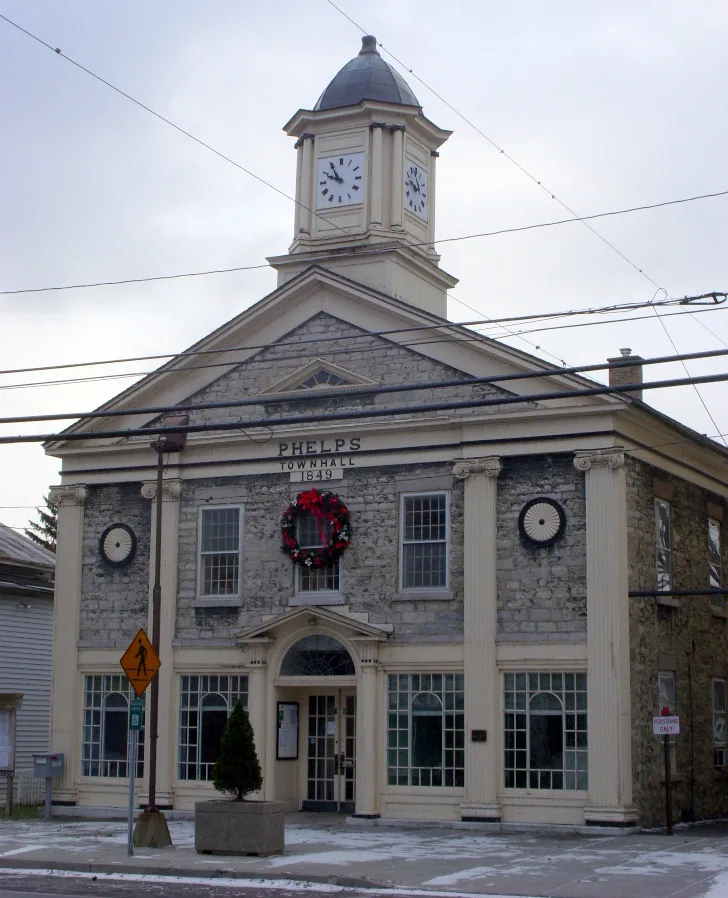
Built in 1849 of cut sandstone, this two-story town hall sits on Main Street at the east end of the village of Phelps' central business district. A fire in 1911 gutted the interior and destroyed the frame bell tower, leaving only the stone shell. Rebuilding in 1912-13 added a Neoclassical front with four fluted Ionic pilasters, a Doric portico and a Federal-inspired clock tower, while the basic Greek Revival form survived. Originally the building held two storefronts, a harness shop and a jewelry and watch repair shop, alongside government functions. It was listed for its architecture as a representative town hall combining Greek Revival and Neoclassical elements, and for its long role in local politics and government. As the area's largest public facility, it also hosted community events and visiting speakers including Susan B. Anthony, James Buchanan, Stephen A. Douglas and Horace Greeley. It remains home to town and village offices.
Significance in brief: The nomination argues it is a representative example of a town hall and a distinguished Greek Revival civic building with Neoclassical modifications. It is also significant for its long association with the political and community life of the town and village of Phelps.
Machine-generated summary. This summary was generated by a language model from the official nomination document and has not been reviewed line by line by an editor. It may contain errors. Check the source document before relying on any detail. Source: nomination document (PDF) · National Archives catalog entry. NRHP reference 96000485, listed April 25, 1996. Summary generated October 2026 (model claude-sonnet-5-5, prompt v1.0-2026-10-29, confidence high).
Key facts
| Address | 79 Main St., Phelps |
|---|---|
| County | Ontario County |
| Listed | April 25, 1996 |
| Reference number | 96000485 |
| Resource type | Building |
| Period of significance | 1849 - 1913 |
| Architect / builder | 1849: John Bloomer & Sons; 1912: J. Foster Warner and Fred Shaw |
| Architectural style | Mid-19th Century: Greek Revival; 20th Century Revival: Classical Revival |
| Criteria |
|
| Areas of significance | Architecture, Politics/Government |
| Level of significance | Local |
| Status (as stated in the nomination) | Still in use as town and village government offices; interior extensively altered over the years. |
| Acreage | 0.9 |
| Coordinates | 42.95716, -77.05735 (NPS GIS) |
What listing means for this property
For a publicly owned building or structure, listing mainly matters when federal funds, permits or licences are involved: projects then go through Section 106 review so effects on the property are considered. Listing also strengthens applications for preservation grants and, for leased income-producing uses, can enable the federal rehabilitation tax credit.
General information, not legal or tax advice. Rules change; confirm with your State Historic Preservation Office or a qualified adviser.
Sources and further reading
- National Park Service, National Register of Historic Places database (snapshot May 2026), reference 96000485.
- Nomination form (PDF, National Archives) — catalog entry
- Wikipedia article (used for cross-checking only; text not reproduced here)
- Wikidata Q7181281
- This listing as JSON
Last updated October 2026. Found an error? See the editorial policy for how to report it.