Brigham Hall
Also known as: Grove Home

The pin is a point inside the NPS boundary polygon, not a surveyed location.
Why it's listed
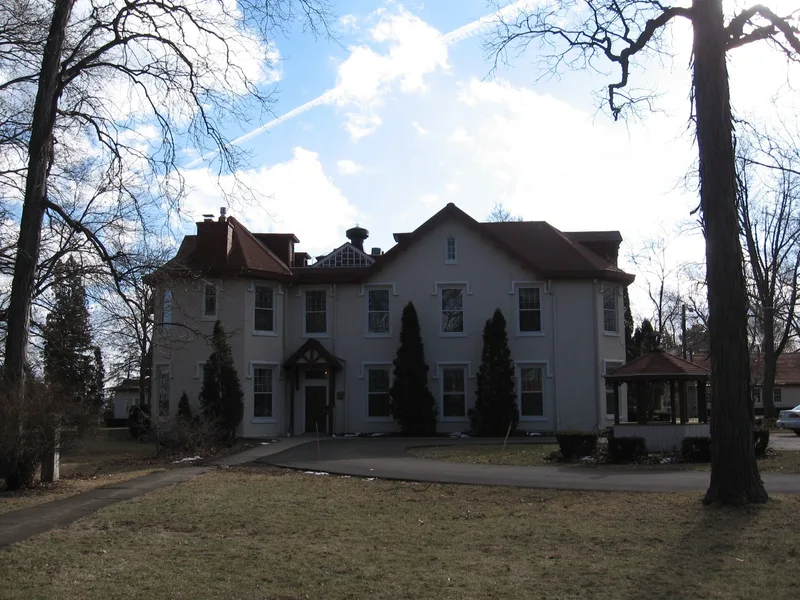
Brigham Hall is a former private asylum for the mentally ill on a sixteen-acre knoll above Canandaigua Lake. Founded in 1855 by Dr. George Cook, his brother Dr. Robert Cook, and William G. Wayne, it was named for Dr. Amariah Brigham, first superintendent of the Utica asylum. The fieldstone central section of about 1855 is flanked by brick wings of about 1859, all in the Gothic Revival style, with steep multi-gabled roofs, decorated eaves and Gothic-arched windows. Around it are outbuildings from the late nineteenth and early twentieth centuries, including Heritage House, occupational therapy units, a paint shop, a gazebo and a recreation building. The landscaped grounds were meant to aid patients' recovery. The facility operated as an asylum for over a century, became a nursing home called Grove Home, and closed in 1979 before conversion to private residences. A heavily altered greenhouse and two garages are non-contributing.
Significance in brief: The complex is significant for its link to mid-nineteenth-century humanitarian ideas about caring for the mentally ill, as a typical small, privately endowed asylum set in picturesque grounds. Its main building is a distinctive example of Gothic Revival architecture with asymmetry, steep multi-gabled roofs, bargeboards and Gothic-arched windows.
Machine-generated summary. This summary was generated by a language model from the official nomination document and has not been reviewed line by line by an editor. It may contain errors. Check the source document before relying on any detail. Source: nomination document (PDF) · National Archives catalog entry. NRHP reference 84002827, listed September 29, 1984. Summary generated October 2026 (model claude-sonnet-5-5, prompt v1.0-2026-10-29, confidence medium).
Key facts
| Address | 229 Bristol St., Canandaigua |
|---|---|
| County | Ontario County |
| Listed | September 29, 1984 |
| Reference number | 84002827 |
| Resource type | Building |
| Period of significance | 1855-1924 |
| Architectural style | Gothic Revival (main building); Tudor Revival and Stick style features on some other structures |
| Criteria |
|
| Areas of significance | Architecture, Social History |
| Level of significance | Local |
| Status (as stated in the nomination) | Brigham Hall later became a nursing home called Grove Home, which closed in 1979; the complex was then converted to private residential units. Condition is listed as good, with no known threats. |
| Acreage | 16 |
| Coordinates | 42.87903, -77.29050 (NPS GIS) |
What listing means for this property
National Register listing is honorary for a privately owned home: it does not by itself restrict what an owner may do with their own money, and it does not require public access. Restrictions come from local landmark or historic-district ordinances, which are separate (how they differ).
Owner-occupied houses are not eligible for the 20% federal rehabilitation tax credit, which applies to income-producing buildings, but many states offer credits for homeowners. Listing also opens the door to preservation easements and to buying a plaque. Start with what listing means for homeowners, renovating a listed house and selling one.
General information, not legal or tax advice. Rules change; confirm with your State Historic Preservation Office or a qualified adviser.
Sources and further reading
- National Park Service, National Register of Historic Places database (snapshot May 2026), reference 84002827.
- Nomination form (PDF, National Archives) — catalog entry
- Wikipedia article (used for cross-checking only; text not reproduced here)
- Wikidata Q4967301
- This listing as JSON
Last updated October 2026. Found an error? See the editorial policy for how to report it.