Estabrook, Charles, Mansion

Why it's listed
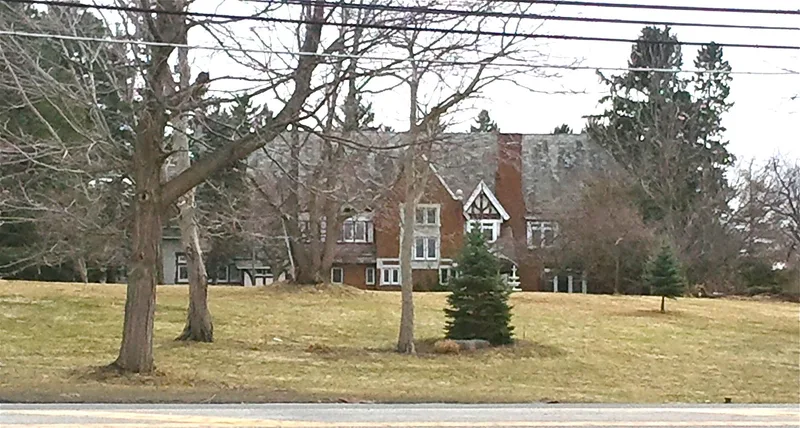
Set on an 11-acre parcel along East Genesee Street west of Fayetteville, this estate was built in 1922 and 1923 for Syracuse attorney Charles S. Estabrook. Architect Ward Wellington Ward designed a group of Tudor Revival buildings: a brick, stone and stucco mansion with a slate roof, a gardener's cottage, and a combined garage, stable and greenhouse. The grounds retain a formal garden, a brick gateway and the original curving drive. Inside, the house features paneled rooms, carved details, and tiles from Henry Chapman Mercer's Moravian Pottery and Tile Works. Stained glass came from the Henry Keck studio in Syracuse. The nomination presents the property as an intact example of Tudor Revival design and as an expression of Ward's commitment to Arts and Crafts ideals and to using the work of skilled artisans. Estabrook lived there until his death in 1975, and the mansion later became a catering and reception center.
Significance in brief: The nomination argues the estate is an outstanding, highly intact example of Tudor Revival eclecticism in Central New York, designed by Syracuse architect Ward Wellington Ward. Its interiors contain Moravian Pottery and Tile Works tiles and Henry Keck Studio stained glass, reflecting Ward's Arts and Crafts ideals. It is described as one of Ward's most prominent and fully integrated commissions in the Syracuse area.
Machine-generated summary. This summary was generated by a language model from the official nomination document and has not been reviewed line by line by an editor. It may contain errors. Check the source document before relying on any detail. Source: nomination document (PDF) · National Archives catalog entry. NRHP reference 96000487, listed April 26, 1996. Summary generated October 2026 (model claude-sonnet-5-5, prompt v1.0-2026-10-29, confidence high).
Key facts
| Address | 7262 E. Genesee St., Fayetteville |
|---|---|
| County | Onondaga County |
| Listed | April 26, 1996 |
| Reference number | 96000487 |
| Resource type | Building |
| Period of significance | 1922-1923 |
| Architect / builder | Ward Wellington Ward, arch, Syracuse |
| Architectural style | Tudor Revival |
| Criteria |
|
| Areas of significance | Architecture |
| Level of significance | Local |
| Status (as stated in the nomination) | Historically a single dwelling; after the owner's death in 1975 and an auction of furnishings, the mansion became the Wellington House, a catering and reception center (restaurant use listed as a current function). |
| Acreage | 11 |
| Coordinates | 43.02852, -76.02076 (NPS GIS) |
What listing means for this property
National Register listing is honorary for a privately owned home: it does not by itself restrict what an owner may do with their own money, and it does not require public access. Restrictions come from local landmark or historic-district ordinances, which are separate (how they differ).
Owner-occupied houses are not eligible for the 20% federal rehabilitation tax credit, which applies to income-producing buildings, but many states offer credits for homeowners. Listing also opens the door to preservation easements and to buying a plaque. Start with what listing means for homeowners, renovating a listed house and selling one.
General information, not legal or tax advice. Rules change; confirm with your State Historic Preservation Office or a qualified adviser.
Sources and further reading
- National Park Service, National Register of Historic Places database (snapshot May 2026), reference 96000487.
- Nomination form (PDF, National Archives) — catalog entry
- Wikipedia article (used for cross-checking only; text not reproduced here)
- Wikidata Q7981420
- This listing as JSON
Last updated October 2026. Found an error? See the editorial policy for how to report it.