St. Paul's Church and Cemetery

Why it's listed
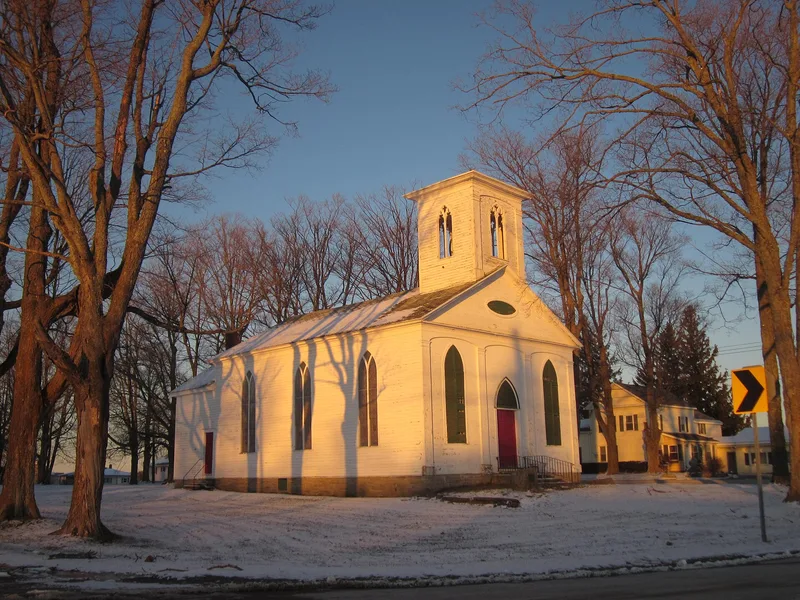
Standing at the north end of the Paris Green in Paris Hill, this 1818 timber-framed church and its adjoining cemetery form a small rural Episcopal site. The building measures 36 by 50 feet, rests on a stone foundation, and carries a square belfry. Its front facade combines delicate moldings, a pediment with a blind elliptical window and blind arcading, with pointed-arch windows adding early Gothic touches. A chancel and sacristy were added in 1868, while the original gallery and cove ceiling survive. The parish was organized in 1797 and is traditionally described as the oldest west of Johnstown; local tradition calls it the ox cart church after an early organizational meeting. Its detailed 1818 building specifications mention a Gothic top for windows and the front door, an unusually early reference in a remote area. The cemetery holds burials from the early nineteenth century to today, including church founders. The site was listed for its architecture and its role in early settlement and religion.
Significance in brief: The church is argued to be a relatively sophisticated, intact example of Federal church architecture with early Gothic detailing typical of Episcopal buildings in central New York. It is also tied to the growth of the Episcopal Church during early westward settlement; the parish, organized in 1797, is traditionally called the oldest west of Johnstown. The cemetery keeps early stones, including those of church founders.
Machine-generated summary. This summary was generated by a language model from the official nomination document and has not been reviewed line by line by an editor. It may contain errors. Check the source document before relying on any detail. Source: nomination document (PDF) · National Archives catalog entry. NRHP reference 96000961, listed August 30, 1996. Summary generated October 2026 (model claude-sonnet-5-5, prompt v1.0-2026-10-29, confidence high).
Key facts
| Address | Rt. 12, jct. with Snowden Hill Rd., Paris Hill |
|---|---|
| County | Oneida County |
| Listed | August 30, 1996 |
| Reference number | 96000961 |
| Resource type | Site |
| Period of significance | 1818 - 1917 |
| Architectural style | Federal |
| Criteria |
|
| Areas of significance | Exploration/Settlement, Religion, Architecture |
| Level of significance | Local |
| Status (as stated in the nomination) | The cemetery remains in active use; the parish was dissolved in 1934 and the property passed to the Diocese, with an annual summer service held since 1993. |
| Acreage | 2.5 |
| Coordinates | 43.00130, -75.31446 (NPS GIS) |
What listing means for this property
Sites (archaeological sites, battlefields, landscapes) are often listed with a restricted address to protect them from looting or disturbance. Listing is honorary for private owners; federal undertakings on or near the site go through Section 106 review, and state laws may protect burials and artefacts regardless of listing.
General information, not legal or tax advice. Rules change; confirm with your State Historic Preservation Office or a qualified adviser.
Sources and further reading
- National Park Service, National Register of Historic Places database (snapshot May 2026), reference 96000961.
- Nomination form (PDF, National Archives) — catalog entry
- Wikipedia article (used for cross-checking only; text not reproduced here)
- Wikidata Q7591064
- This listing as JSON
Last updated October 2026. Found an error? See the editorial policy for how to report it.