First Congregational Free Church

Why it's listed
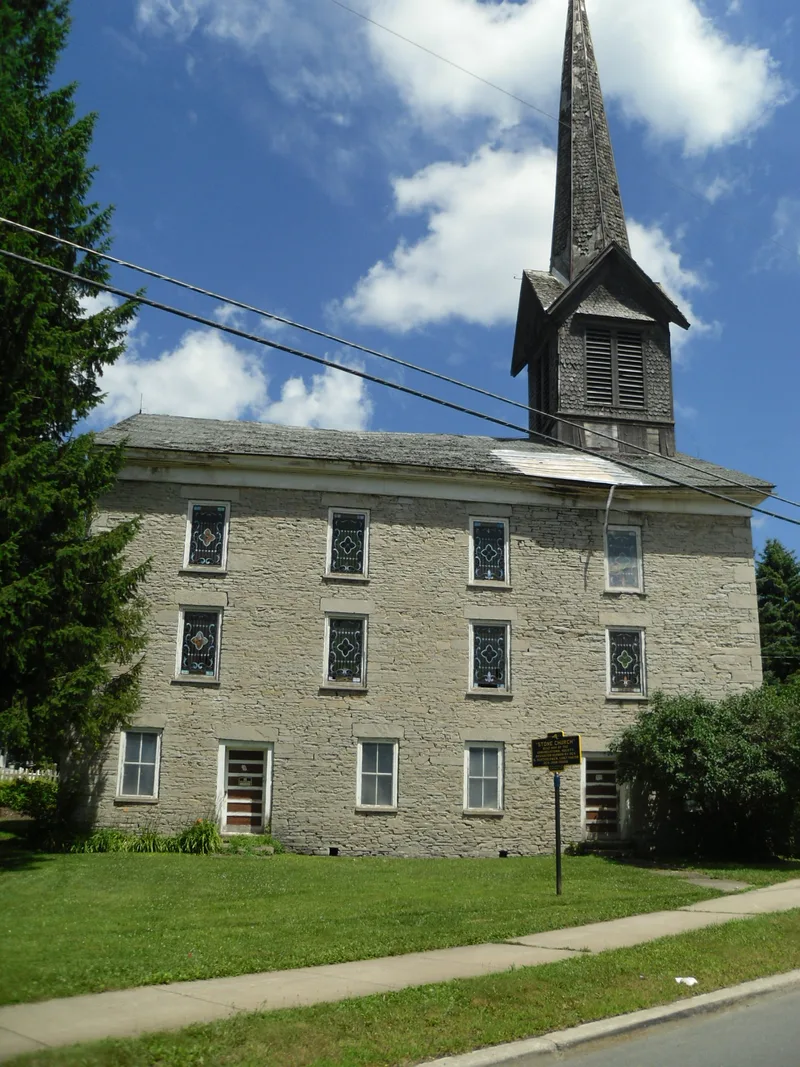
Limestone from a nearby quarry was used to build this church on North Main Street in Oriskany Falls, New York. Construction began in 1833 and finished in 1845, with members contributing labor or materials as they could. Amos Allen donated the land. The congregation grew from Augusta's Congregational church, whose membership had risen to about 400 by 1833, and 35 of its members joined five newcomers to found the new church in 1832. The building looks like a New England meeting house, with a rectangular plan, three tiers of small flat-headed windows and pedimented gable ends, yet its front has two tall Gothic pointed arches holding the entrance doors. Stone was an unusual choice for a Congregational church, though several early stone churches stood in the Mohawk Valley. A belfry holds a bell cast in 1838, and the spire was added in 1886. The congregation used the church until 1959, and the village later acquired it and has sought to restore it.
Significance in brief: The church is significant as the first Congregational church in Oriskany Falls and as a link to the early settlement of the county by New Englanders. Architecturally it combines a simple New England meeting house plan with Gothic arched entrances, built in native stone, which was unusual for a Congregational church. It also reflects the dedication of villagers who built it with their own labor and materials.
Machine-generated summary. This summary was generated by a language model from the official nomination document and has not been reviewed line by line by an editor. It may contain errors. Check the source document before relying on any detail. Source: nomination document (PDF) · National Archives catalog entry. NRHP reference 79001609, listed January 25, 1979. Summary generated October 2026 (model claude-sonnet-5-5, prompt v1.0-2026-10-29, confidence high).
Key facts
| Address | 177 N. Main St., Oriskany Falls |
|---|---|
| County | Oneida County |
| Listed | January 25, 1979 |
| Reference number | 79001609 |
| Resource type | Building |
| Period of significance | 1800-1899 (specific dates 1833-1845) |
| Architectural style | Combination of New England meeting house tradition with Gothic elements |
| Areas of significance | Architecture, Religion |
| Level of significance | Local |
| Status (as stated in the nomination) | Owned by the village, which was working to restore it and find a viable use; the form marks it as unoccupied. Congregational use continued until 1959. |
| Acreage | 0.4 |
| Coordinates | 42.94025, -75.46022 (NPS GIS) |
What listing means for this property
Religious properties are listed for their architectural or historical significance, not their religious use. Listing is honorary and does not restrict the congregation's use of the building. The federal rehabilitation credit is generally unavailable unless part of the building is income-producing; some state programmes and preservation grants do cover religious buildings. Federal funding or permits trigger Section 106 review.
Noted as vacant in the nomination. Nomination documents can be decades old; current status may differ. If you are considering buying an empty listed property, read the due-diligence checklist.
General information, not legal or tax advice. Rules change; confirm with your State Historic Preservation Office or a qualified adviser.
Sources and further reading
- National Park Service, National Register of Historic Places database (snapshot May 2026), reference 79001609.
- Nomination form (PDF, National Archives) — catalog entry
- Wikipedia article (used for cross-checking only; text not reproduced here)
- Wikidata Q5452869
- This listing as JSON
Last updated October 2026. Found an error? See the editorial policy for how to report it.