Glen Historic District

Why it's listed
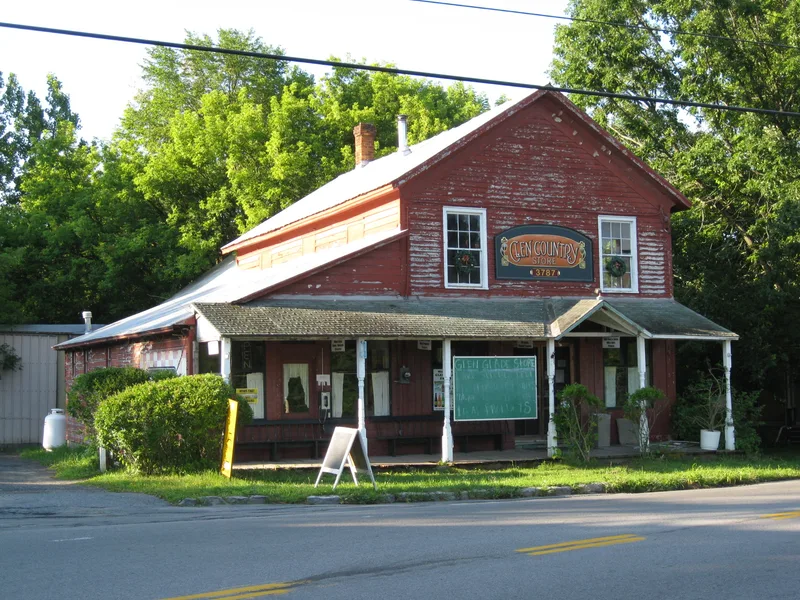
Glen is a small crossroads hamlet on a ridge about four miles south of the Mohawk River in Montgomery County, New York. Its historic core contains 26 principal properties along Route 30A, Route 161 and Logtown Road, built between about 1795 and 1900. Most are modest timber-framed houses, barns and shops, with a few brick landmarks: the 1818 Federal residence of Jacob Sanders Glen, the namesake of the hamlet, an 1878 Second Empire house, and the 1875 Italianate Glen Reformed Church. Other surviving buildings include an 1831 church hall, an 1860 Greek Revival schoolhouse, a relocated Grange Hall, a mid-century country store and farms with an early Dutch barn. The hamlet served travelers on two roads and trade for dairy farmers, though the canal and railway bypassed it. Its nineteenth-century development and vernacular architecture are the reasons for its listing. An early brick store was lost to fire in 2000, but its site remains.
Significance in brief: The district is argued to be a substantially intact crossroads community showing how a rural Montgomery County hamlet developed from the Federal period to the end of the nineteenth century. It reflects local settlement patterns, trade, agriculture and vernacular building practice. Its Federal, Greek Revival, Italianate and Second Empire buildings illustrate regional architecture.
Machine-generated summary. This summary was generated by a language model from the official nomination document and has not been reviewed line by line by an editor. It may contain errors. Check the source document before relying on any detail. Source: nomination document (PDF) · National Archives catalog entry. NRHP reference 01000844, listed August 8, 2001. Summary generated October 2026 (model claude-sonnet-5-5, prompt v1.0-2026-10-29, confidence medium).
Key facts
| Address | NY 30A, NY 161 and Logtown Rd., Glen |
|---|---|
| County | Montgomery County |
| Listed | August 8, 2001 |
| Reference number | 01000844 |
| Resource type | District |
| Period of significance | ca. 1795-ca. 1900 |
| Architectural style | Early Republic/Federal; Mid-19th Century/Greek Revival; Late Victorian/Second Empire, Italianate |
| Criteria |
|
| Areas of significance | Exploration/Settlement, Architecture |
| Level of significance | Local |
| Status (as stated in the nomination) | Most buildings remain in residential, commercial, religious and agricultural use. The 1818 brick Glen-Edwards store was destroyed by arson fire in November 2000, leaving foundation ruins. |
| Acreage | 25 |
| Coordinates | 42.89398, -74.34221 (NPS GIS) |
What listing means for this property
This is a historic district. Buildings within its boundary are either contributing (they add to the district's significance) or non-contributing. Owners of contributing income-producing buildings can claim the 20% federal rehabilitation tax credit; homeowners should look at state credits. National Register districts impose no design review by themselves; a local historic district ordinance, if one exists, does (the difference explained).
General information, not legal or tax advice. Rules change; confirm with your State Historic Preservation Office or a qualified adviser.
Sources and further reading
- National Park Service, National Register of Historic Places database (snapshot May 2026), reference 01000844.
- Nomination form (PDF, National Archives) — catalog entry
- Wikipedia article (used for cross-checking only; text not reproduced here)
- Wikidata Q5567810
- This listing as JSON
Last updated October 2026. Found an error? See the editorial policy for how to report it.