Guthrie, Dr. Samuel, House

Why it's listed
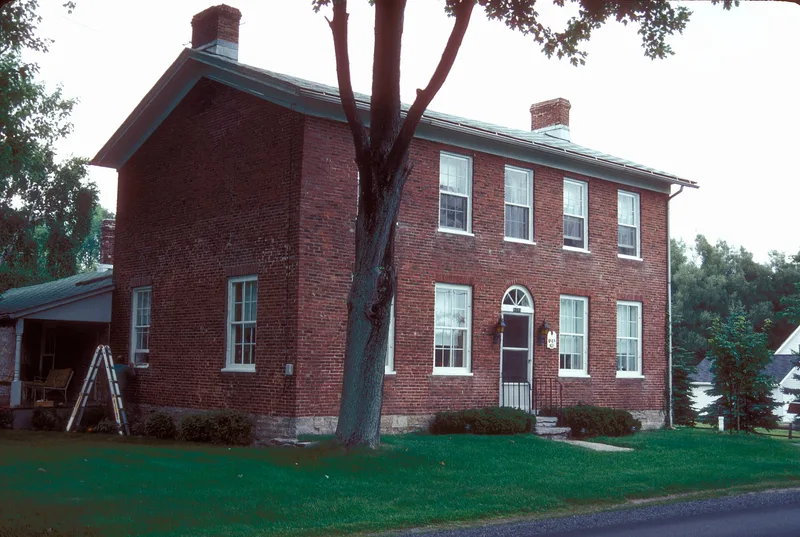
Built in 1818 for physician Dr. Samuel Guthrie and his wife Sybil, this brick house sits on Watertown Road near Sackets Harbor in Hounsfield. It has a two-story, five-bay main block in the Federal style, a round-arched center entrance, and a rear wing added in stages from about 1822 to about 1910. The brick was probably made at a local yard in the mill hamlet of Jewettville, of which the house is among the last survivors. Guthrie kept his medical office upstairs and carried out experiments here. In 1831 he discovered chloroform and perfected a percussion pill priming powder for firearms, which eventually made the flintlock obsolete. The house is also notable as one of few intact Federal-era brick houses in a town where limestone was the usual masonry. Its original stone-lined well and a surrounding parcel of about three and a half acres are included, along with a modern garage that does not contribute to its historic character.
Significance in brief: The house is tied to Dr. Samuel Guthrie, the American discoverer of chloroform in 1831 and inventor of percussion pills for firearms. It is also one of the few intact Federal-era brick houses in Hounsfield, built of brick in a region where limestone was usual. It is one of the last remnants of the milling hamlet of Jewettville.
Machine-generated summary. This summary was generated by a language model from the official nomination document and has not been reviewed line by line by an editor. It may contain errors. Check the source document before relying on any detail. Source: nomination document (PDF) · National Archives catalog entry. NRHP reference 89001616, listed October 18, 1989. Summary generated October 2026 (model claude-sonnet-5-5, prompt v1.0-2026-10-29, confidence high).
Key facts
| Address | Co. Rd. 75/Military Rd., Hounsfield |
|---|---|
| County | Jefferson County |
| Listed | October 18, 1989 |
| Reference number | 89001616 |
| Resource type | Building |
| Period of significance | 1818-1840 |
| Architectural style | Federal |
| Criteria |
|
| Areas of significance | Military, Health/Medicine, Architecture |
| Level of significance | Local |
| Status (as stated in the nomination) | Used as a residence and described as in good condition; the form lists no known threats. |
| Acreage | 3 |
| Coordinates | 43.95146, -76.09309 (NPS GIS) |
What listing means for this property
National Register listing is honorary for a privately owned home: it does not by itself restrict what an owner may do with their own money, and it does not require public access. Restrictions come from local landmark or historic-district ordinances, which are separate (how they differ).
Owner-occupied houses are not eligible for the 20% federal rehabilitation tax credit, which applies to income-producing buildings, but many states offer credits for homeowners. Listing also opens the door to preservation easements and to buying a plaque. Start with what listing means for homeowners, renovating a listed house and selling one.
General information, not legal or tax advice. Rules change; confirm with your State Historic Preservation Office or a qualified adviser.
Sources and further reading
- National Park Service, National Register of Historic Places database (snapshot May 2026), reference 89001616.
- Nomination form (PDF, National Archives) — catalog entry
- Wikipedia article (used for cross-checking only; text not reproduced here)
- Wikidata Q5304367
- This listing as JSON
Last updated October 2026. Found an error? See the editorial policy for how to report it.